
A French Chicken in the Land of Pancetta
When roasting poultry in Rome, all roads lead to Gaul

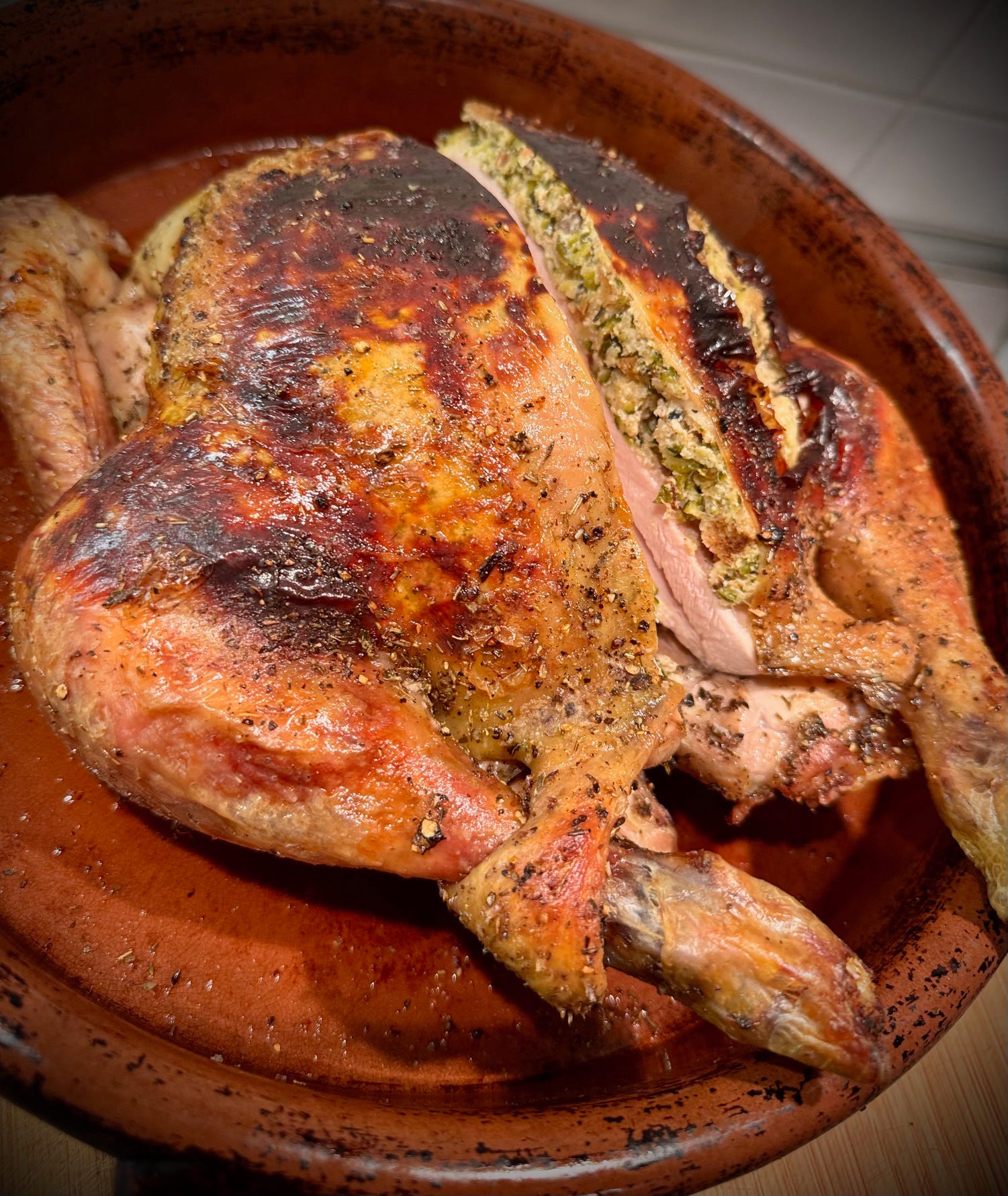
Italians eat few chickens. They’re mostly for special occasions like the flu, when you make chicken soup.
But Alexandra is on the usual Italian-woman springtime ritual of dieting before beach season, so I’ve been cooking more chicken, and more breasts. Fortunately I know from chicken, having raised and slaughtered hundreds of them (and ducks and geese) on our Maine farm decades ago.
As do the French. Which led me back to Richard Olney’s 1974 book Simple French Food. To call this classic a cookbook is to call Moby Dick a whale book. It is poetry, as few cookbooks are, and Olney—a fellow Midwestern expat, he to Provence—taught me as much how to think about food as to cook it. Indeed I take issue with many of his fussy techniques, which I think he would appreciate as one who writes, in his improvisational recipe for onion soup: “The mind rarely registers weights and measures in terms of visual bulk.”
Yet until my newfound, and romantically motivated, interest in chicken, I had not cracked Olney in six years living in Rome. Nor cooked much chicken.
Americans eat a lot of chicken. When the New York Times listed its 50 most popular recipes of 2025—after eliminating drinks, desserts and vegetarian plates—almost two thirds were chicken, many of them breasts.
Americans’ fondness for chicken breasts reflects two customs. The first is the general American reluctance to deal with bones. The second is the American fear of fat. I will hardly be the first person to observe the irony of obese Americans obsessing over fat, and many theories have been proposed to explain why Italians (among other Europeans) are thinner than Americans despite a diet heavy on processed pork like salami and white-flour pastas.[1]
One plausible theory is that Italians don’t snack between meals, with the exception of small bites during the aperitivo hour because in Italy it is considered improper to drink alcohol without food.
Another credible explanation is that Europeans eat more slowly—there are bones to sort through—which may explain why they eat less, as eating takes more time.
In America, the palate for chicken breast has inspired countless adaptations of classic Italian dishes not previously associated with poultry, often substituting for Italy’s ubiquitous veal—as in Chicken Milanese and Chicken Marsala. Even Italian vegetarian classics like Eggplant Parmesan have been re-purposed with chicken cutlets. (“Chicken Parm” is not an Italian dish.)
I was having none of that. I wanted to revisit some classic French ways with chicken. Re-reading Simple French Food made me realize how much I miss not just French cuisine, but French techniques. You will search in vain for the phrase “stew onions gently in butter” in any Italian cookbook. I finally settled on Olney’s recipe for a whole roasted chicken, blanketed under the skin with a ricotta-zucchini-Parmigiano stuffing and thus tangentially “Italian” without going down the Chicken Parm path to perdition. It’s a dish I had made dozens of times in America, for family and guests, always to acclaim. Although unmentioned by Olney, the brilliance of this dish is that the stuffing protects the breast from drying out, allowing the thighs to cook longer than could otherwise be recommended, tenderizing them further. What follows is my updated version.
But first consider this: a recent article in the Wall Street Journal informs that Americans are changing their habits and now embracing the thigh over the breast. Meanwhile, Italians have taken a shine to chicken breasts, which I’ve recently noticed have gotten larger here—more like those boob-enhanced American chickens that I used to raise in Maine.
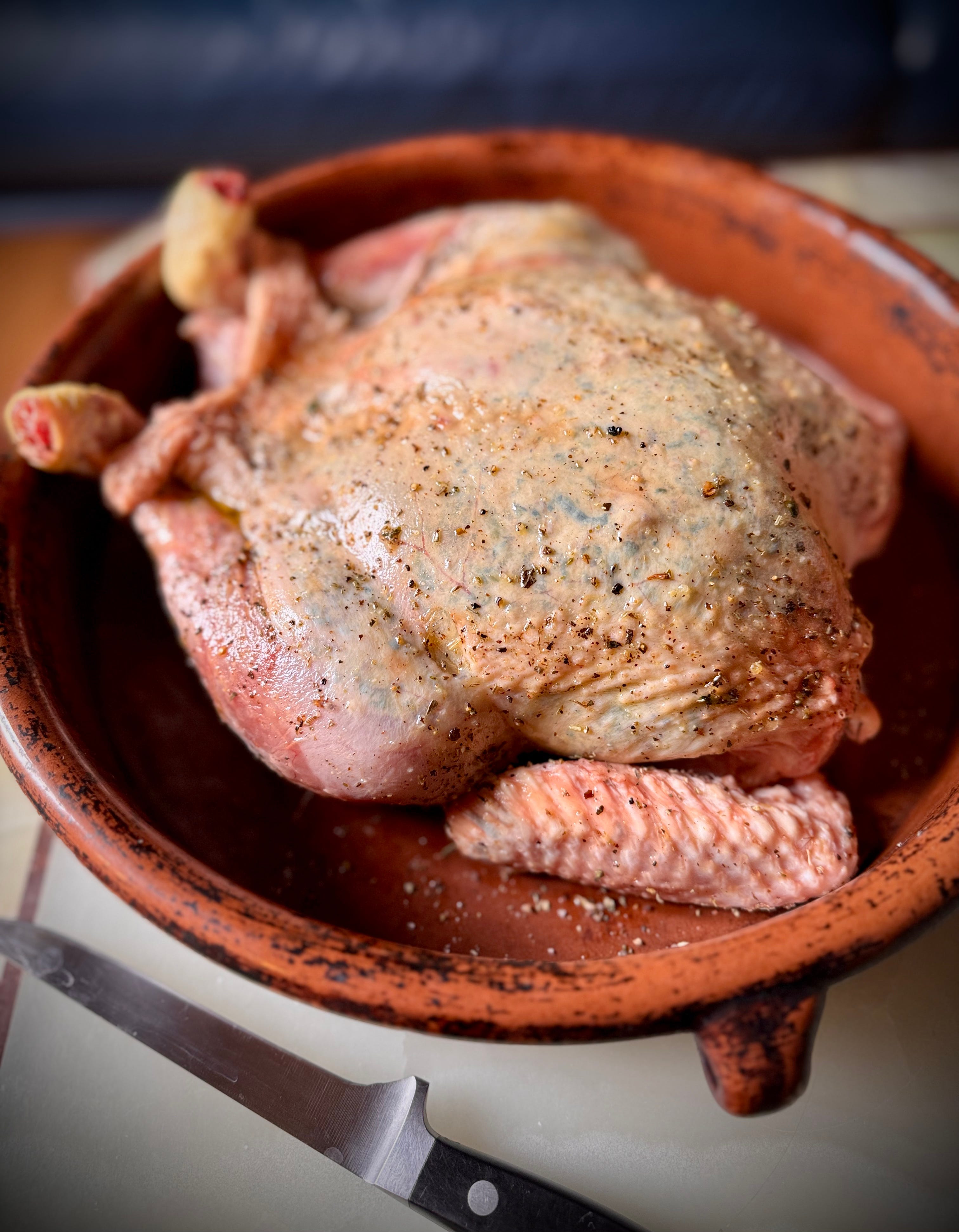
Stuffed and roasted chicken, hommage à Richard Olney
Olney’s recipe calls for spatchcocking the chicken, but as he then carefully re-shapes the bird into its natural form, and having personally made it both ways, I see no point in the bother.
Using first fingers and eventually inserting your whole hand, gently separate the skin from the breast, thighs and legs, being careful not to tear it. This is easier than it sounds. Rub the whole, on the skin and back side, with olive oil, dust with salt, pepper and dried herbs (I like herbes de Provence which includes lavender), and let sit for an hour or two.
Meanwhile make the stuffing. Coarsely grate a pound of zucchini, add salt and let it rest for half an hour. Squeeze out all the liquid through a sieve or towel. Sauté in a bit of butter until dry and lightly colored. Grate or mince an onion, then stew gently in butter without coloring. Mix the two and set aside.
When the vegetables are cool, add 1/3 cup or so of ricotta[2]; a couple tablespoons of softened butter; a handful of bread crumbs (preferably homemade; I regularly run stale bread through the food processor and store it in the freezer); one egg; a handful of grated Parmigiano; salt and pepper; some chopped fresh herb like marjoram (I used the Roman herb mentuccia, rather like a cross between oregano and mint and known as lesser calamint in English, because I had some). Also because I can, I added grated fresh black truffle which I buy in season at the local farmer’s market. The possible absence of a fresh truffle in your pantry is not a dealbreaker.
Spread the stuffing under the chicken skin, all the way down to the legs, smoothing as you go.
Transfer the bird to a large casserole (a round terra cotta type like the Spanish cazuela being ideal) and bake in the lower half of a 450F/230C oven for ten minutes before reducing the heat to 375F/190C for 1-1.5 hours until the inner thigh reads 195F/90C. Should the breast arrive early to the browning party (every oven is different), tent with foil. Let rest before carving at table.
Olney counsels against serving the pan drippings as they are too fatty, but no law forbids saving them and, when chilled, removing the fat, to be used in cooking potatoes another day, while the gelled stock becomes a sauce for tomorrow. Or simply pour the delicious fatty drippings right over the stuffed breasts, when Alexandra isn’t looking.
[1] The real Mediterranean Diet.
[2] Try to find something better than those supermarket tubs of ricotta, which are made from acidified and stabilized milk. In Italy, genuine ricotta is made from the whey of cow, sheep or goat milk. I used buffalo ricotta, which is mild; sheep ricotta would be more intense.
Congratulations, you met the goal of anyone writing about food: You made me hungry. I've lived in Rome 12 years and one of my girlfriend's best recipes is chicken with Gaeta olives. I cook a lot of pasta dishes with chicken. Maybe I've Americanized some but they're healthy and tasty. One reason Italians are thinner, despite pork being the predominant meat, is the processing is healthier. It has less fat. They serve less of it.
I can attest to the no chicken culture -- Italians - would general eat veal and that is my Italian Canadian family, we never were fans of chicken. However my mom did make nice chicken cutlets !
Chicken --- is ok!