
Beans and Beef
In Tuscany, on the other Mediterranean Diet

Italians consider sunshine their birthright and feel cheated when it fails to arrive, especially along any seashore in summer. Even in cities, a cloudy day with a bit of wind will have residents beginning conversations with “Che brutto giorno!” and finding ways to avoid going outdoors. But the Tuscan countryside is an exception. Those melancholic hills, cloaked in silvery olive groves and dotted with ochre stone farmhouses, somehow gain when glossed in rain—even as the fog flattens the landscape and makes everything look like a late medieval altarpiece before the painters figured out perspective.[1]
So it was without regret that nine of us gathered one rainy February weekend in a farmhouse owned by a Roman friend named Massi. We’d only met recently, through other friends, and this was my first invite to the country place. The sprawling stone casale near Siena has been in his family for generations; his sister maintains the compound next door. Most of the surrounding places have been bought up as summer homes by Brits including the rock star Sting—the region is now known as Britaly—but of course the grapevines and olive trees are still tended by locals. Arriving from Rome on Friday evening, I steered the car along slippery roads that wound like watch springs around the hills. Beyond the exertions of the windshield wipers, we saw few signs of human life.
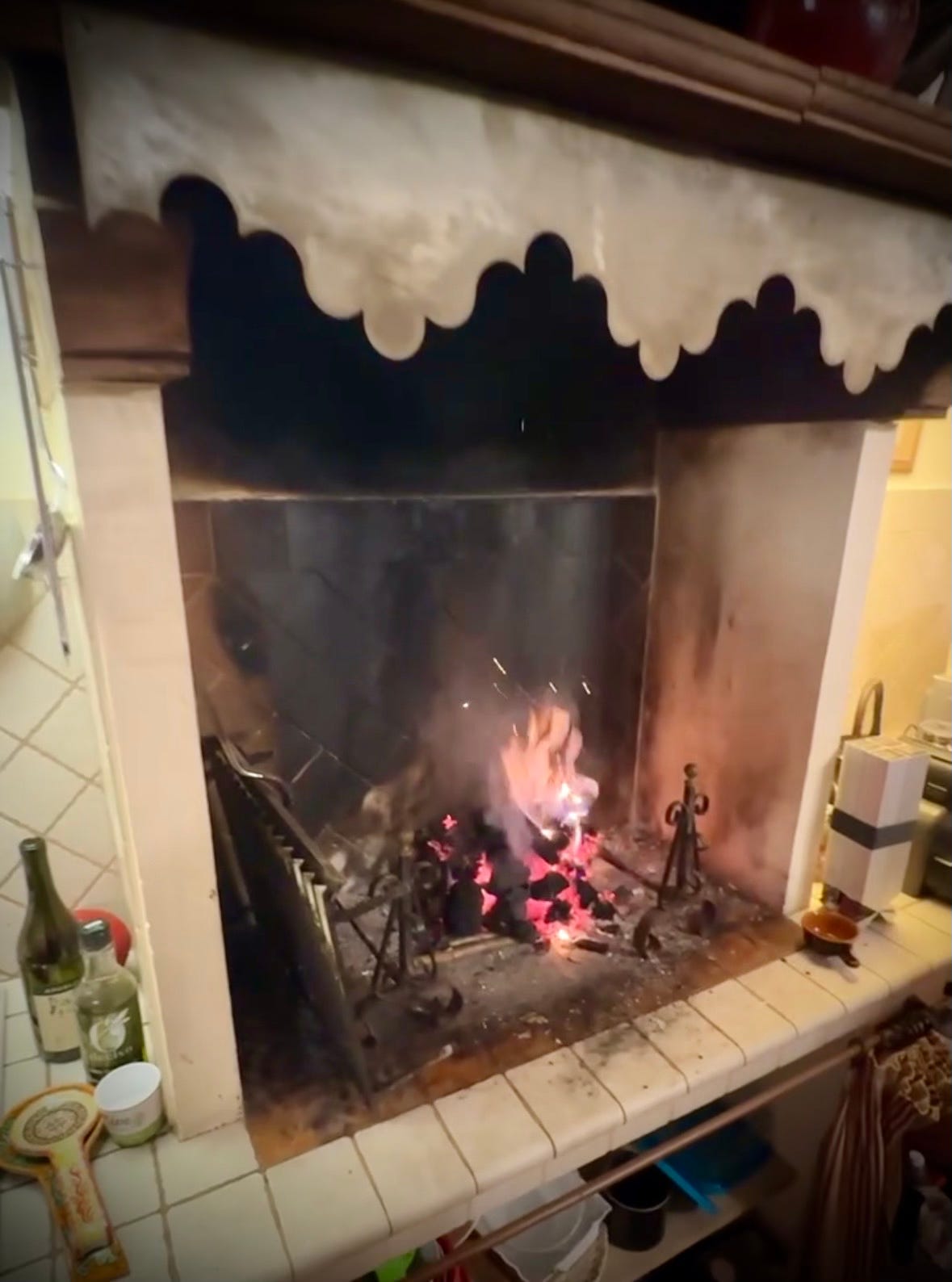
Arriving way after dark, we parked at the end of a narrow driveway through the woods. The door of the house led directly into an eat-in kitchen, commodious and mercifully unmodernized, included a vintage six-burner gas stove, mismatched freestanding cupboards and two massive zinc-topped dining tables pushed together in the center of the room. But what caught my eye was the indoor grill—basically a counter-level tiled fireplace with a cast iron cooking grate, under a chimney shrouded in a decorative tin apron. Everything was blackened with soot. We would cook here. As Massi hauled firewood and charcoal in from the carriage house, we made a shopping list for Saturday morning. There was only one thing on it: Florentine steaks.
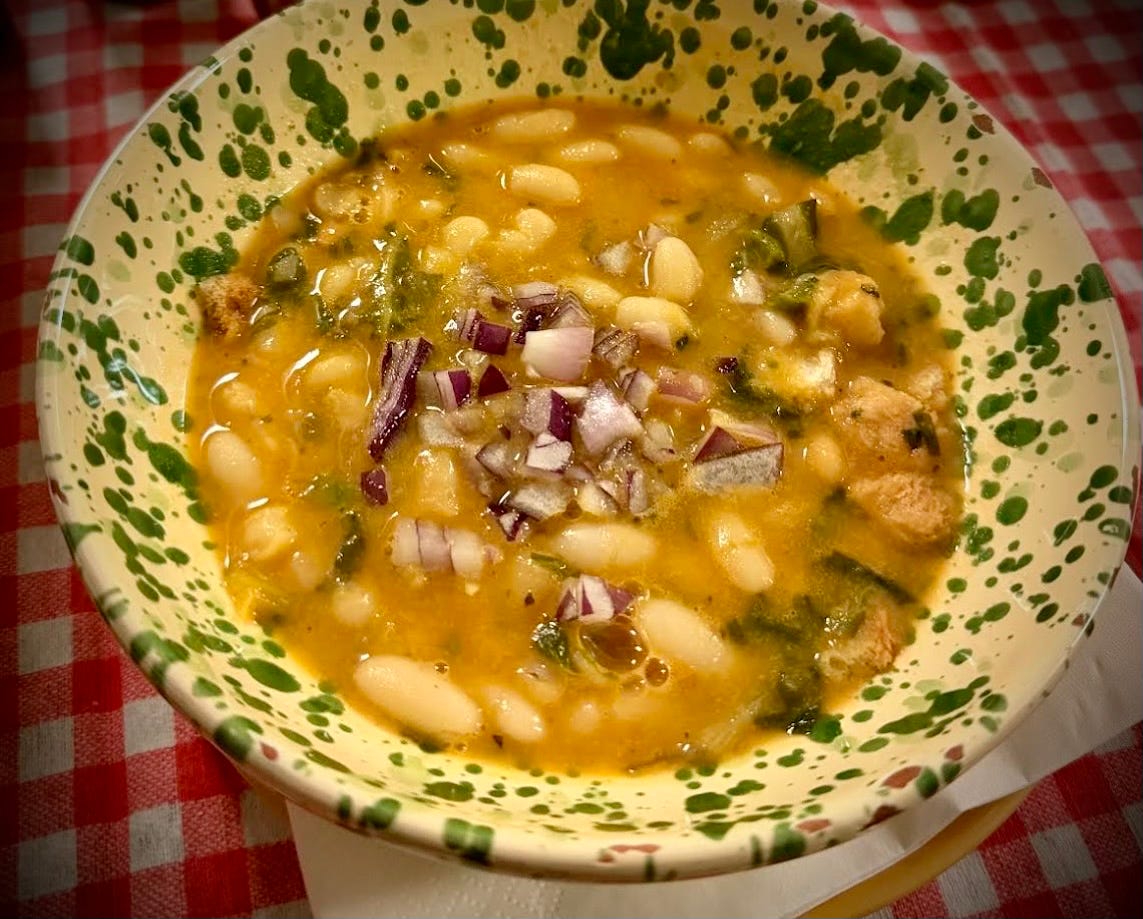
Tuscans do eat other things than giant steaks, which come from the region’s pale white Chianina cattle and are cooked blood rare (you don’t get asked your preferred doneness level). There may even be vegetarians in Tuscany.[2] For them, there are beans, generally the brown borlotti which are similar to North American pintos. Indeed, the two ingredients that define Tuscan cuisine are beans and red meat—not just the famous steaks but also pork (notably the heritage Cinta Senese breed), lamb, rabbit and game like deer and wild boar.[3] Tuscans are also famous for using up stale bread in both soup (ribollita) and salad (panzanella). And they have distinct pastas, among them pici, which are long hand-rolled strands that look like very thick spaghetti. Then there are the famous pecorino cheeses, whose grassy perfume comes from the meadows on which the sheep graze.
Beans aside—and they usually are eaten as a side—all this meat and cheese and white flour prompts a question about the so-called Mediterranean Diet, which of course favors plants, whole grains and olive oil over red meat, cheese, white flour and animal fats. Italians are known to roll their eyes over the Mediterranean Diet because that’s not how they eat. We could start with magazine photos of a typical Mediterranean Diet, which reliably show a fillet of salmon—a cold-water fish that has never set fin in the Mediterranean. Or the fact that, according to the United Nations Food & Agriculture Organization (FAO), every European Mediterranean country except Spain consumes less seafood per capita than most Scandinavian countries.[4] And any visitor to Italy who has enjoyed an Aperol spritz at an outdoor table in late afternoon will recall the platters of salami and prosciutto served with drinks.
On the surface, at least in Italy, the Mediterranean Diet would seem to be more stereotype than reality—rather like the cliché of Italian men zipping around on Vespas wearing linen suits and silk ties. (Reality: t-shirts and track shoes.) Could the Mediterranean Diet, like those tailored playboys swanning about Rome in Fellini films, exist only in the imagination? The truth is complicated.
The Mediterranean Diet was codified by Ancel Keys, an American nutritionist and physiologist who came to Rome in 1951 at the behest of FAO (the organization is still based here) for a convention to address food deprivation in Europe after the war. Keys was already noted for a book he had written on the physiological effects of starvation, and for inventing the military K-ration (K as in Keys). He observed that despite vitamin and protein deficiencies attributed to postwar poverty, Italians had far fewer heart attacks and less coronary disease than well-fed Americans. So began a yearslong study across seven countries with his biologist wife Margaret, in which they compared diets and cholesterol counts from America to Europe and Japan. Their conclusion was that a largely plant- and seafood-based diet lowered cholesterol (a new field of study) and increased longevity.
No argument there. But how do we square that with what Italians really eat? Was the Keys study flawed?
Possibly, in one sense—the postwar desperation under which the Keyses conducted their study. Cities bombed out, farms and roads laid to waste, hungry Italians were looking for food wherever they could find it. Often that meant foraging for weeds and catching fish. Was the research inherently flawed by the extreme conditions after the war? Were Italians devouring veal meatballs by the bucketload until the war interrupted their carnal saturnalia?
For help I turned to my sister-in-law, a nutritionist and executive at the Gates Foundation, where she works to promote food security in developing nations all over the world. She sent me some academic studies on the history of Mediterranean eating habits that pointed strongly to a plant- and fish-based diet going back to ancient Roman times. I already knew that a primary condiment across the Roman empire was garum, a fermented brew made of fish, much like modern Southeast Asian fish sauce. The studies introduced me to written accounts stretching over centuries that documented an Italian diet heavy on plants, including plant-based fats like olive oil instead of butter.
So how did Italians, and in particular Tuscans, come to embrace red meat? In a word: affluence. As Italy’s economy exploded in the 1960s and 1970s—the country became famous for its cars, fashion, even Olivetti typewriters—its citizens started to eat…differently. “I imagine there’s been diversification into more meat consumption with income growth throughout the Mediterranean,” my sister-in-law told me. “That happens everywhere.”
Especially with children. Obesity is on the rise in Italy (although far below the U.S.) but notably among kids, who are not set in their dietary ways and easily tempted by ubiquitous fast food and processed snacks. That said, Italians are well placed to return to meatless cuisine when deprived, and you don’t have to go back to World War II. In his 1988 book A Tuscan in the Kitchen, the New York restaurateur Pino Luongo recounts living through the 1966 flood of the Arno as a child. While that inundation is best known for damaging priceless artworks in Florence, it also wiped out crops and cattle. Families survived on dried pasta and whatever cheese they had: every night, Luongo’s mother made spaghetti with ricotta cheese, seasoned with cinnamon and a sprinkle of sugar. The children never complained.
* * *
Rain, if not actual floods, was our only concern on Saturday morning as we set off in two cars for the butcher, in the nearby hilltop village of Pienza. The town, a Unesco World Heritage site, is dominated by an imposing Renaissance cathedral built by Pope Pius II who was born there. Around the church and its trapezoidal piazza radiate narrow streets lined with trattorias and shops selling the famous local pecorino cheese. There are dozens of varieties—bright red wheels coated with tomato purée and olive oil, others wrapped in walnut leaves or coated in ash. Some are aged for years and enjoyed with honey as an aperitivo or dessert, others are fresh and made for melting over beans or in sandwiches.
After stocking up on cheese, walking around the town, dodging puddles and ducking into the cathedral during a downpour, we sat down for lunch at Osteria Sette di Vino, a small warm trattoria with a simple handwritten menu. As we ran through the offerings, someone took charge of ordering wine—there were three choices: a house red Chianti, in straw-wrapped bottles, a Brunello di Montalcino (a half-hour drive west of Pienza) and a Nobile di Montepulciano (20 minutes to the east). No pasta here—plates included bean-and-bread soup, beans with olive oil, beans with onions, chickpeas with rosemary, various bruschette topped with everything from strips of lard to pecorino with truffle oil to fegatino—a local chicken liver pâté made with capers, anchovies and dessert wine. A specialty of the house was a grilled slab of pecorino topped with rigatino—paper-thin slices of bacon traditional to the coastal Maremma region of Tuscany. We ordered pretty much everything, including fresh anchovies in pesto sauce, marinated artichokes, grilled sausage, and sweet-and-sour onions. Dessert revolved around almonds from the local groves—either almond biscotti dipped in vin santo or a local specialty called serpe di Pienza, a coiled serpent-shaped almond cake.
After lunch, at the meat shop, the butcher hauled out a massive whole side of Chianina beef prime rib, then cut us four bone-in steaks about two inches thick; we figured that would be enough red meat for the nine of us, combined with a chain of sausage links about the length of a lion’s tail.
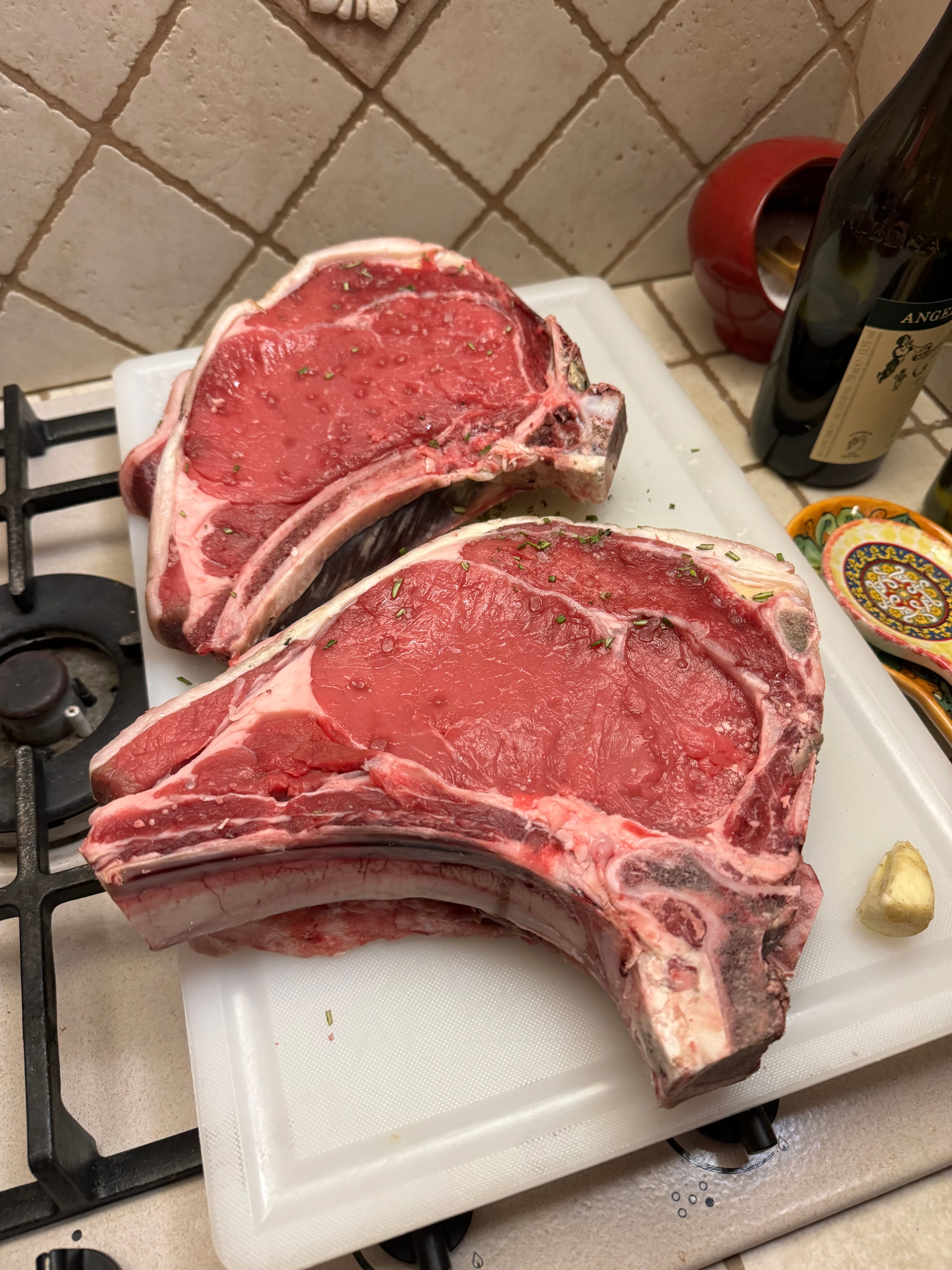
Back at the farmhouse that evening, we lit a thick layer of natural wood charcoal in the fireplace and got it glowing. I spread the sausage links around the edge, where the heat was lower, while others drizzled olive oil over the steaks, then a sprinkle of fresh rosemary from the garden and some black pepper. At this point, well into several bottles of wine, an animated discussion transpired on the subject of when to salt the steaks. I mentioned that Americans typically salt steaks before cooking, the better to season them fully. The Italians scoffed. “That will only draw out the moisture!” said one. Indeed, Italian tradition is to serve rare steak with a salt cellar at the table, from which diners generously dust each slice just before eating. I argued that I didn’t think salting two-inch steaks an hour in advance would dry them out measurably—but nor did I think the salt would penetrate much in the way of seasoning the whole steak, so it’s a wash. In the end, I usually end up sprinkling salt on each slice anyway.
“Max, how are the sausages doing?”
Like many Italians, Massi has a way of dismissing your stupid American ideas with a return to some important matter at hand—in this case, not burning the sausages.
And so we ate, a lot. There was salt on the table. All over the table. There were no sausages or steaks left over, and not much wine. The rain beat down all night. The ping pong table in the courtyard was as useless as the swimming pool.
As luck would have it, on another rainy day in Rome months later, I was reading an essay by Emiko Davies (an Australian-Japanese cookbook author who lives in Tuscany) about the first known mention in the West of Japanese cuisine. She was reporting on the chronicles of a Florentine traveler named Francesco Carletti, who detailed his culinary adventures in Japan during the 1590s. His diary is the first known description in the West of Japanese cuisine—and the last for centuries, as the country would soon close itself to foreigners until the late 18th century. Beyond Carletti’s enthusiasm for strange Japanese ingredients like miso, what caught my eye was his lament over the lack of red meat: “They eat meat very little because of a certain superstition of theirs.”
So could it be that Italians have always preferred steaks over weeds from the meadow, or a fish full of bones? Could Italians have been, since medieval times, more like modern Americans firing up the barbecue than we imagine? Granted, the High Renaissance of Carletti’s Tuscany was a time of prosperity—the “one percent” of Renaissance Florence and Siena invented modern banking. For them, meat was maybe a status symbol. I don’t know. But on a rainy weekend in Tuscany in a stone farmhouse with rare steaks sizzling on a blazing hot kitchen grill, I saw a Mediterranean Diet of many colors, but mostly red.
[1] The first record of a painting to employ perspective was a 1415 rendition (now lost) of the Florence Baptistery by Filippo Brunelleschi; perhaps all those flattened, foggy Tuscan landscapes inspired him to invent the graphic idea of horizontal lines converging on a distant point that we now take for granted.
[2] Saint Catherine of Siena eventually ate nothing except the daily Eucharist; she died at age 33 of a stroke, doubtless caused by what we would today call anorexia.
[3] Tuscans are known as the most enthusiastic hunters in Italy.
[4] The fish eating capital of Europe is Portugal, which like Scandinavia lacks a Mediterranean coast.
Max , when they come to my cell to ask me what I want for my last meal, I am going to ask for grilled steak and white beans and some steamed grains. I just love reading these pieces.
Max, a wonderful essay, effortlessly combining a vast array of history and culture. I particularly enjoyed your revisionist exploration of the origins of the so-called Mediterranean diet. You have been good to Italy, as it has been to you.