
Consider the Clam
On eating and flirting by the sea in Italy

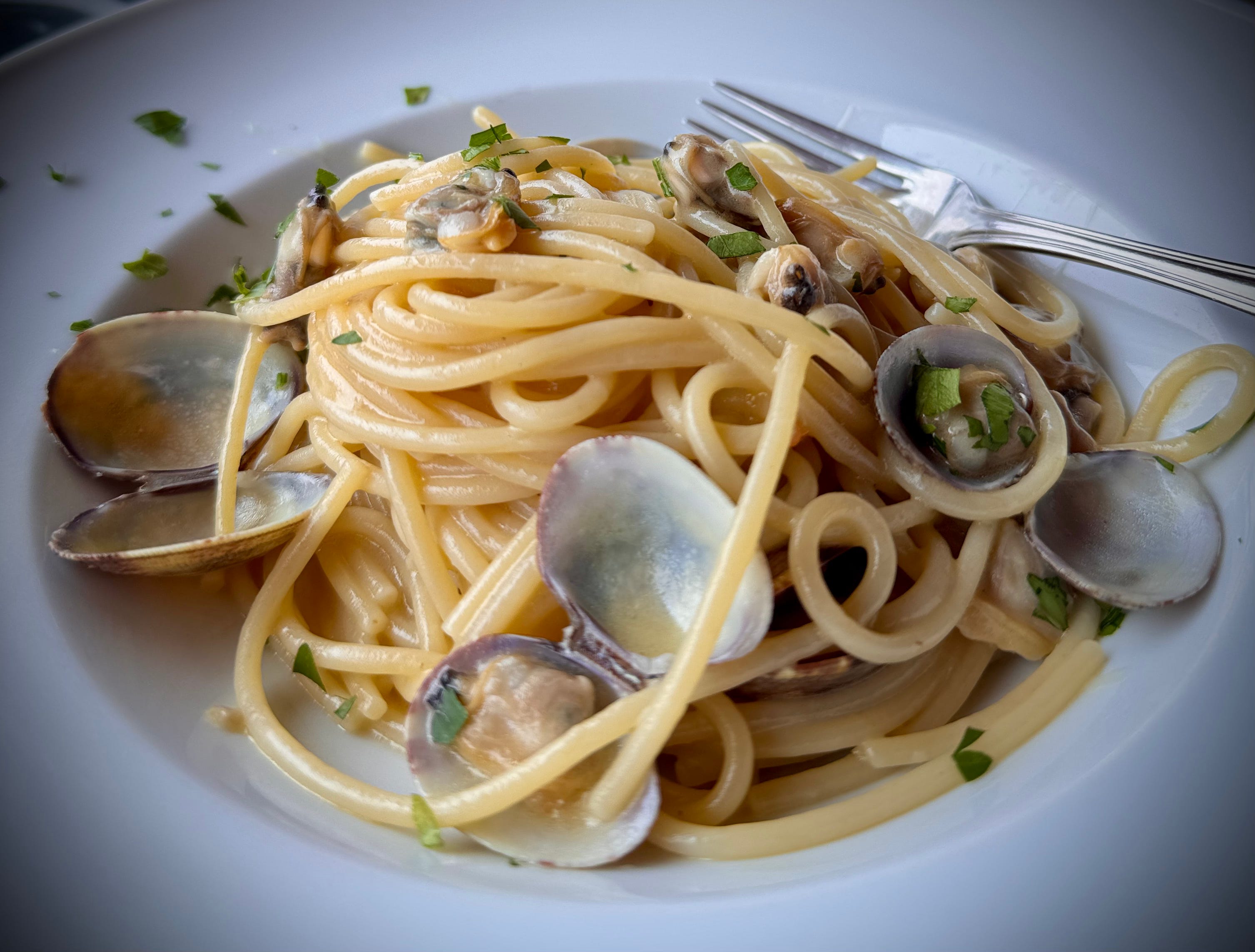
Of course I took the title from M.F.K. Fisher’s 1941 book Consider the Oyster. I consider oysters favorably over clams, but here in Italy they cost way too many euros apiece in the fish markets, more in restaurants, because most get flown in from France or Holland. Okay in Apulia they’re now raising oysters, you see them on menus, but I don’t trust raw oysters from warm water which is why you eat them breaded and fried in New Orleans.
What we have are clams, and where we eat them, with spaghetti, is at the beach in summer.
Which makes no sense. Italy’s Manila clams, they came from the Philippines in the 1980s, are basically a crop—the fishermen if you can call them that sow the spawn in shallow beds, then harvest the mature clams, year-round. There is no “season,” technically. What’s more, most are raised in a small Adriatic bay near Venice; it’s not like the clams you’re eating at a Sicilian beachfront restaurant are hauled in on local boats but feel free to think that. They are trucked in from the Veneto.
The clam harvesters of Italy currently face many challenges, including successive droughts and floods, warmer water and the invasion of voracious Atlantic blue crabs, which probably came on a ship and decided to stay, devouring the clams and other native fish. Some days the clam nets are filled entirely with crabs, clicking their dangerous claws in defiance. As these are the exact same crustaceans considered a delicacy along the Chesapeake Bay, one reasonable response has been to encourage Italians to eat them. Authorities (right up to the prime minister) have been promoting crab dishes. But Italian culinary traditions change at the speed of cold molasses, and at any rate getting manicured Italian women to wrestle with a crab at the dinner table is a big ask. And so Italians stick to their clams.
I had my first spaghetti with clams in 1980, at a long-gone place in Bristol, Rhode Island called Tweet Balzano’s. Tweet’s was a legendary Italian-American restaurant a few blocks from the Narragansett Bay, with a menu heavy on Rhode Island seafood specialties like stuffed quahog clams (“stuffies” in the local parlance), fried calamari, steamers (soft-shelled clams), snail salad, and spaghetti with littleneck clams.
In my Providence days we went there whenever we could find someone with a car and a relatively low blood-alcohol count—it took about 45 minutes from downtown Prov—and I always ordered the spaghetti with clams in “white sauce,” which meant swimming in olive oil. It was not a subtle dish; like much Italian-American cuisine it tasted primarily of garlic. The waitress (this was before “servers” and they were never men) always brought around two large shakers—one filled with red pepper flakes, the other with some kind of processed “parmesan cheese”—and you were expected to douse the dish with both. It was delicious in the same way as a triple bacon cheeseburger, which is to say in the way of unbridled gluttony.
My first genuine Italian spaghetti alle vongole was in Venice in 1985 as a college student. It was a garden restaurant in Santa Croce, the less-touristed quarter across the Grand Canal from the train station. Anyone expecting spaghetti with clams à la Tweet Balzano’s would have been disappointed, but by that point, after two months in France and many culinary revelations, I had developed a nascent European palate and an open mind. Beyond the smaller portion size typical of pasta servings in Italy, and the mere hint of garlic flavor, most surprising was the size of the clams—about half as large as America’s familiar littlenecks. The dish came with the clams still in their gaping shells, along with a side plate for the empties. This is traditional in Italy and encourages slow, mindful eating.
Slow also was the train one morning in June, temperature volcanic by seven, down to Sperlonga, the ancient white village dangling on a cliff above the sea south of Rome. Below the medieval borgo are among the finest beaches in Italy, not breaking news: Tiberius had a villa there, with a natural grotto which you can tour. A small museum contains the excavations, notably a colossal sculpture of the nude and copiously endowed cyclops Polyphemus from The Odyssey, in the process of being blinded. I wasn’t going to the museum today. I had in mind spaghetti with clams.
But not just.
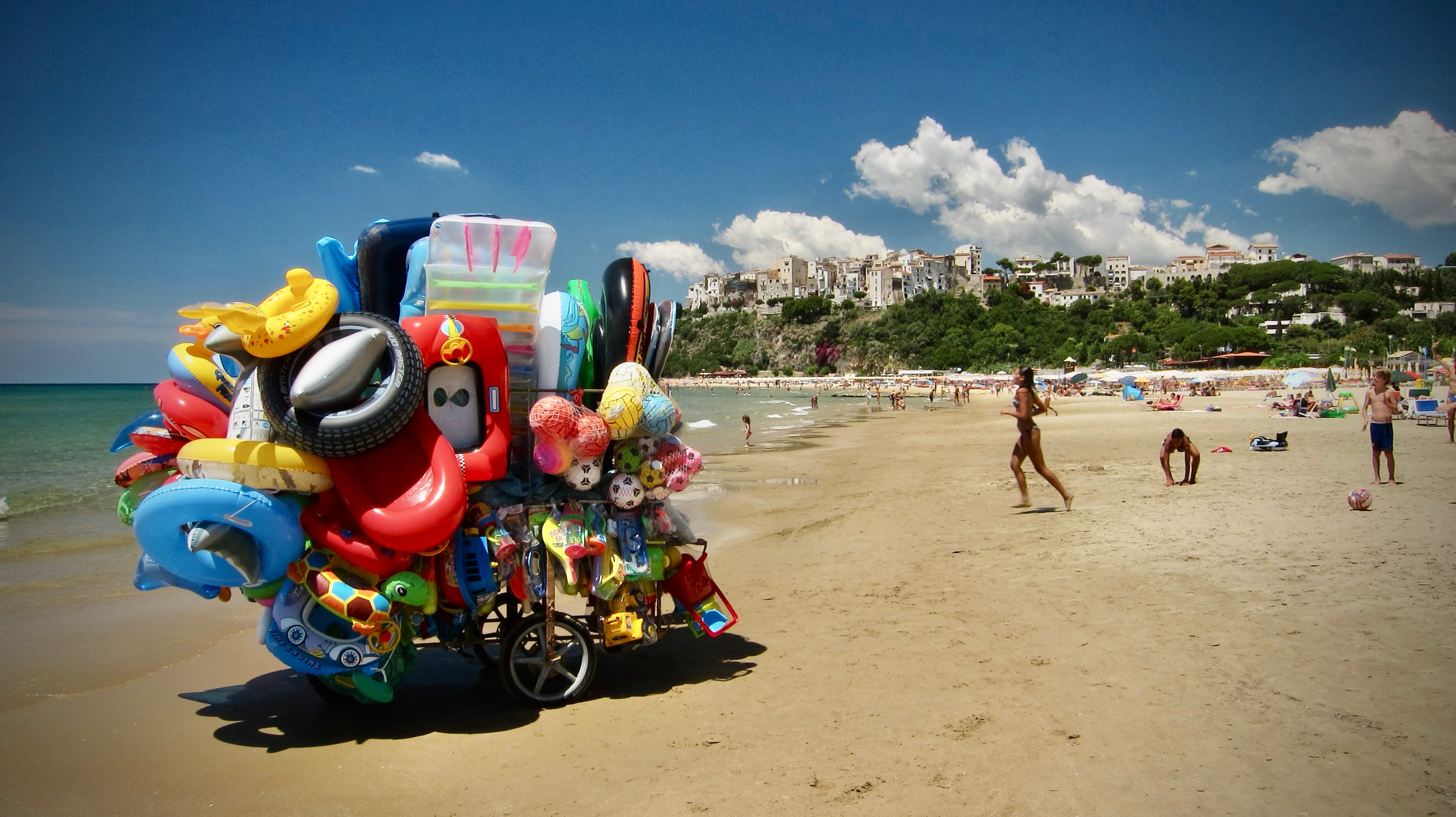
Her name was Inez which means virgin which she surely wasn’t. She was born in northern Spain, in coastal Galicia where they also harvest clams, but her father died when she was a baby and her mother met a Roman and moved there and so it went. Her hair was straight and blond and her eyes rare green, and she worked as a waitress at a beach club there in Sperlonga. I came to see her every summer and to eat clams and she knew all that.
I arrived around nine, paid the bagnino for a lounger and umbrella, dumped my beach bag and went straight to the restaurant, under a gazebo, to reserve my usual lunch table and flirt with Inez.
“The clams are just in today,” she said, folding linen napkins.
The beauty mark on her cheek came in and out of view between tangles of her hair as she bent over the table. She was wearing a bikini top the color of strawberries under her white blouse. I wondered who she would swim with, and when.
“Don’t you prefer Atlantic clams from Galicia?” I felt like asking.
“When I can get them.”
Did she really say that? Wasn’t that from Spartacus?
Almost.
The famous snails-and-oysters scene, cut by censors in 1960 and not restored until 1991. The slave Antoninus (Tony Curtis) is bathing his master, the elite general Crassus (Laurence Olivier) who comes on to him using a culinary metaphor whose meaning would not fail a nine-year-old.

“Do you eat oysters?” says Crassus.
“When I have them, master.”
“Do you eat snails?”
“No, master.”
“Do you consider the eating of oysters to be moral and the eating of snails to be immoral?”
“No, master.”
“Of course not. It is all a matter of taste, isn’t it?”
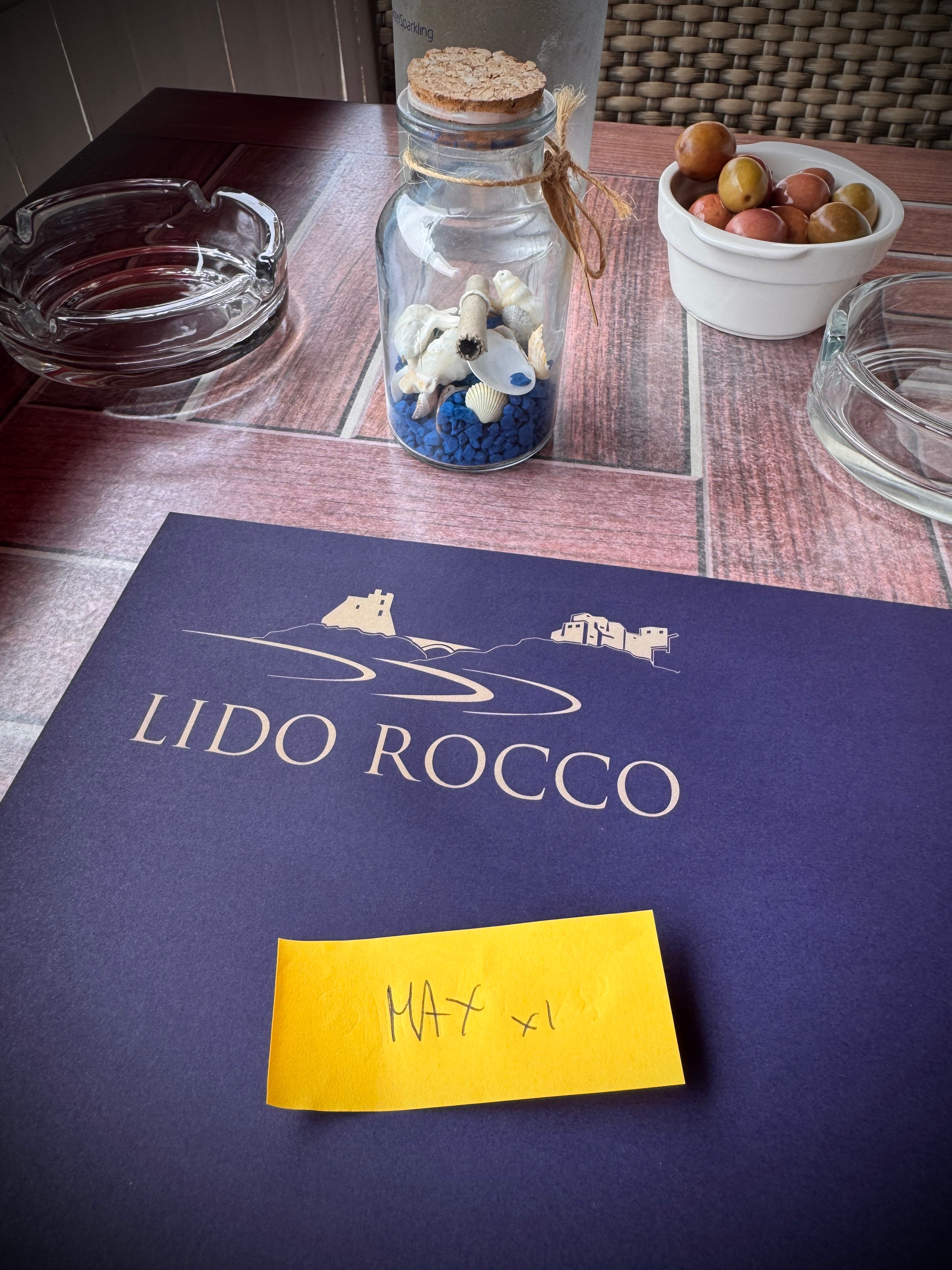
As a matter of taste I took my table at one o’clock, the one by the seafront where Inez had put my name on a sticky note. I could have changed out of my wet swimsuit, but why bother? Red Smith, the late New York sportswriter, dissed the America’s Cup yacht race as a non-sport practiced by “rich men with wet bottoms.” At lunch at the sea in Italy, everybody has a wet bottom.
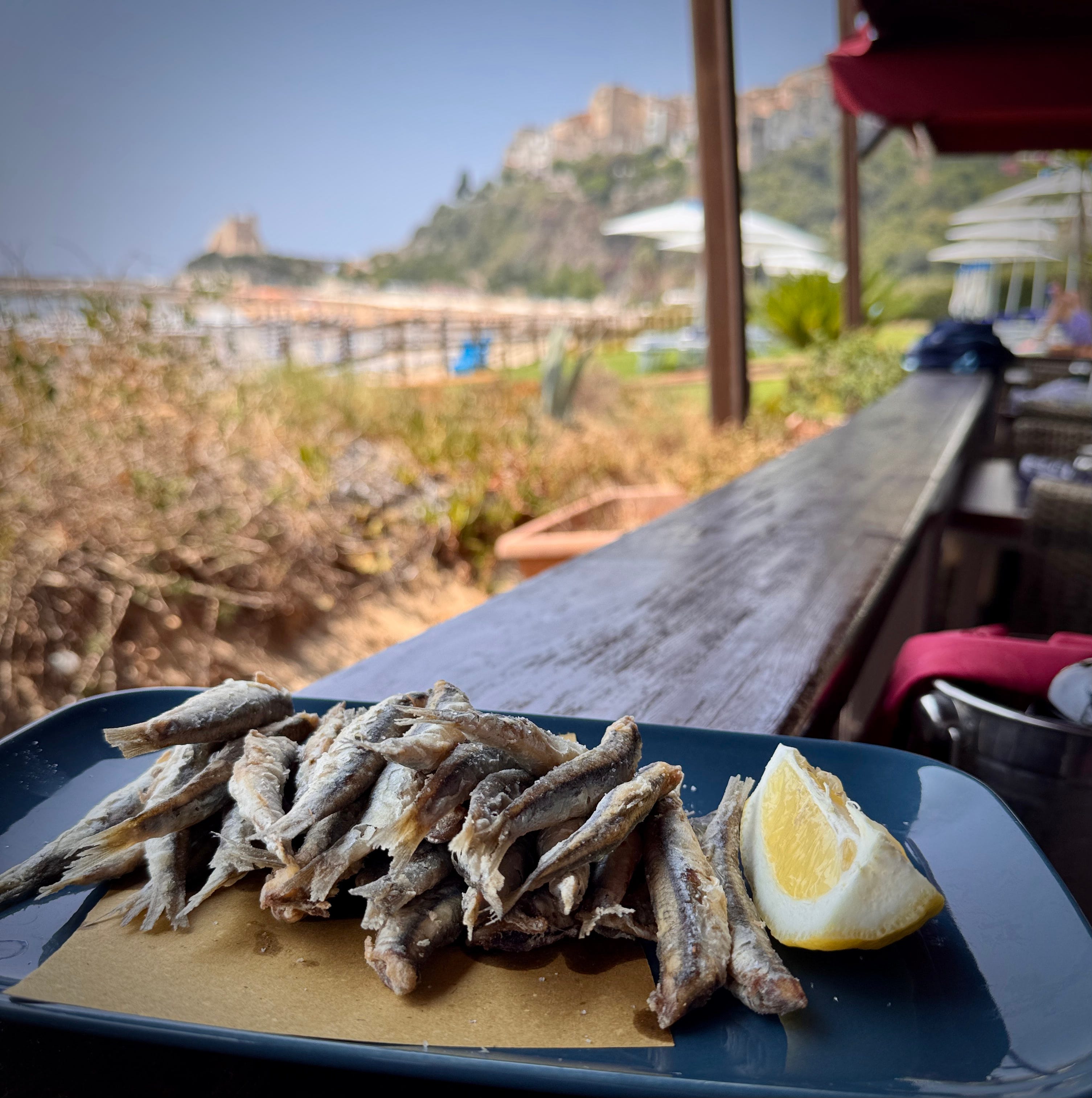
“The anchovies are good today.” Inez again.
“Marinated or fried?”
“Fried.”
I was thinking poached baby octopus to start, but I went with Inez and those fried anchovies, dusted only in flour and served with a lemon wedge, nothing else—no vinegar no tartar sauce and God forbid “mushy peas” like they do in England. Chips? That would be the crunchy bones and tails. Half bottle of local Pecorino, flinty and dry. I didn’t need to tell her my second plate.
The spaghetti with clams arrived, glossed in olive oil and glittered with parsley. I speared each tiny clam with my fork, twisted it out of the shell, then wrapped a strand of pasta around it. I did this more than two dozen times. On the beach, an old man was blowing up a plastic shark for his grandson.
“Are there enough clams?” Inez again. She winked.
When I was finished my fingers were sticky from the clams and I poured mineral water over them from the bottle, leaning over the rail onto the sand—an advantage to outdoor dining. It was hot and I wanted to swim. “Alla prossima,” I said to Inez. I’ll see you soon. It was only June.
Recipe: Spaghetti alle Vongole
1. Clean a mess of fresh littleneck clams under running water, eliminating any that are broken or remain open. Figure about three pounds in their shells to serve four people. Cover them in heavily salted water for several hours in order to purge the sand—thinking they are in the sea, the clams will open up to eat, in the process disgorging gritty waste. Rinse thoroughly.
2. Brown a clove of garlic (one clove!) in a large pan with a good glug of olive oil. Add the purged clams and a glass of white wine, cover and cook over high heat, stirring occasionally, until all the clams have opened and released their liquid. Dump them into a colander over a large bowl. Discard the garlic. Transfer the liquid back to the pan, pouring it through a fine-mesh sieve if you suspect residual grit.
3. Meanwhile, set a lightly salted pot of water to boil—a couple quarts, no more, as you’ll be using some of that water later and you want it super starchy from the pasta, to render the dish creamy. Cook spaghetti for half the time called for on the label. (Italians measure 80 grams, or three ounces, of dried pasta per person.)
4. Using tongs, transfer the partially cooked pasta into the pan with the clam liquid, along with a ladle of the starchy water, and continue cooking the pasta over low flame until al dente, stirring with tongs. As the pasta absorbs the liquid, add more starchy water as necessary; aim for saucy not soupy.
5. Add the clams in their shells along with some chopped parsley (and maybe red pepper flakes if you like), stir to combine, and serve with ice cold white wine. Lacking a view of the Mediterranean, loud techno music will approximate the Italian beach club ambience.
Damn you! It’s 5 AM in NYC, I just read this, and all I can think about is clam pasta!
I will probably offend everyone. But what exactly is great about clams. They are just filters of the ocean. I don’t understand have rocks as my mom used to call them. In your pasta. Perhaps it’s the fresh garlic and parsley. Which I think you can dip a shoe in butter and garlic will taste good. I will pass give me pasta simply with butter and garlic. And as we had with our French cousins. Pasta garlic 🧄. And fresh parsley with good white wine