
Cooking for One in Rome
Without being a loser

Alexandra and I don’t live together.
I have a small apartment in Rome’s historic center, streets packed with tourists.[1] She lives in a small apartment with pink Barbie walls in Testaccio—ten minutes by bicycle from me yet a world apart.
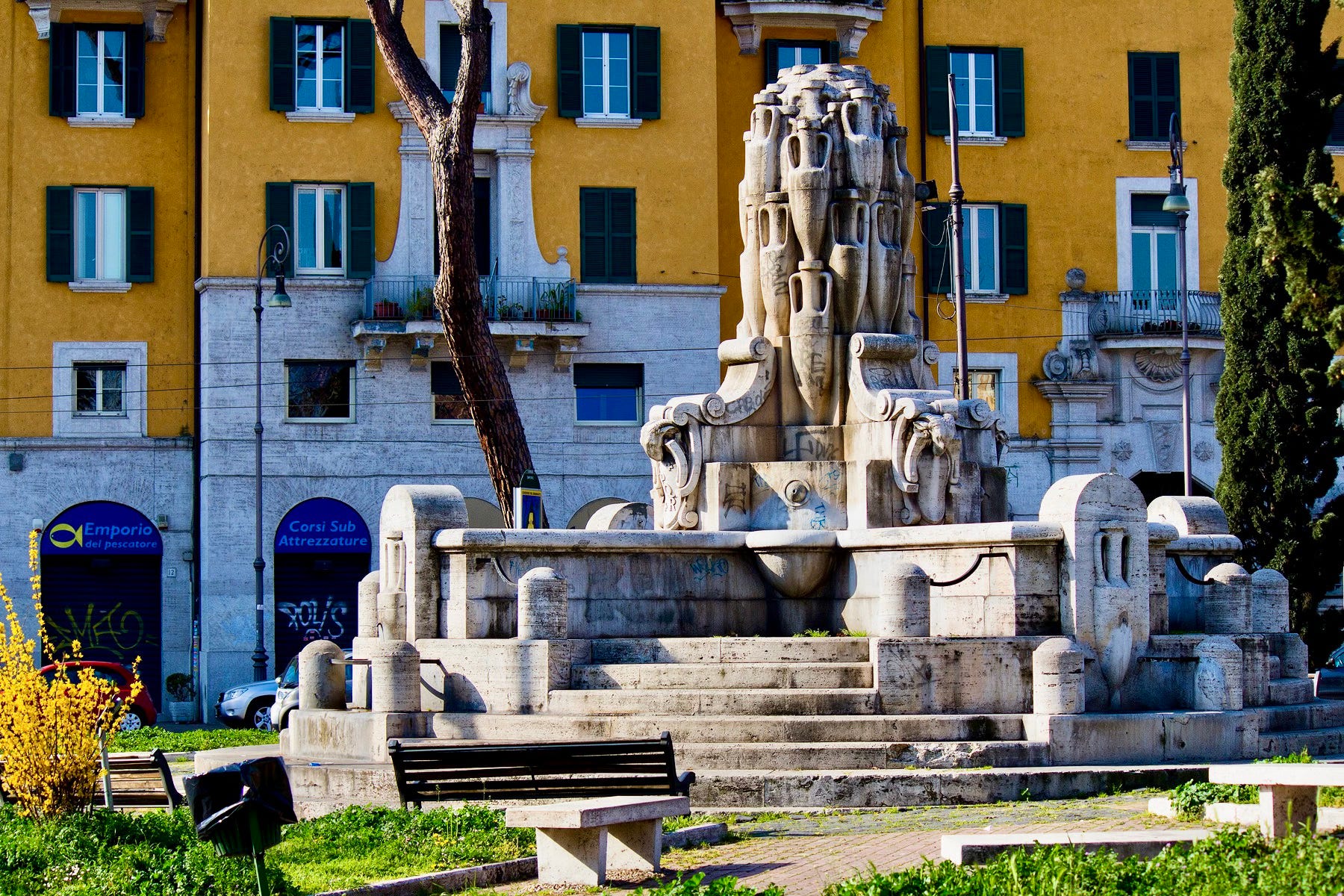
Testaccio, just across the river from the ultra-touristed neighborhood of Trastevere, is mostly inhabited by Romans. The apartment buildings, ochre in tone and five floors in height, date from the 19th century and rarely have elevators which is a dealbreaker for a lot of ex-pats. There you still find wine bars, restaurants and beer halls full of Italians after work. On weekends the patrons spill out of the bars and drink around benches in the central piazza, dominated by a Fascist-era travertine fountain depicting a tower of ancient Roman amphorae, those tall twin-handled terracotta jugs for oil and wine. The fountain honors the neighborhood’s history as the deposito or storage site of amphorae in ancient times.
Nearby are several dusty old hardware stores where they can show you the right way to hang a mirror on brick walls, and butcher shops. Lots of those, as Testaccio is traditionally where Rome’s butchers lived, it being the site of the old mattatoio, the sprawling slaughterhouse whose buildings are now occupied by modern art galleries, an architecture school and a vaguely socialist flea and farmer’s market called the City of Alternative Economy whose opening hours are impossible to divine. That might smack of gentrification, but in truth the mattatoio was outdated and unsanitary; it’s been replaced by a nearby modern public market with some of the best food stalls in the city. (And tourists do find their way there.)
The butcher families of Testaccio were inventive masters at cooking organ meat, the cheap parts they kept for themselves. They called innards er quinto quarto or the fifth quarter—meaning after selling the desirable four quarters of red meat to Rome’s elite, they went home with that “fifth quarter.” Testaccio restaurants still specialize in so-called snout-to-tail dishes; it’s where you go if you have a hankering for intestines, stomachs, kidneys and hearts. That they continue to serve these traditional Roman dishes amazes me, as most younger Romans would sooner eat seagull[2] than spleen.
For all this and more, Testaccio feels today as it might have been in the desperately poor years right after World War II, when it was the setting for a large part of Elsa Morante’s semi-autobiographical novel History.[3]
But back to Alexandra and me. We generally see each other on weekends, which means most weeknights we aren’t dining together. Discounting evenings spent with other friends or family, we often eat alone, separately.
Of course I could, and do, go out. But in winter, when Rome by night is so often cloaked in cold rain that makes even the bronze church bells peel like a wet sponge, I stay home. And I don’t like eating takeout alone because…loser?
So what to cook?
Not for me those tired cooking-for-one recipes like, you know, buy a single chicken breast blah blah blah. Because…loser? In winter I like making soups, stews and rich meat sauces that cook all day, filling my apartment with their scents while I’m writing and pretending to stay in shape with a few dumbbell lifts. Even better if my neighbors exclaim Che profumino! Cosa stai facendo? I’m making cazzo dinner for one is what I’m cazzo making, and it’s not a cazzo loser chicken breast.
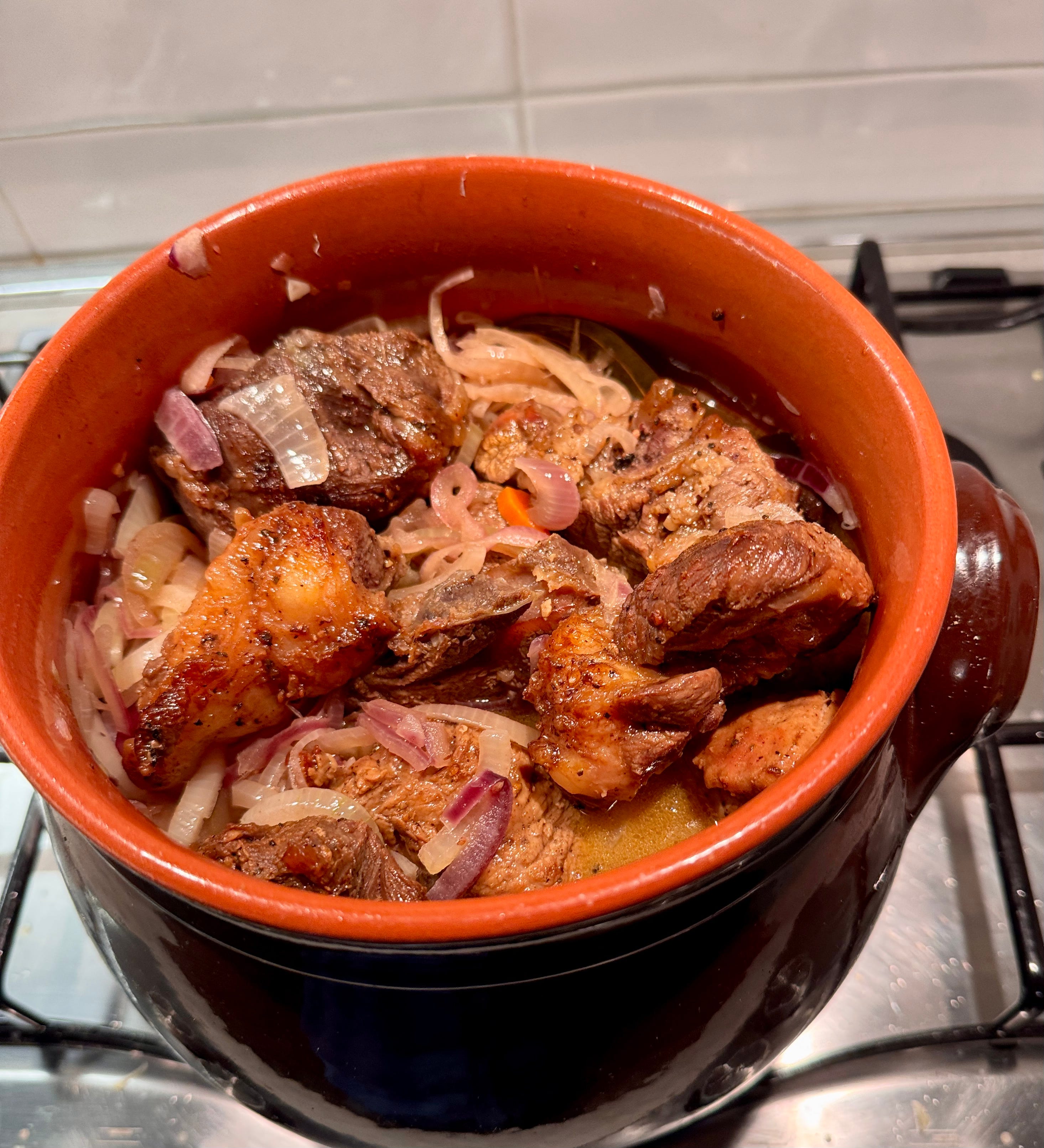
So the other day I decided to make a ragù Genovese, which despite its name is a classic dish from Naples.[4] It’s a long-simmering meat sauce made not with ground meat like a Bolognese but rather with large chunks, which braise in the sauce for hours until you can shred them with a fork. There are no tomatoes (but for a squirt of tomato paste); what makes the liquid, beyond a good glug of white wine, are dozens of thinly sliced onions, which you caramelize and then cook, ever so slowly, until they melt. In that sense it’s a bit like French onion soup. After hours in this manner, you remove the meat and shred some of it back into the sauce, which you toss with pasta as a first course. The remaining chunks of meat are served as a second course of…meat. You could serve the meat with mustard, as I do, which would be French and possibly cause revocation of my Italian residency permit, but life is a series of measured risks.
Anyway, I bought a couple kilos of beef and veal shoulder chunks from a butcher at the new Testaccio market and went to work. I won’t reproduce a recipe because I stole it from my Italian daughter-in-law, who runs (with my son) a popular cooking YouTube channel and blog. You can find her recipe, in English, here.
The point is, I had a lot of sauce. After a few days eating various types of pasta with ragù Genovese, I got tired of it. But I still had a vat of that fucking sauce. I froze as much as I could, which was like a quart given that my small apartment has a small fridge with an even smaller freezer, most of which is occupied by bottles of vodka and limoncello (priorities).
Again, what to cook?
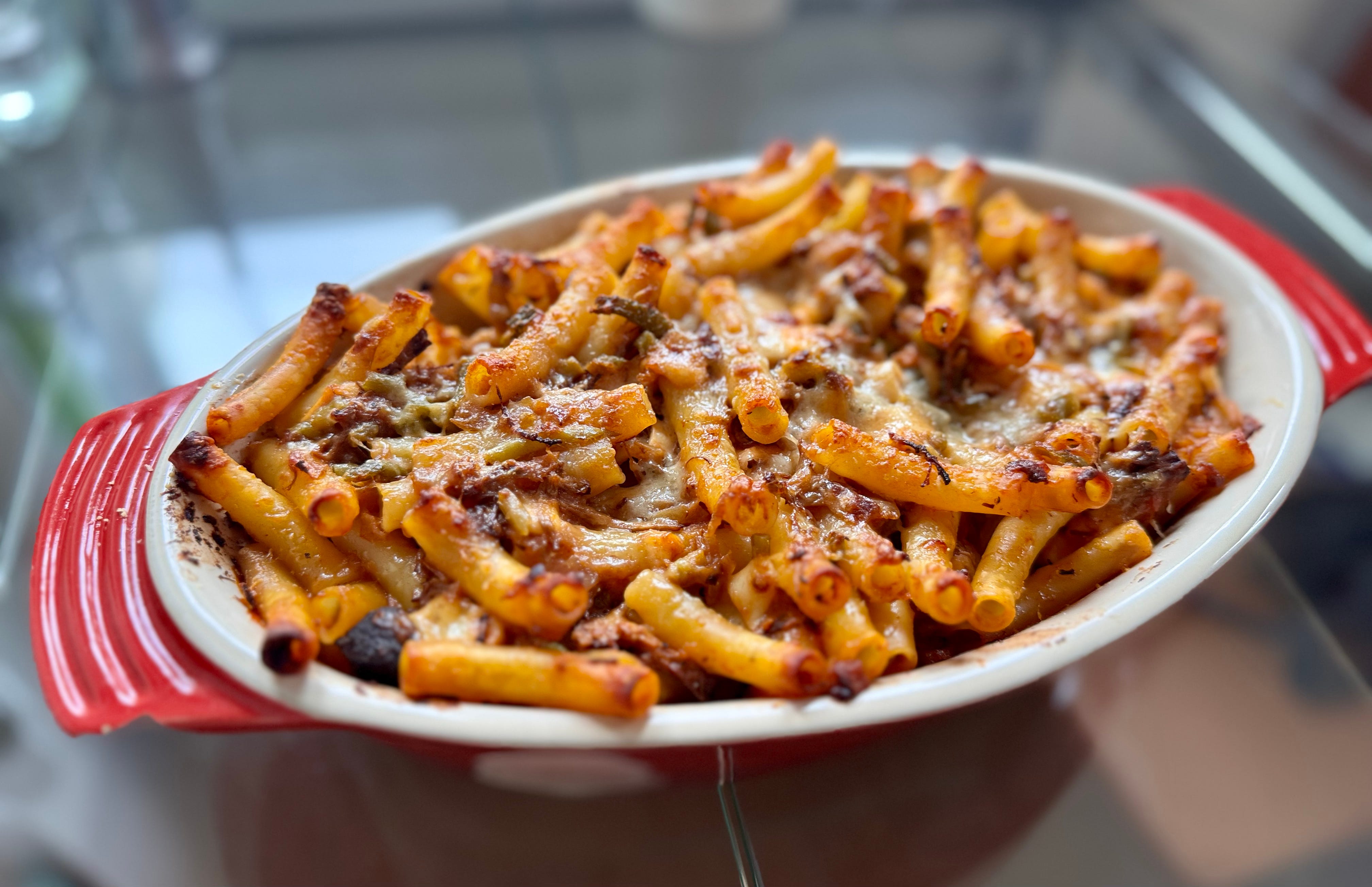
The correct answer, if you’re playing along at home, was a baked pasta. I boiled some ziti a few minutes shy of al dente, then tossed them with a few ladles of the ragù and a handful of cubed fresh mozzarella and grated Parmigiano. I used buffalo-milk mozzarella because I can, but a good cow’s milk version would be fine. Should you have neither, a soft melting cheese like Bel Paese or Fontina would be far better than commercial supermarket non-mozzarella. Transfer to a casserole dish and bake on medium heat for about an hour, until golden and crispy on top. With mine, I noticed it was browning too quickly so I covered it with aluminum foil for a bit. Whatever.
Okay, on one level you could say it’s just more pasta with ragù Genovese. But this was different. There was that crispy crust, then the gooey interior with melted cheese. It was a real transformation. And yes there will be leftovers. Good. I opened a bottle of 100-percent Sangiovese from the small biodynamic producer Tenuta Santa Lucia in Emilia Romagna.[5] And though I was eating alone, I considered myself a winner.
[1] I don’t mind the tourists—we are all tourists somewhere—although they could dress better.
[2] The flying rats of Rome.
[3] The Italian title, La Storia, is more lyrical as the word can mean both history and story. I highly recommend it.
[4] It may have come to Naples from Genoese sailors during the Renaissance.
[5] The English on the label makes me think it’s distributed beyond Italy.
This will help were to look for accom our 5 days in Rome in April. Thks
Your daughter-in-law(DIL) and son mentioned you on their recent YouTube. Congratulations on the news ! You’re going to be a Nonno ! 🥳🎊🍾🥂