
Embracing the Void, Part 2
The chocolate sphere that keeps on giving

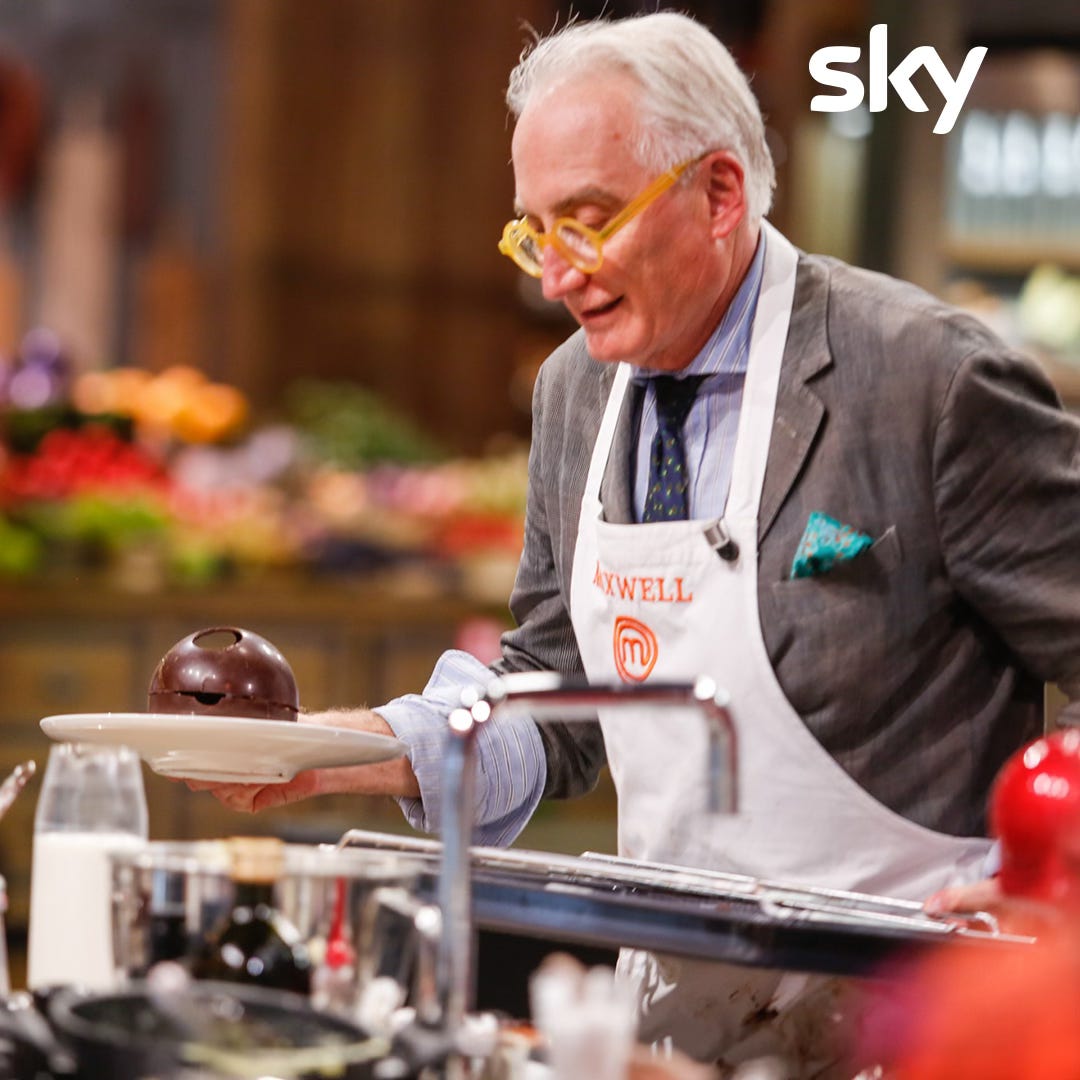
If you live in Italy and drive cars, sooner or later you need to get an Italian driver’s license. If you are American you will need to enroll in driving school—even if, like me, you have been driving all over the world for more than half a century. U.S. driver’s licenses are not convertible to the Italian version; as far as Italy is concerned, you’re a neophyte behind the wheel.
It may stretch the bounds of credibility for anyone who has driven in Italy, but the process is rigorous—requiring months of classroom instruction followed by a head-exploding written exam (in Italian) that even many Italians fail, then at least six hours of driving instruction and a final test behind the wheel. Which is how I found myself last Friday driving an inspector around Rome, demonstrating parallel parking and proper U-turns. At one point he asked me to pull over. I was worried. Then he handed me his phone. On the line was his daughter, apparently one of my fans from MasterChef Italia; she wanted to say hello, and ask how did I ever make such an amazing chocolate sphere that was my crowning achievement on the broadcast five years ago.
At that point I figured I would have to run over a child to fail my driving exam.
The chocolate sphere, mostly air, inflated my standing in the competition and my ego. It went like this:
We entered the studio and faced, on the stage, a giant upholstered armchair turned away from us. As the lights came up the chair rotated; seated in it was Iginio Massari, the 77-year-old maestro of Italian pastries. A spotlight revealed the three chef judges up on the balcony; today they would relinquish the floor to Maestro Massari.
“Welcome to the MasterChef Skill Test,” said the maestro. One contestant was crying like a Beatles fan in 1964.
Americans could be forgiven for scratching their heads, but in Italy, and indeed beyond, Massari is venerated as a god of la pasticceria. He makes an appearance on almost every season of MasterChef Italia, and families crowd around the TV for his dessert-making episode.
Chef Giorgio Locatelli, one of the judges, gave us the big picture: “You are about to confront a very tough Skill Test. There will be three levels; each has the possibility of salvation. The last will be for the elimination. Tutto loud and clear?”
“Sì Chef!”
Chef Bruno Barbieri continued the plan: “We decided to address a culinary theme that is very interesting but not well known. L’involucro!” Wrapping things.
A contestant muttered “porca miseria!”
Picking up on our groans, Barbieri continued: “You are right to be worried. The challenges include technical skills, artistic skills and of course the challenge of flavor.”
Then Maestro Massari lifted three cloches, under each of which was a hollow chocolate sphere the size of a softball. One was made of dark chocolate with a lacy filigree etched into the surface; another was white chocolate, with round holes cut through the dome; the last was another dark chocolate sphere accompanied by a small jeweler’s hammer, also made of chocolate.
As the orchestral music swelled on the soundtrack, he poured hot chocolate sauce over the filigreed sphere, melting the dome and revealing yet another dessert inside. Then he took the hammer and smashed another dome, to reveal a different fine confection inside.
“Your job,” he said, “will be to create a chocolate sphere with a tiramisù inside. You must also prepare a hot chocolate sauce for the final serving.”
“Guys,” said Barbieri, “you must also make the tiramisù. From scratch.”
“Including the savoiardi?” asked Monir Eddardary, our Moroccan-heritage contestant,[1] referring to what Americans would call lady fingers although the Italian ones are crispy, not mushy.
Barbieri scowled. “Monir, have you ever seen a tiramisù without savoiardi?”
But Monir’s question was justified. In Italy, almost everyone buys savoiardi at the supermarket. Today we would have to make our own, while also sweating that fucking chocolate sphere. I had made savoiardi before, in fact with my daughter-in-law Eva, and I remembered the ingredients are simple: separated eggs, sugar and flour, with the need to whip the egg whites. But I couldn’t remember the portions, and panic was setting in.
Massari approached our work stations, which had been arranged galley style with rows of contestants facing each other, and gave us a brief course on how to temper chocolate—a professional cooking technique that ensures melted chocolate will stay glossy and crunchy after re-hardening in desserts. After heating the chocolate pieces in a bain-marie to around 120F, he deftly poured the molten blob onto a cool marble counter top, then used two offset metal spatulas to spread and turn the mass.
“Work quickly and keep moving the chocolate,” he explained, “to bring it down to almost room temperature.”
He touched the chocolate in several places with the back of his pinky. “Now it’s ready. There will be thermometers for anyone who doesn’t have this pinky skill.” In other words, all of us.
Then he poured the chocolate into plastic hemispherical molds, spreading it to the rim with a ladle and swirling it around to be sure of even coating. The final step was loading the molds into a blast chiller[2] to cool, before unmolding. The idea was to put our tiramisù into the upturned bottom hemisphere, then gently set the other hemisphere on top. We each had enough chocolate and molds to make six hemispheres—room for error.
“You have seventy minutes!” said Barbieri. “Cinque, quattro, tre, due, uno, now!”
Ignoring the giant boom clock, Massari checked his Rolex.
As we frantically worked, Barbieri chatted with the maestro: “The order in baking is fundamental. For this dessert, what would you do first—the sphere or the tiramisù?”
“We would want to make the chocolate sphere first,” said the maestro, “because the room temperature is good. But now they are all lighting the ovens to bake their savoiardi, which will increase the room temperature by five degrees. Then the chocolate will stick to the forms.”
Luck was with me, as Monir was directly across from me at our galley station, and he appeared to know the portions for savoiardi batter.
I copied him slavishly,[3] then quickly squeezed out the batter through a pastry bag onto a lined sheet pan. Into the oven, on to the chocolate.
The show cut to my post-challenge interview: “I once tempered chocolate, but it was years ago.”
As I poured my chocolate into molds, Maestro Massari came by to greet me.
“Good evening Maestro!”
“Are you sure they’re ready to go?”
“Sì Maestro.”
“Ok bene.”
Into the blast chiller they went.
I finished my tiramisù and put it in the blast chiller; ideally it would rest overnight, but whatever. Then I made my chocolate sauce. With minutes remaining, I unmolded my spheres, then cut decorative holes in the top dome with a small round cookie cutter I heated with a kitchen torch. As I put the finishing touches on my dish, the studio erupted in a cacophony of beating ladles and wooden spoons, like some drunken noisemaking ritual at midnight on New Year’s Eve.
None of the other contestants could release their chocolate spheres from the molds.
They banged and clanged on those molds like demons. They whacked them on the counter. Chef Antonino Cannavacciuolo mimed a drummer performing a virtuoso solo. Barbieri covered his ears. Finally he looked up at the clock and shouted, “Five, four, three, two, one, stop! Finally, silence!”
The judges surveyed the battlefield in disbelief. “The only one whose chocolate sphere came out of the mold is Max.”
Another contestant whispered, “he even made three holes. Bella bella bella.”
I poured my hot chocolate sauce over the sphere, revealing the tiramisù. Maestro Massari inspected my creation: “The chocolate is tempered, but it’s not uniform—you didn’t mold it well, one sees here.” He pointed to the uneven edges where my two spheres joined. “But the presentation is what we wanted. Now I will taste.” He took a bite and pronounced, “this is an excellent dessert! Bravo!”
Locatelli asked me who I have made desserts for. I said mostly my children.
“And you made desserts with them?”
“Yes.”
“This is really very beautiful.”
Cannavacciuolo said, “Max you worked hard in your career, also very important work. Where did you find all of this energy to cook?”
“It’s very simple,” I said. “I adore cooking. And when I finish my work I want to cook.”
He nodded. “When someone is passionate about something, it’s not a burden but a gesture of love. It is indeed very simple.” Then he gave me a fist bump.
The cameras cut back to the maestro: “Max, this is the best dessert that I have ever eaten on MasterChef. And I’m happy to tell you, run to the balcony!”
As I watched from the heights, Massari summarized the day’s failures. “Half of you didn’t properly temper your chocolate. Someone didn’t put their chocolate in the blast chiller for enough time.”
Barbieri said, “Let us now thank Maestro Massari for joining today.”
“It was my pleasure,” he said. “The MasterChef school is not just a cooking school. It’s a school of life.”
After he left, Locatelli addressed the losers. “Aspiring chefs, you not only embarrassed yourselves but you embarrassed us, in front of the number-one baker in the world. This is unpardonable.”
They stood, stone-faced, heads bowed over chocolate-stained aprons that might as well have been bloody surgical scrubs.
To this day I don’t know why my chocolate hemispheres popped right out of the molds. Maybe I did a better job tempering the chocolate? Or maybe it was karma? Which could be the same thing?
I told the driving inspector’s daughter that it was just my lucky day. Then I got my license.
[1] Monir now owns a Moroccan restaurant, Amina, in Milan.
[2] Professional restaurant refrigerators that rapidly chill ingredients without freezing them. We had several in the studio.
[3] I don’t consider this cheating as we could all plainly observe each other working.
Having seen the episode, it was fun to read of your experience on set. And congratulazioni on finally getting your license!
Max: Bravo. A typically delightful dissection of your interaction with Italy's challenges.