
Hold the Garlic
Reflections on the Italian Palate

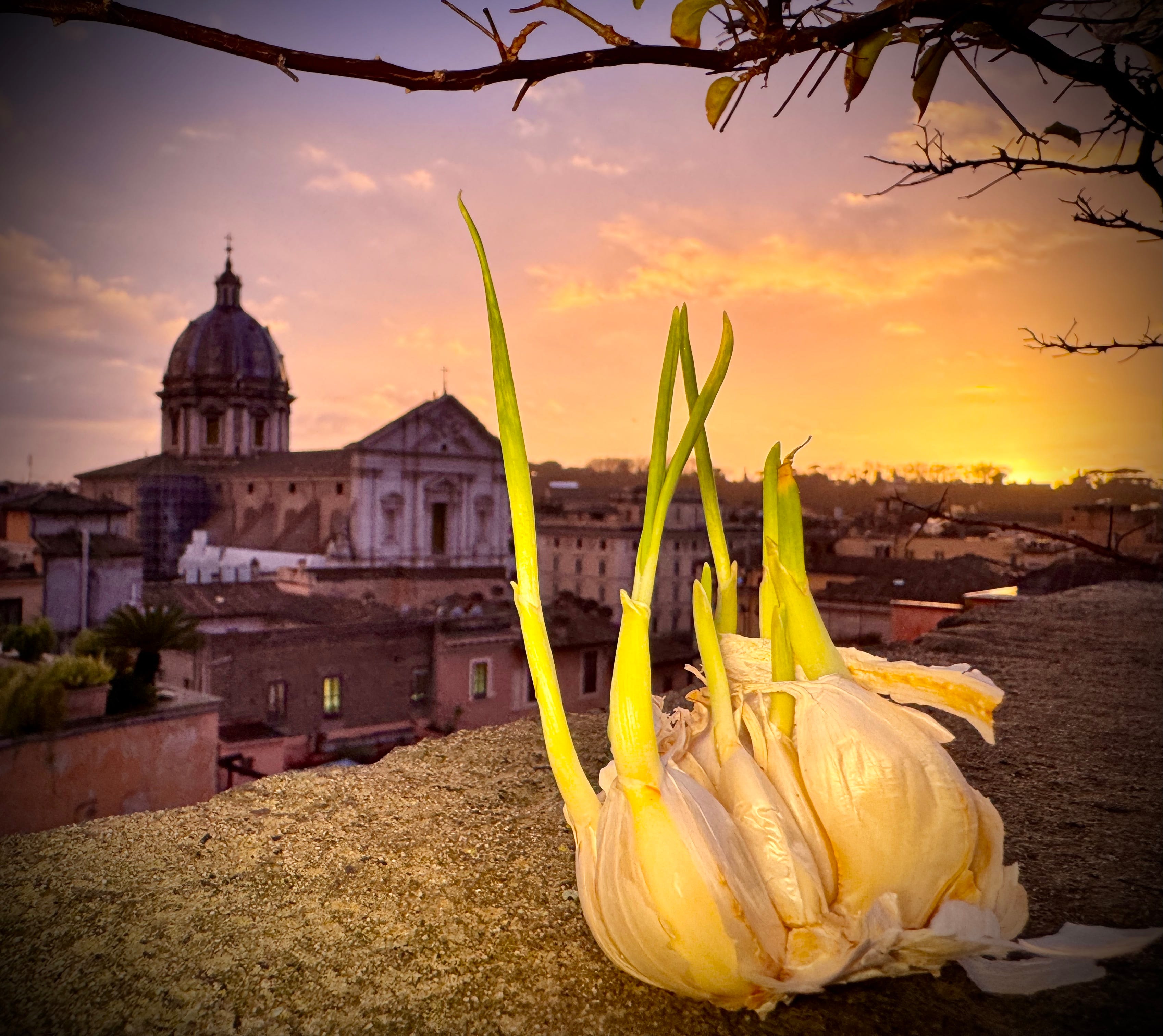
Youth—lacking perspective, judgment or risk assessment, and with a naturally addictive personality—led me down some exciting yet dangerous paths, a few of which I still tread lightly. One of them was garlic. That path I got off when I moved to Italy.
When Americans think about Italian cuisine, they often think about garlic. Lots of it. The truth is that Italians eat very little garlic and almost never raw, the better to prevent indigestion and fitful sleep, according to Italians. The American says there is no such thing as too much garlic. The Italian says why does everything in America taste like garlic?
I’m being harsh. Other cultures use lots of garlic, around the world. Not Italians. Even close to home, Mediterranean cuisines heavy on raw garlic, such as Middle Eastern meze dips or Catalan allioli[1], are regarded by Italians as unserious novelties. In Italy, even cooked garlic is used sparingly: When making a tomato sauce, Italians brown a clove of garlic in olive oil, then remove and discard it; the idea is to lend a hint of garlic to the dish, not overpower it. Garlic in salad dressing? Italians might soak a crushed clove in salted vinegar for 15 minutes, then (again) discard it. Add olive oil.
An American-style style red sauce—laden with handfuls of garlic (and diced onion and peppers and every dusty spice shaken from a greasy jar above the stove[2]) comes from Italian American cuisine, which is not the same. Somewhere along the line, Italian immigrants blending into America’s melting pot decided to toss the kitchen sink into their own bubbling pots.
Here’s what it boils down to: American cooking is additive—more is more—while Italian cooking is subtractive. In the Italian kitchen, less is almost always more. So garlic (in small amounts) is rarely combined with onion—pick one. Likewise basil or parsley. Olive oil or butter. In this way, the simple and direct flavors of a main ingredient (the protagonista in Italian) can shine. It could be sweet grape tomatoes from the slopes of Mount Vesuvius or an Alpine taleggio cheese from grass-fed cows or tiny Adriatic clams. Whatever it is, you don’t want to hide it under handfuls of extraneous other stuff.
Of course, it helps to have optimal ingredients. In Italy (and Europe in general) food is less industrialized than in the U.S. Quality overrules quantity, and groceries are more expensive as a result.[3] When Trump’s trade marionettes met with EU bureaucrats on tariffs, the subject of American meat came up. Maybe Europe could avoid punishing “emergency tariffs” on wine (a clear national security threat) if it accepted U.S. beef and poultry? The Europeans replied, in so many words: Not happening dudes. You can put a thousand-percent tariff on Chianti and you still won’t sell your chlorine-washed chicken and artificial growth-hormone-laced beef over here. Full stop.
I don’t want to suggest that the meat and produce sections of an Italian supermarket are brimming with artisanal products, lovingly harvested in straw baskets by noble contadini. As in America, agriculture in Italy is mostly done by immigrants, and there are plenty of large mechanized farms, as well as sprawling greenhouse operations. Wine in particular has suffered from mass production and the trend away from hyper-local grapes to internationally recognized varieties like the dreaded Merlot—although that is changing thanks to a younger generation of vintners committed to native cultivars and natural fermentation. And to be completely honest, the heirloom tomatoes you can find at just about any American farmer’s market in August are better than what you find in Italy. (There, I said it.) But generally speaking, Italians are more vigilant about the origins and quality of their food; they care about what they eat, they watch MasterChef every Thursday night, and you can’t fake them out.
None of which is to knock Italian American cuisine, which I grew up on although I could do without the dried “Italian spice” jar. Nor do I diss the inclusive American palate—only to point out other paths…
Which brings me back to garlic. Withdrawal is hard. But the benefits extend well beyond breathing easy. There comes a glorious liberation when you realize it is possible to eat, and live, allium-free, or in my case allium-lite. There’s the joy of tasting tomatoes in August (we’ll get there) as they were meant to be, adorned with only salt. The understated elegance of salad dressing with a whisper of garlic aroma. The sublime recognition, Zen-like in its profound simplicity[4], that you can taste more from less, when less is more.
[1] Like Provencal aïoli but generally made without eggs.
[2] The dried “Italian spice” sold in America does not exist in Italy.
[3] Naturally, Italian specialty ingredients like Parmigiano, prosciutto and olive oil are considerably cheaper here than in the U.S.
[4] The Buddha lived during the period of the Roman Republic and traveled widely, but there is no record of him dining (cross-legged) in an Italian trattoria.
Well no wonder Harper is an upstanding young man he has a great dad!! Thank you for being such a great source of information!! And also love your passion in cooking Italian!!
Great blog. Well put. I know all too well what you mean by the Americanization of Italian food. When I lived in Denver for 23 years, we had an "Italian" restaurant near me with a slogan under its name on the facade: "IF YOU DON'T LIKE GARLIC, GO HOME!" I went once. My breath smelled like garlic for two days. When I covered Major League Baseball for The Denver Post, San Francisco's stadium was famous for its garlic fries. My girlfriend tried them one night. She slept on the couch. I've lived in Rome now for 12 years and I ALWAYS cook garlic in olive oil first before I cook anything else. A bulb of garlic will last a month. I do disagree with your statement that groceries are more expensive here. They are MUCH cheaper, particularly in the public markets where they're priced for average Italians, not rich, health-conscious Americans, however few there are.