
How Much Would You Pay for Pizza?
(If it included a colonoscopy)

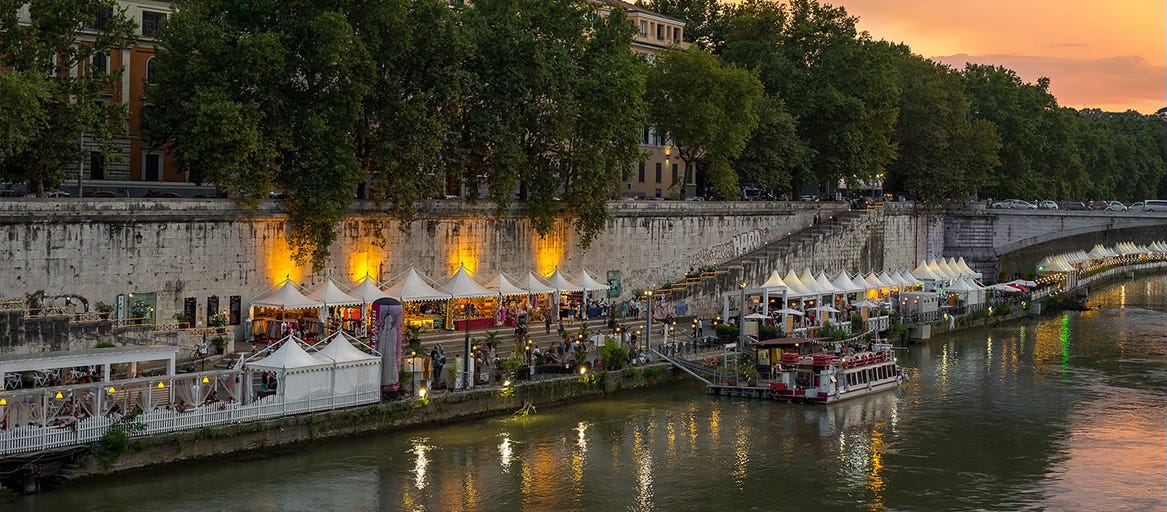
A welcome sign of summer in Rome: the army of workers erecting popup bars and restaurants along the quays of the Tiber. Beginning in early June, tourists and residents alike snake down marble stairs from the embankments for riverside dinners of—well, what’ll it be? Pasta Carbonara sure but also smashburgers and Tex-Mex. Local wines for a song, IPAs on tap, margaritas frozen or not. Live music? You might catch an excellent country western group with an Italian singer who could pass for Loretta Lynn. Who knows? Everybody goes.
Last year I went one steamy night to meet up with a group of American expats, seeking every now and then to speak English. One of the guests was not a fellow expat but a divorced tourist from New York, of middle age and medium paunch. He wasted no time telling the table of strangers, unbidden, that he was a bond trader with an apartment on Park Avenue before yelling at the waiter for the best bottle of local red. Soon arrived a fresh €20 Cesanese from the Castelli Romani south of Rome. Our trader peeled off a €20 note, then handed the surprised young waiter another €20 tip as the rest of us locals looked on, aghast.
Having failed at this late stage in life to master the saxophone, I can at least claim to have learned, generally speaking, to withhold unsolicited advice. But I was already one bottle in for the night (a cracking cold Sicilian Grillo as I recall), and so whatever.
“You shouldn’t do that,” I told him.
“Why not? I can afford it!”
“I’ve no doubt,” I replied, adding that I once worked on Wall Street myself—not mentioning as a lowly proofreader at an investment bank, my first job after college. “But then they come to expect tips like that from Americans. And the rest of us have to live here.”
I was thinking of that night last week when I saw an Instagram post by Keith McNally, the British-born New York restaurateur, owner of Balthazar and other hotspots. He posted a photo of the bill at one of his restaurants for $3209, presumably a large party, under which the guest had added a $5000 tip for the waitress.
Naturally the post got thousands of likes (McNally has 214,000 followers), with commenters singing the generosity of the guest. I get it—I spent years in America working for tips in restaurants. But from my position here in Italy it felt…creepy? The whole thing—the massive dinner bill itself (granted we don’t know how many guests), that obscene ostentatious tip, and finally the praise of the plebians for this blessed gift from the plutocrat. It can be hard to see how different America is from the rest of the world when you live in it. For those of us who don’t, the country’s dystopian restaurant culture opens a larger window into the so-called affordability crisis.
I believe them when American restaurant owners say they barely make a profit. When I worked in restaurants (and wrote cookbooks with chefs) I was aware that a 5 percent margin would be a good year. You can make as much in a money market fund, and no grease.
The question is, why are restaurant economics so different in America than in Europe? Why does everything from a cappuccino to a plate of pasta cost multiples more in America than in Italy, and still with almost no profit?[1]
To be specific: how can a one-person wood-oven pizza Margherita in Bismark, North Dakota[2] cost $20 (including 8 percent tax and 20 percent tip), while the same (better?) pizza in the historic center of Rome costs the equivalent of $10 including 22 percent tax and (let’s say) a one-euro coin tip? Do rents and other operating expenses really cost double in North Dakota than a European capital? As Italians say, c’è puzzo d’imbroglio (it smells fishy).
About those tips: Americans often justify their singular tipping culture by claiming that European waiters[3] are paid a “living wage” instead of relying on customer alms. Let’s break it down. According to friends who own restaurants here, the average salary for a waiter in Rome is €1300 a month. But they get paid for 13 months a year (don’t ask, it’s the weird Italian bonus system). So they effectively make €1400 a month—at today’s exchange rate, the equivalent of about $20,000 a year. For that salary, they are also expected to speak at least English and preferably also French or Spanish.
I guess you could call that a living wage; the Italian poverty threshold for an individual is currently about €750 a month. But that’s a national average; in Rome or Milan, a waiter’s salary means living way out in the peripheries with a long commute, late at night, or living with parents.[4]
So those “living wage” waiters, with bilingual skills, aren’t exactly living high.
To be totally fair, let’s dig a little deeper. Italian waiters also get, by law, cumulative severance pay of one month’s salary per year—meaning when they get fired or even just quit, they get another €1300 for every year they worked. Also included, again by law, is one month paid vacation every year, usually split between August and Christmas. Waiters also make tips—nothing like in America, but perhaps anywhere from €20 to €50 a night, depending on location and level of service.[5] Those working in tourist centers frequented by American bond traders can make even more.
But to bite all the way into the core: Italian waiters, like all Europeans, also get free universal healthcare. Which means neither waiters nor owners have to deal with medical bills and insurance premiums. Yes, taxes are higher under universal healthcare, but it’s a fraction of what Americans pay out of pocket for their unregulated for-profit system.
So how does that affect restaurant economics?
In America, when you buy an overpriced pizza and tip your server 20 percent, what you’re really paying for is somebody’s healthcare. Follow that money up the chain, and your dinner is paying the multi-million-dollar salary of a hospital president[6] or an insurance company CEO. As those jobs basically don’t exist in Italy, the price of your pizza in Rome does not include their salary.
For better or worse and alone among developed nations, America has chosen a casino society. Sometimes you hit the jackpot with a $5000 tip—but sometimes you bet the rent and go busto. Those waiters and baristas with outstretched palms are just one aspect of a society that, like Blanche DuBois in A Streetcar Named Desire, always depends on the kindness of strangers. You can argue for or against that system; sometimes it works out pretty well, and America has led the world in everything from culture to technology, although maybe not much longer. Other countries have chosen the more boring path of reliable social safety nets, and cheap pizza.
So when in Rome, do as we do. Go down to the river, enjoy the food and live music, and know that if you slip and twist your ankle on the marble steps (it can happen after a bottle or three of Cesanese), your ambulance and emergency care will cost you nothing. But do us all a favor and don’t leave a ridiculous tip.
[1] For the record, inflation has also surged in Europe since Covid.
[2] The “Daisy” at Fireflour Pizzeria is a Margherita by another name, and it looks authentic based on Google Maps photos. Current online menu price is $16 before tax and tip.
[3] Italians don’t have “servers,” they are either waiters or waitresses. Mostly waiters.
[4] Multi-generational households are common in Italy—a chief reason Covid was so deadly here, as kids brought it home from school to their vulnerable grandparents.
[5] Tips in Italy are always cash (there is no way to add a tip to a credit card bill) and thus presumably never reported as taxable income.
[6] For more on America’s “nonprofit hospitals” see here.
Oh. my head hurts. Healthcare systems and doc practices were my consulting wheelhouse. All looking to become more efficient, make more money or at least ducking massive malpractice payouts. It seems it will always be thus, here in "the land of the free." Italy seems to have a way of making things work reasonably well, despite its quirks and bureaucratic frustrations. Please raise a toast to your native land while summering on the river. And btw why the missing waitresses?
Salute!
Well as far as I can understand. Italians do not live to work. They enjoy their life and employment policies reflected as well ! I wish our Canadian lifestyle was the same here. ! We have a lot to learn on what is really important in North America. And working with benefits needs to change. I feel that we need better policies here in Canada you get fired and good luck. Unemployment insurance is a joke! And you are at fault should you quit or get fired! You get nothing! As for universal healthcare. It’s not all cracked up to be 🙄. Canadians have long waiting times next to no doctors! Cancelled ultrasounds. Hip replacements etc surgeries can take months. This article was excellent because i follow a lot of food bloggers and the cost of food at a restaurant in Italy is a steal. We pay up to$40 for pizza here. Over $30 for good pasta. ! Always wondered how Italians sustain employment and food costs down!!