
Jump Into the Fire
Cooking for fishermen on an Alpine lake.

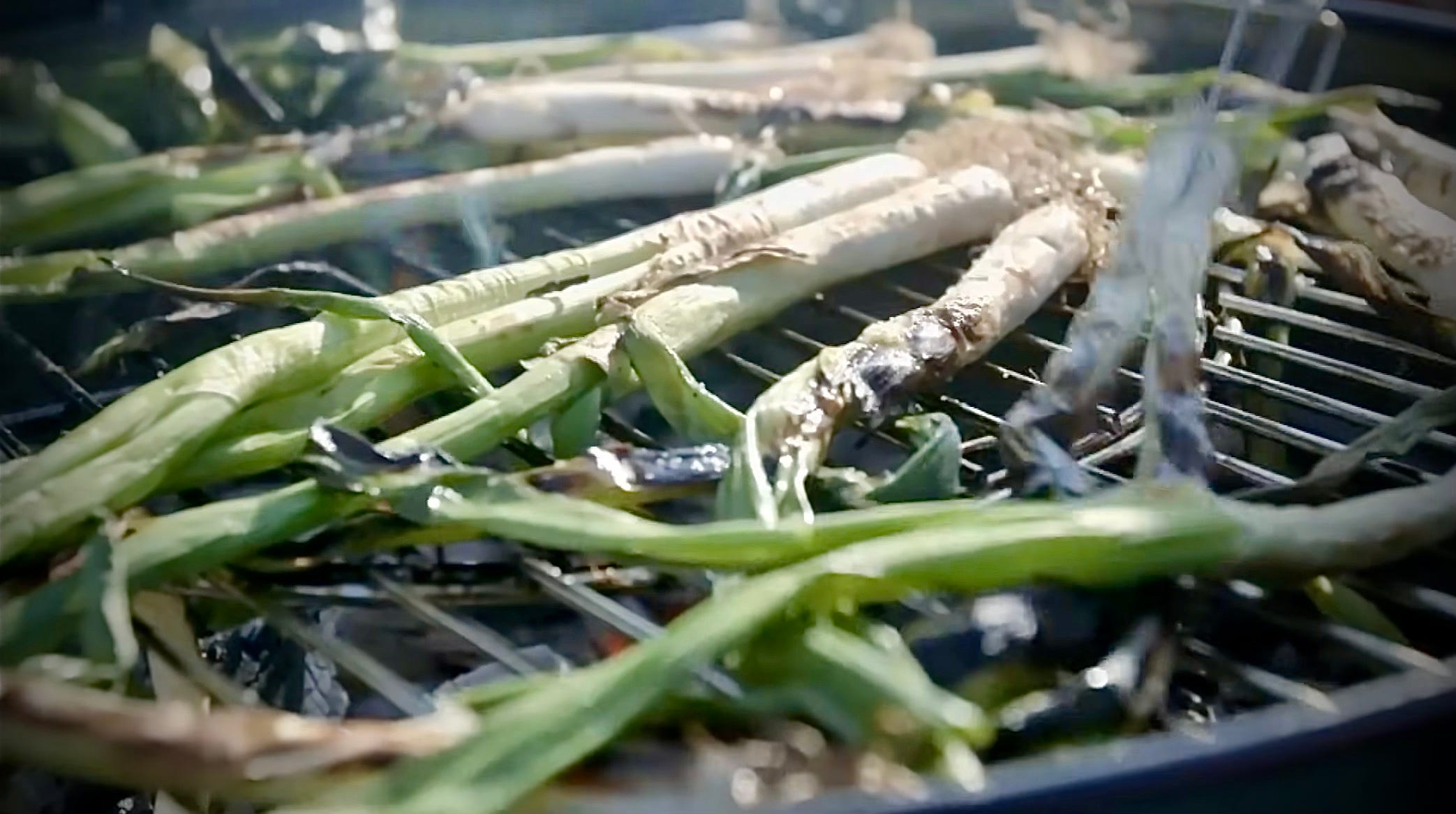
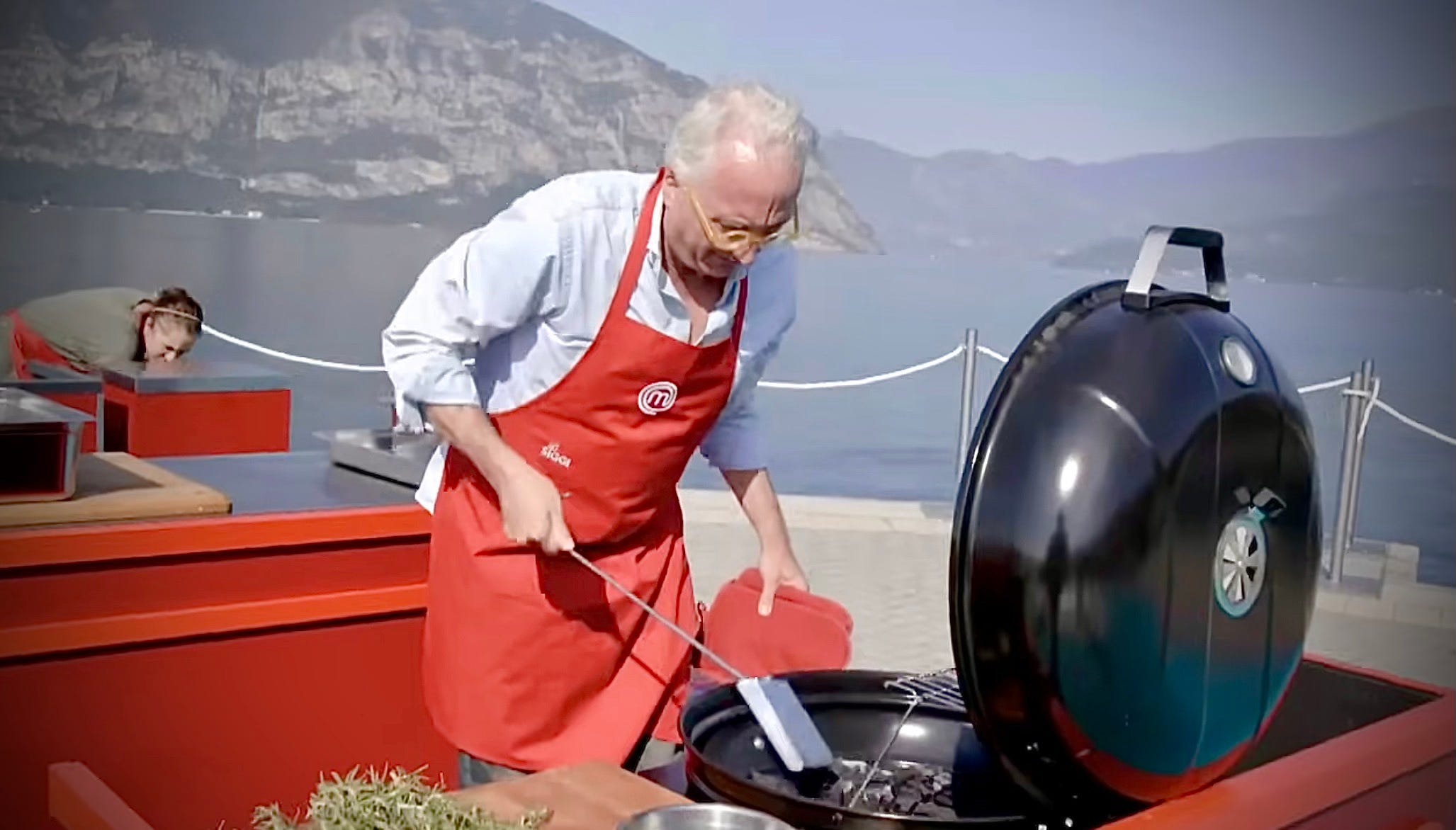
I stood with bandaged hand, sunburned and bleeding sweat, before the fire. It was a charcoal fire in a kettle grill, which I had stoked nearly to the rim and into which I was now feeding long branches of rosemary that sent up curls of flame like solar flares. “The Old Fox is on fire!” yelled Giorgio Locatelli, one of the three Michelin-starred chef-judges of MasterChef Italia.[1] That was my nickname on the show, the Old Fox. I scanned my body to make sure he was speaking metaphorically, having already filleted my left hand while trying to fillet a fish in front of several cameras.
We were on a helipad at the end of a long pier on Lake Iseo, a glacial teardrop two hours east of Milan in the foothills of the Alps. Every season the show moves out of the studio for several episodes to engage in external team challenges, generally in scenic locations around Italy. We had left Milan before dawn in a tour bus. We had no idea where we were going other than what we could see from the tinted windows: east on the A4 autostrada toward Venice. We passed Bergamo as dawn broke, the morning sun sending orange rays across the industrial landscape of Italy’s wealthiest region. The factories appeared cast in bronze as early rush-hour traffic merged onto the highway. Before Brescia we left the highway and navigated several roundabouts with signs pointing the way to Lago Iseo. Soon the road narrowed and threaded into the Alpine foothills, finally delivering us to the day’s scene of torture.
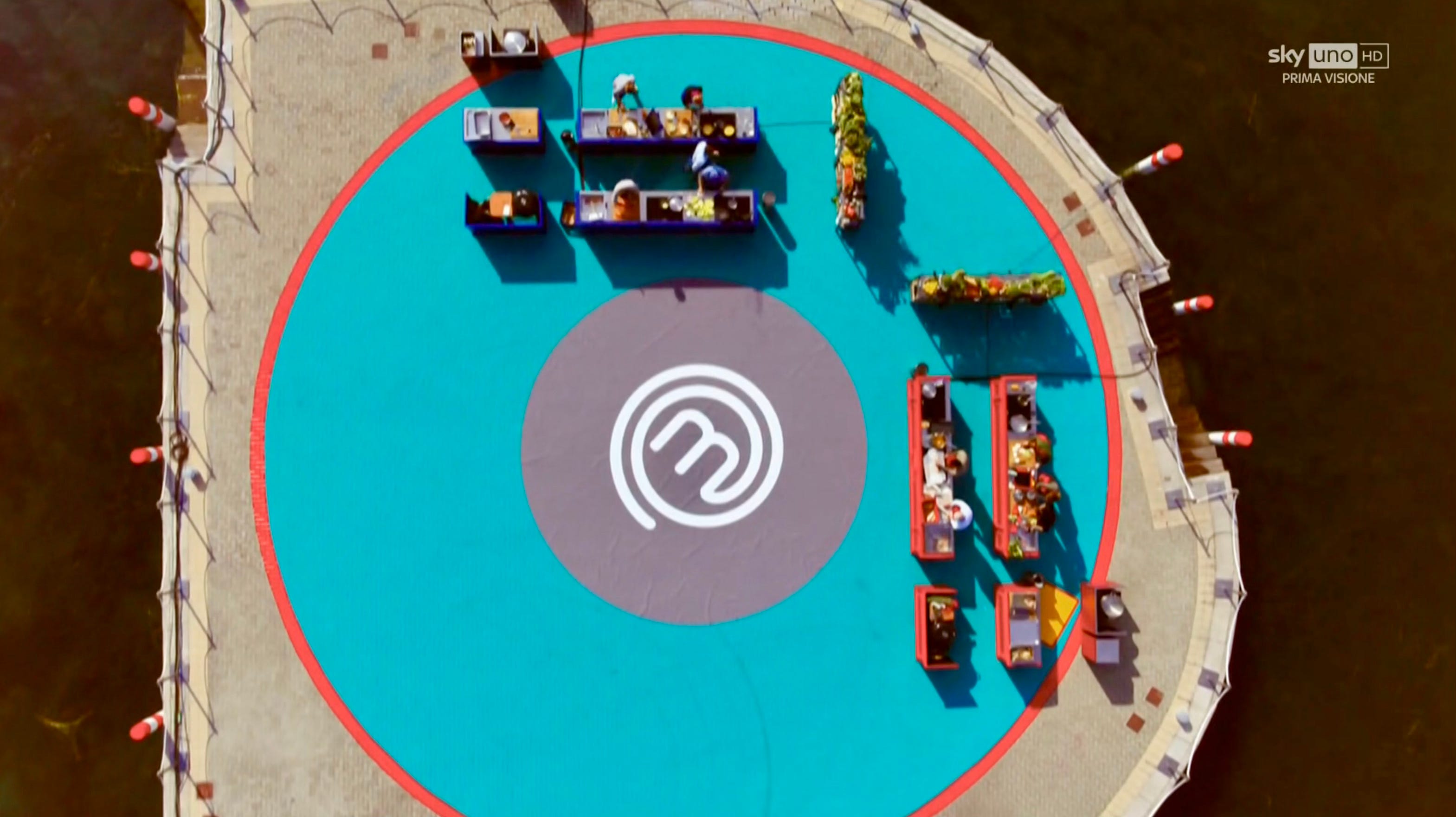
The big H on the helipad had been covered with the MasterChef logo, a lower-case m encircled by coils like an electric stove burner. Behind me, across the water, lay several islands with high castles and Renaissance churches. One island was owned by the Beretta family, they of the handguns. In 2016 the late artist Christo had installed his project Floating Piers between the mainland and two of the islands. Busy stoking the coals of my grill, I was not enjoying the view.
Chef Locatelli started dancing and singing: “Come on baby light my fire!”
But I wasn’t thinking about the Doors song. In my mind was another song from that era, by Harry Nilsson, that summed up my situation during the autumn of 2020: “Jump Into the Fire.”
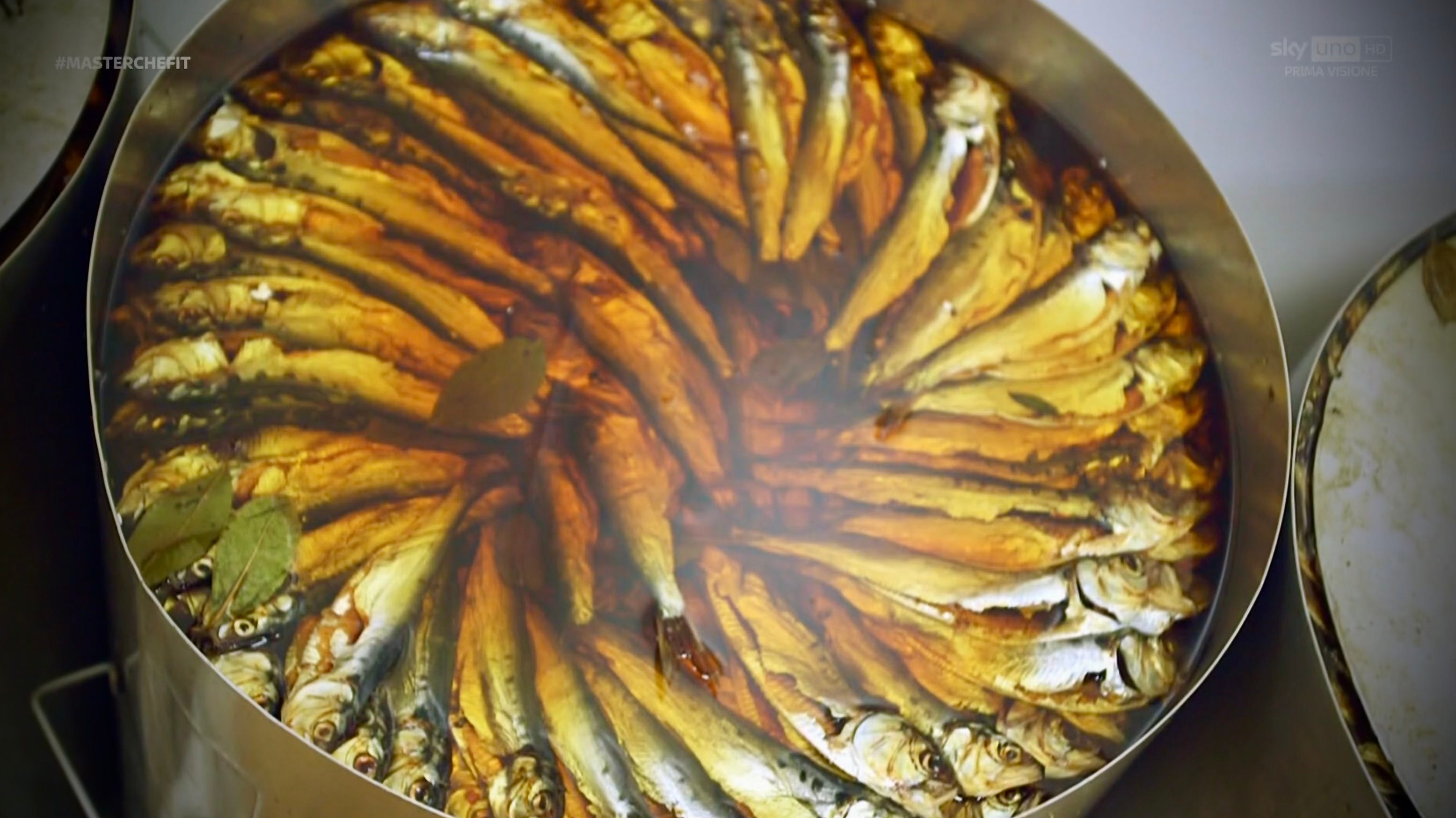
We were down to ten—two teams of five on this external challenge. Our protagonista that day, meaning the principal ingredient we were meant to cook with, was agone, a small freshwater shad caught on the lake at night, in long nets. The fishermen, it was explained to us, salt the catch for two days followed by a month of air drying. Finally they press them into containers and marinate them in olive oil for several months. Of course this is a preservation technique that pre-dates refrigeration; I was familiar with similar dried fish while living in West Africa but also from my years in Maine, where people still harvest alewives every spring as they move up rivers from the sea to their freshwater spawning grounds. The alewives are then dried and smoked. Our challenge was to cook a multi-course meal using the preserved shad and other local ingredients—such as other species of fresh (not preserved) fish from the lake, polenta and so on—for the local fishermen and their families, who would then judge the winning team.
We had two hours.
Scanning the supplies in our mobile pantry as the giant boom-mounted clock ticked, my fellow Team Red members started getting all chef-y. They were younger than I, mostly by decades, with many hoping to parlay their MasterChef appearance into careers as celebrated chefs. I understood that—even though at age 63 it wasn’t my goal. But today I was getting worried about their menu ideas. There was talk of making a shad mousse. I looked out at the ten fishermen and their wives, now gathering at long tables on the other side of the helipad. They reminded me of lobstermen in Maine, with swollen, scarred, callused hands from a life of dragging heavy traps and nets. Their skin was bronze as beeswax, like the Maine fishermen at the bar in Rockland who joked they got their tan at “Steel Beach” meaning on the boat. They were drinking coarse local wine and smoking hand-rolled cigarettes.
I asked my teammates if they had noticed the piles of firewood outside the houses when we drove in, then pointed at the grills next to our cook stations. I said we need to grill the fish, not make a mousse.
My teammates were skeptical. What could an American possibly know about cooking? I plowed on, noting we had 40 preserved fish in our crate, for 20 guests. We could grill half, cook the other half some other way, then decide which to plate.
Someone said, “Then we have no room for error.”
“So don’t fuck it up!”
I scanned the pantry in desperation. There were oranges, cinnamon and cumin. I could give them a Moroccan flavor, different but still grilled the way they understand.
More raised eyebrows. The clock was ticking. Team Blue, on the other side of the helipad, had already finished their huddle and were busy gathering ingredients.
I pressed on. “Ragazzi, tempo stringe!” Guys, time is tight! “What do you say, Jia Bi?”
Jia Bi was our team captain, 53 years old, Shanghai born but raised in Italy; she worked as an interpreter in Apulia at the port of Bari. She was squinting at us in the bright sun. She mopped her brow with the bottom of her red apron. “Max is right,” she said, as the camera crew circled us. She gave everyone their tasks—me on the grill—and said “Andiamo!”
Two hours later we squatted, dripping in the sun (there were no chairs no shade), watching the fishermen and their wives eat. Jia Bi had decided to go with my grilled fish. The diners were arrayed across tables set up on the jetty as camera and sound crews hovered over them; we couldn’t make out their reactions. But finally it came time to vote. Show staff members started gathering their ballots as we were escorted back to the harbor.
Hours passed; we waited. Finally the director summoned us back to the helipad. Locals stared and applauded as we marched through the town. The mobile kitchens had been dismantled, the helipad now bare but for the MasterChef logo. We took our places and gazed around the lake, unsure what was coming. Part of the show’s schtick is that on external challenges, the winning team is announced by some visual gimmick, like red or blue confetti erupting from a cannon or, at night, color-coordinated fireworks.
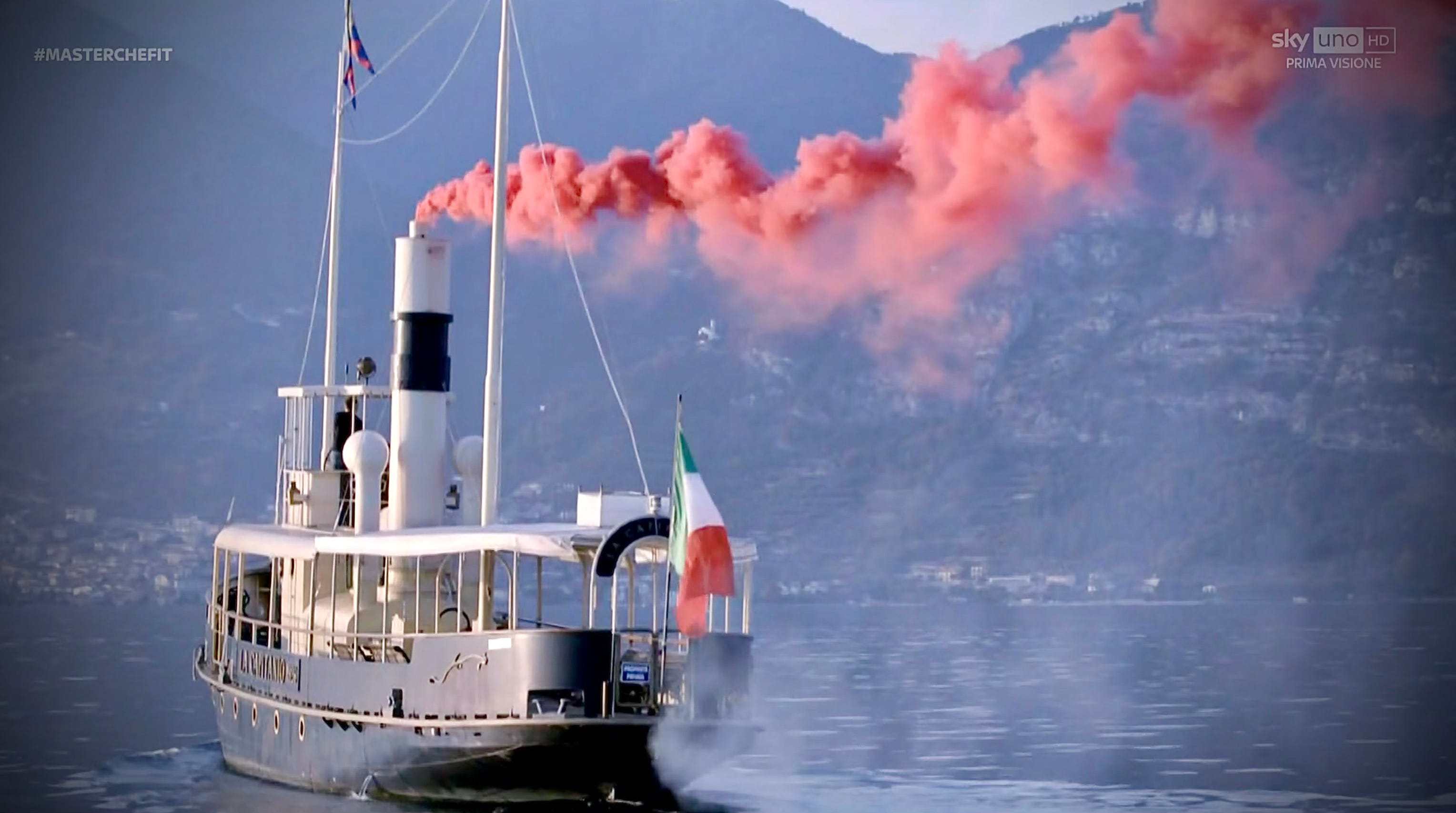
Then we saw it, a large ship rounding a point up the lake, steaming our way. Well, not literally steaming, more dieseling, although when it was built in 1926 the 79-foot steel passenger ship La Capitanio (named after a beatified local nun) was in fact steam powered. But appearances being everything in Italy, the current owners managed to create “steam” from the smokestack using mass quantities of dry ice. We watched as the ship drew slowly near—my team in our red aprons and the other guys in blue, a few yards away. Finally the Capitanio arrived about fifty yards off the helipad.
And then its smokestack erupted in a cloud of red steam. “Abbiamo un papa!” I yelled. We have a pope! That got a laugh, but the point was Team Red won, and we would avoid the elimination round back in the studio the next morning. After several minutes of cheering and high-fiving for the cameras (as Team Blue quietly sobbed in their own corner of the helipad), Chef Locatelli announced that the vote was 13-7 in our favor. Not even close. Antonio, a 22-year old graduate student in chemistry, also on our team, was softly crying. He explained to the judges that today’s challenge reminded him of summers with his dad on their boat in Liguria, fishing for squid at night—just like in Maine.
“The guests singled out Max’s grilled fish as the best plate,” said Locatelli. “Another bullseye for you, Max. They appreciated that it was a treatment very similar to their traditional method, but you took it a step forward.”
It was dark when we finally climbed on the bus for the long drive back to Milan. It had been a good day on the lake. As we collapsed into our leather Pullman seats I was thinking about those fishermen. Every day, out on the water in their flat-bottom boats, they brought home food for their families and the world beyond. Fishing—that was work that meant something. Not like us, spending three months of our precious time on Earth making a reality TV show. Reality. No, reality wasn’t “competitive cooking” on TV with an official paper towel sponsor. It wasn’t even making a floating “art installation” across the lake. Fuck us. Fuck Christo and the fucking ship he came in on, which was possibly La Capitanio. Reality was netting shad from small boats.
As our bus trundled through the narrow, dark streets of Iseo, I looked out at the modest cottages of the fishermen. From every window, in every home, flickered a warm glow. But the fisherfolk were not sitting around the primeval hearth. They were all glued to their TV sets.
Recipe: Grilled whole fish with North African flavors
This is a no-recipe recipe, which is how I made it on Lake Iseo when my team won the challenge, cooking for the fishermen who harvest and cure lake shad. My idea was to grill the whole fish over coals, as they do—but with some vaguely North African flavors to make it just a little different.
“Vague” is the key word—there’s no set portion or ingredients list, whatever you want. But basically I would make a type of Moroccan chermoula sauce, which is a fistful of chopped cilantro, parsley, some toasted and ground cumin seeds, salt, chopped garlic (remove the strong-tasting green shoot), paprika and cayenne pepper to taste. Mix it all up with a glug of olive oil and some lemon or orange juice. Add toasted ground caraway seeds for a more Tunisian flavor. Try coriander. Maybe turmeric.
Take some whole fish like dorade or red snapper, coat them inside and out with the sauce. Add some preserved lemon bits and whole olives inside, but then go easy on the salt. Grill over hot coals, first making sure the grate is super clean and coated with some olive oil. Toss in some rosemary branches and cover for a few minutes to infuse with the smoke. Done. Serve with extra chermoula sauce.
If you’re not big on whole fish you could make this with tuna or swordfish steaks—or make skewers with the pieces.
[1] Technically, Michelin stars are awarded to restaurants, not chefs; their various restaurants have collectively won many.
Max, you have internalized the key to Italian cuisine: simple is best.