
On Riffing Italian Food
Some rules can be broken. Not all.

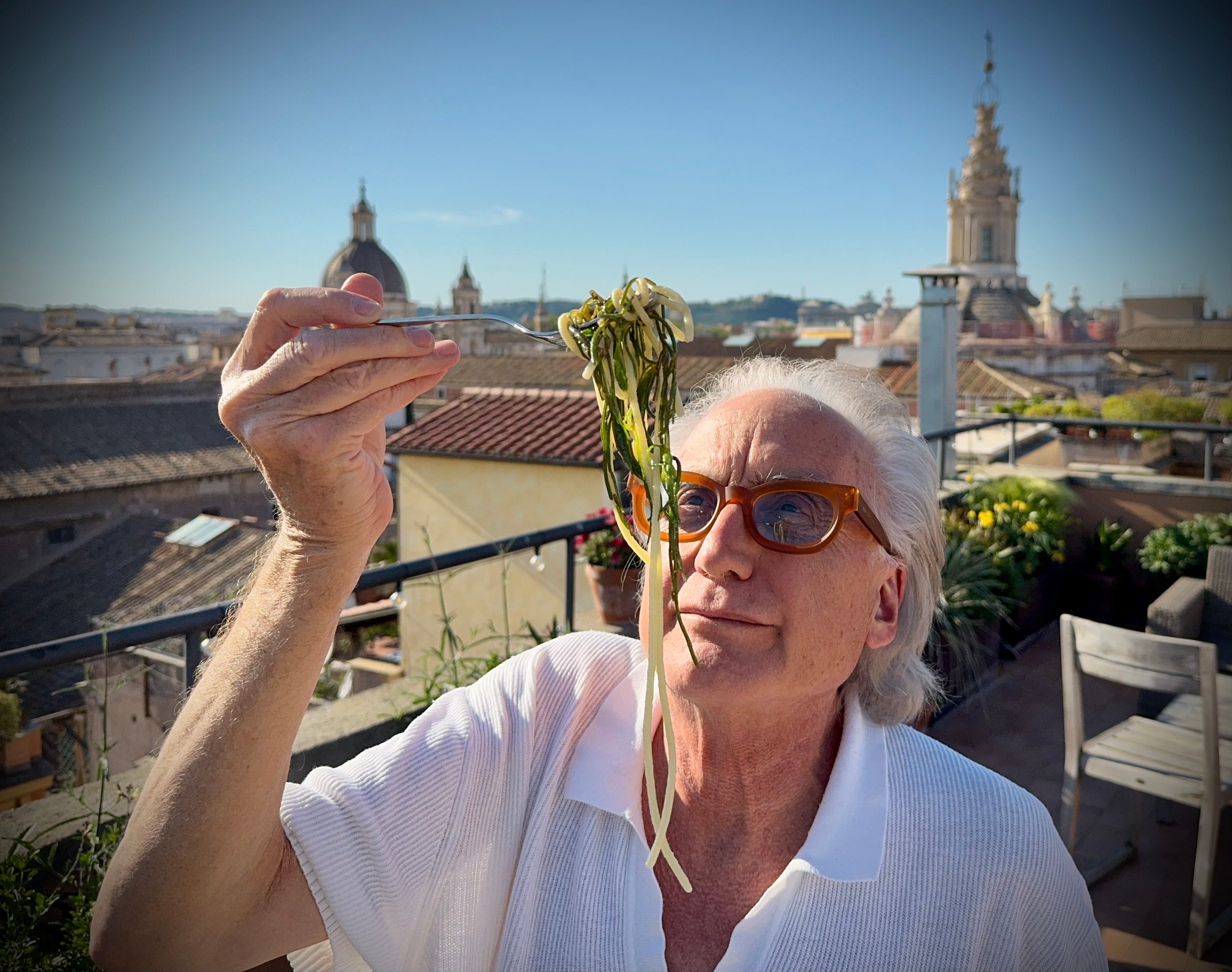
Sleepovers at Alexandra’s offer many comforts, not least of which is waking up in the pink. Everything pink, in several shades, walls and floral curtains, in a style Italians have recently taken to calling molto Barbie. Her south-facing windows wash it all in morning sun, and between the time when you wake and when you finally decide to fight gravity and throw off the (pink) covers, the colors have shifted.
And yet…I would sooner eat raw badger liver than paint the walls of my own apartment pink, that color being so firmly associated with the feminine side—especially in Italy. This “rule” defies logic, frequencies of the color spectrum being objectively gender neutral. But it prompts reconsideration of other accepted cultural norms, here as regarding cuisine.
You will not be shocked to learn that Italians get upset when people mangle their iconic dishes (peas in pasta carbonara, balsamic vinegar on a caprese salad) to the point of parody. My Instagram feed overflows with videos of Italians, often married to foreigners and living abroad, rolling their eyes at what passes for Italian food overseas.
While it’s well known that Italian ingredients like Parmigiano Reggiano and Prosciutto di Parma are “protected” by territorial designations—meaning the names can’t be attached to cheese from Wisconsin or ham from Nebraska—not so many foreigners know that Italy also has official versions of iconic dishes. For example, the correct preparation of Bolognese sauce has been certified by that city’s Chamber of Commerce. Unlike ingredient protections, these “serving suggestions” don’t carry force of law—no Italian grandmothers are in prison for substituting veal over beef in their Bolognese sauce—but they do carry enormous cultural weight, signifying there is a right way (and by implication many wrong ways) to cook something.
Italians consider their cuisine part of their cultural patrimony; your “riff” on it is invalid and possibly criminal, like the tourist who was recently caught carving his initials on the Colosseum. Mind you it’s fine for Italians to experiment with their cuisine, and many Italian chefs these days are doing exactly that. But they own it; you’re just visiting.
I get it—that’s harsh and frankly stupid. Anyone can cook whatever they want. Anyone is free to substitute ingredients, plop meatballs on spaghetti or make carbonara barbecued tofu for all I care. Cooking at all should be encouraged.
And the truth is, what now passes for canonical Italian cuisine is recent. Consider that before 1861 there was no country called Italy, and certainly no “Italian cuisine,” only hyper-local dishes. Well into the 20th century, you could find residents of rural Sicily unaware they were part of something called “Italy.”[1] Even on the mainland, geography discouraged integration. While the supposed difficulty of crossing the Alps is a myth—passes through the range have been known and used for millennia, most famously by Hannibal and his elephants in 218 BC—the real obstacle has always been the rugged Apennine ridge down the spine of Italy, not easily traversed.[2] Until the advent of trains (and their tunnels), residents of the peninsula’s Tyrrhenian coast rarely met those on the Adriatic side.
Not that they would have understood each other. Before “standard” Italian (basically Florentine dialect) became widespread thanks to television, most Italians spoke only their local dialect (and still do at home).[3] These are not “accents” but proper languages that are often not mutually intelligible. Indeed it’s thought that the charming propensity of Italians to speak with their hands was born of necessity—so a man from Modena could chat with his compatriot from Palermo.
But hand gestures could never make the parched mountain landscapes of the south suitable for raising cows, which need the rich grassy meadows of the rain-soaked north. Nor could they make olive trees grow in the shadow of the Matterhorn. This is why southern Italians prefer pork over beef, olive oil over butter, and sheep’s milk cheeses like Pecorino over cow varieties like northern Taleggio. “Italians” weren’t cooking the same thing for dinner.
That all changed in 1929 with the publication of the first modern Italian cookbook. Ada Boni, born into an aristocratic Roman family, dedicated her life to codifying Italian home cooking. Her book, The Talisman of Happiness, became to Italian housewives what The Joy of Cooking was in American households—an encyclopedic reference work.[4] As my friend Katie Parla, a Rome-based American expert on Italian food, has noted, Boni’s passion for promoting a step-by-step guide to pan-Italian cuisine happened to coincide with Mussolini’s vision of a united, orderly Italian culture—in which women, generally pregnant, took their proper place in front of the stove. But the book was not political and continued to be a bestseller in the postwar decades. To Boni we must credit the 20th-century concept of an Italian cuisine.
End of story? I don’t think so. Consider that Boni’s recipe for pasta carbonara would make modern Romans cringe with its ingredient list including butter, onions, white wine and parsley. Either Boni was riffing on Rome, or today’s Romans are riffing on Boni, or everybody’s riffing on each other.
In my own international kitchen, cupboards overflowing with ingredients from China to Turkey and Peru, I riff judiciously on Italian, in ways that (if I may say) improve on the baseline.
The first is not cooking vegetables into mush, which is the Italian way. Some vegetables wear their mushiness proudly, such as cicoria ripassata—chicory boiled, then re-cooked in a pan with olive oil and perhaps a hint of garlic, rather like African American collard greens. Unfortunately, Italians also tend to cook non-leafy vegetables like broccoli, asparagus and Brussels sprouts into mush. If you’re like me, you prefer fresh spring asparagus boiled, broiled or grilled for a few scant minutes, then eaten by hand while still bright green and snappy. That makes you not Italian.
Riffs on vegetables suggest new versions of that classic late-night pantry dish known to Americans as midnight pasta, the most famous being spaghetti aglio e olio, tossed simply with toasted garlic and oil, possibly adding red pepper flakes and parsley. As a young man that was my go-to hangover carb recharge at Angelo’s Civita Farnese, the century-old red-sauce joint on Providence’s Federal Hill. Photos on Google Maps reveal it’s been sadly “renovated” since my day; one hopes the waiters are still old and surly.
The whole idea with midnight pasta (spaghettata di mezzanotte here) is that you use whatever you have on hand, which means riffing is in its genes. For Italians that can mean tossing in some anchovies, or canned tuna, maybe capers.
My own vegetal version is, I suppose, a take on the American dish called pasta primavera, but more restrained. Most primavera recipes, like so much American cuisine, throw in the kitchen sink with every vegetable in the spring harvest; the result tastes like everything and nothing. I make mine with just asparagus and some cured pork like pancetta. If you leave out the pork and its velvety fat, add more olive oil.
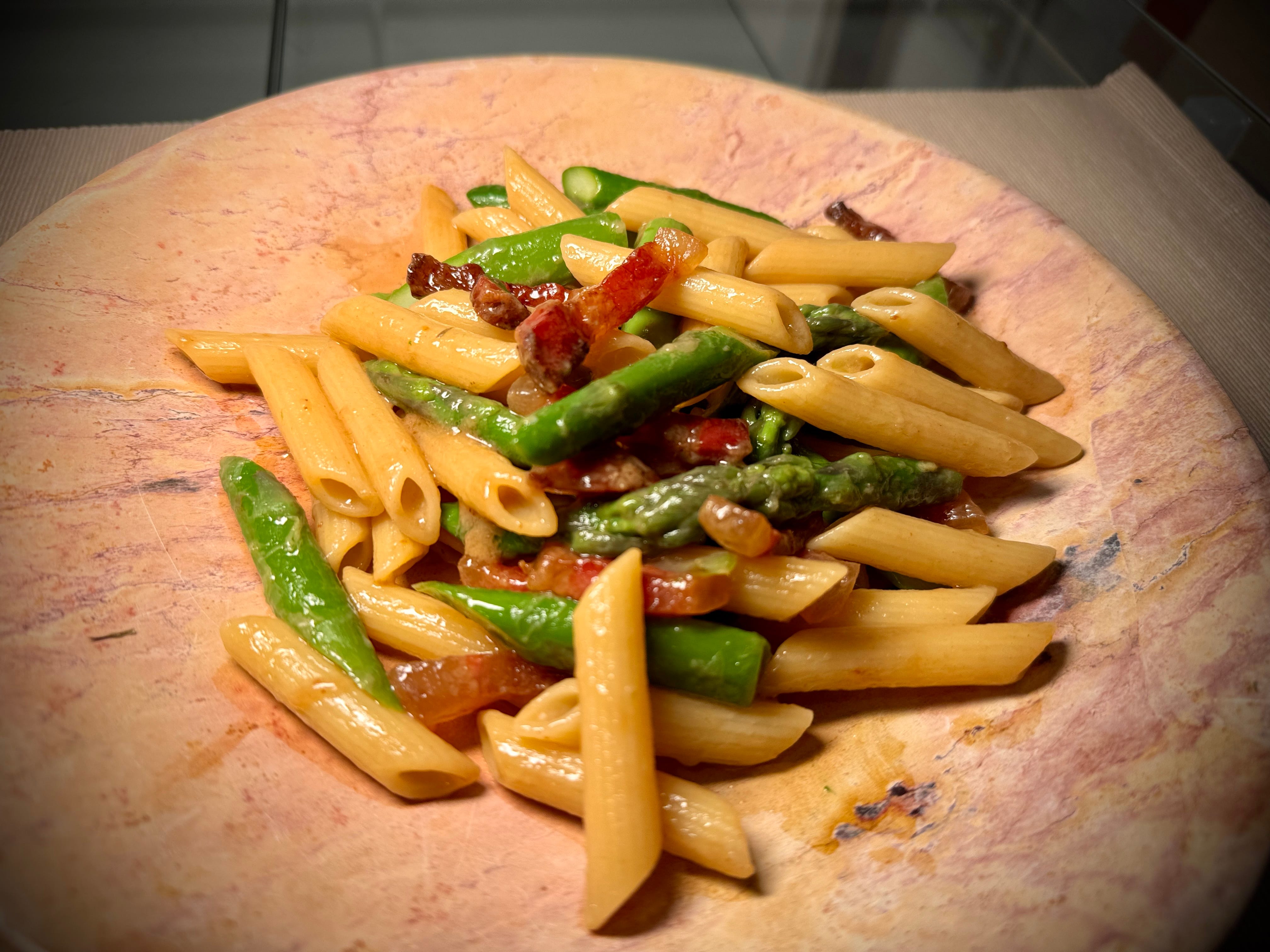
It goes like this:
Parboil asparagus, plunge into ice water to retain color, then cook penne rigate in the same water. Meanwhile, brown some chunks of guanciale or pancetta in a glug of olive oil with a clove of garlic. Remove the garlic; leave all the fat, which is your sauce. Cut the asparagus into diagonal lengths the same size as the penne and keep aside. Use a slotted spoon to transfer the al dente pasta into the pan with the pork, stirring to coat over low heat while adding a bit of pasta water to extend the scant sauce. Grate in some Parmigiano, toss well to integrate, add the asparagus and serve.
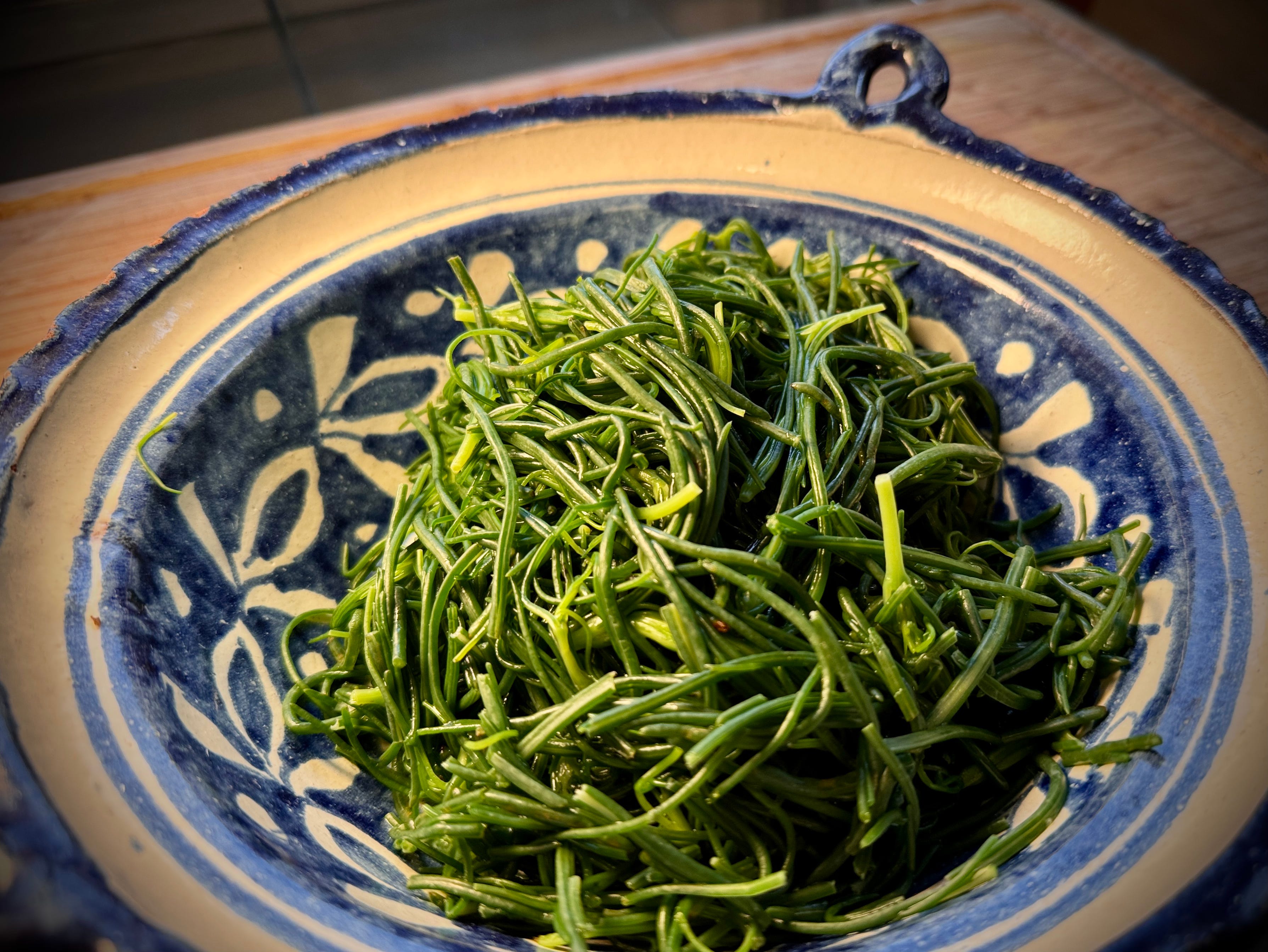
Or another version, courtesy my American friend Bruce Rubin in Orvieto. This one features agretti, also known as barba di frate or monk’s beard, a springtime grassy green with a taste somewhere between asparagus and artichokes. I’m told agretti is now showing up in some American farmer’s markets, so keep a lookout as now is the season. Italians would never mix agretti with pasta—it’s a side dish on its own, dressed with olive oil and lemon—so this is definitely Bruce’s riff. But given agretti’s long stringy shape, it’s a natural paired with spaghetti. Plus it rhymes. Large spaghetti (spaghettoni here) will perfectly match the width of the agretti. Prepare as for asparagus above, but hold the pork, add a generous squeeze of lemon and some red pepper flakes if spice is your thing. A pinch of sugar? Go ahead.
Having moved to Italy at age 63 I can hardly come out against change, which is good at any age. I’m always changing, and changing up Italian food, within limits: hold the peas in carbonara, please. Some rules, even silly ones, carry weight. While it’s possible that Paleolithic bachelors painted their caves pink before layering on those exquisite hunt scenes, I draw the line at my pink Oxford-cloth dress shirt.
[1] The one book to read is The Pursuit of Italy by David Gilmour.
[2] During World War II, German defenses in the Apennines delayed by nearly a year the Allied push to liberate Italy, at huge cost of lives.
[3] So foreign is the concept of “standard” Italian that they gave it an English loan word: standardizzato.
[4] Pointedly, both books came out in the years between the wars, and both reference joy and happiness in their titles.
love this Max! I just sent you a dm request here on Substack in the “requests” tab of the “chat” section -Chef Harrison :)
Max, I love your posts. They cover food, style history and so much more. I just subscribed.
Living in Rome, you might feel untouched by what’s going on here in the US. Knowing you, probably not.
it’s time to speak up.