
Sand and Clams
Italy’s August beach culture, deconstructed

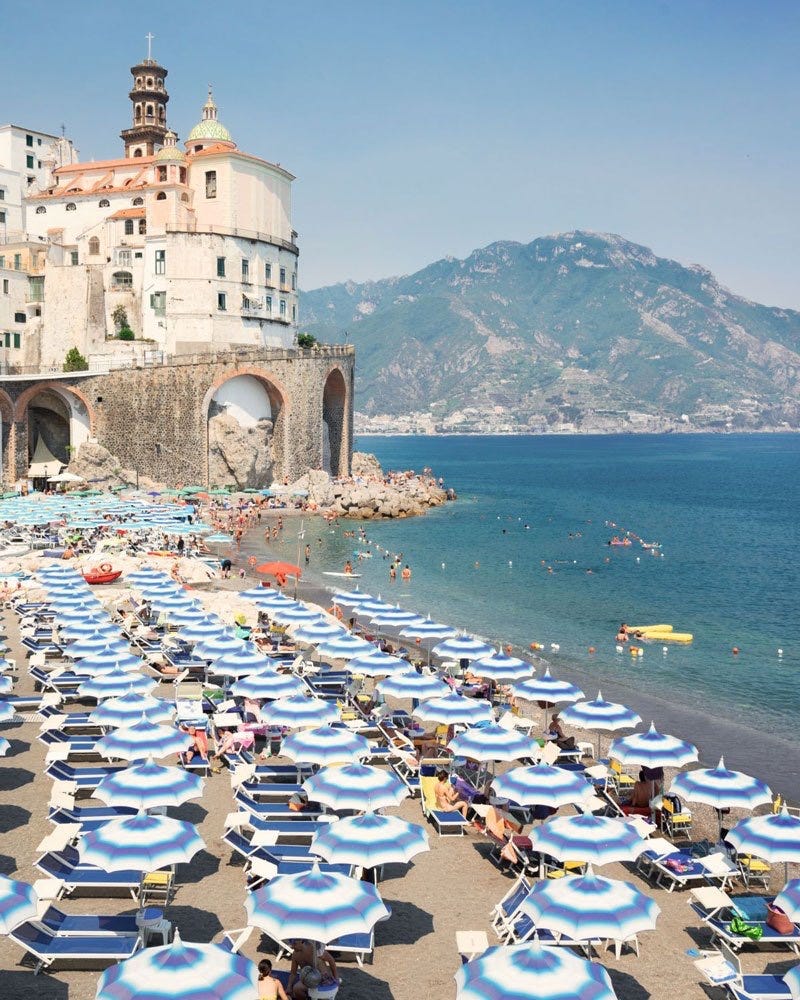
I heard the yelling from the changing rooms, some 30 feet behind where I was reading under my umbrella. This was not normal Italian yelling-as-a-form-of-greeting. A crowd gathered. Some guy in his 40s, pacing in front of the changing rooms and screaming. He stopped every now and then to bang on a door; the object of his wrath had locked himself inside.
“You stay away from my daughter you fucking son of a fucking whore! I’ll kill you!”
Parents were shunting their children away. At the snack kiosk, the elderly barista was pretending not to hear. After half an hour of this tirade, some other guys managed to calm him down and lead him away, giving the young suitor enough time to slink out of the changing room and escape along the seafront boulevard known in every beach town as the lungomare (literally “along the sea”). Another vacationer filled me in: the teenager had been dating the daughter for a couple summers, but things went crooked, they fell out, he broke her heart. Dad wanted Lothario on a one-way bus back to Rome.
Which was about two hours. We were south of the city, still in Lazio region, at San Felice Circeo—a medieval town on a promontory overlooking the sea, backed by even higher Mount Circeo. The place has been settled since pre-history—nine Neanderthal remains have been discovered nearby—and was an ancient Greek outpost before Roman times. Its vantage above the sea, along with a port down below, made it a natural defensive position that was often contested. Many Greek and Roman ruins are scattered about the area, which was a playground for vacationing emperors who built villas there. Like many Italian hilltop towns, a modern city has sprawled below. But the compact old town on the heights, with its stone passageways, breathtaking sea views and stylish boutiques, is now a vacation destination for Romans. A noted summer resident was the postwar film star Anna Magnani;[1] the local cinema is named for her, and she is buried in the cemetery. Mount Circeo itself is a national park with strenuous hiking trails to the 1,775-foot summit; there is a lighthouse on a point to rival any in Maine.
A steep descent from the town takes you to long beaches of powdery sand and azure water, interrupted by several tidy ports that are convenient should you happen to arrive by yacht. I had arrived by bus, renting a place in the upper village for a week in late August. And so there I was, with a friend from Rome, at the beach club Baia Felix.
* * *
Italy has 4,900 miles of coastline, all of it public. But for a few grandfathered exceptions, there are no billionaire homes on private beaches like in Malibu or East Hampton, although wealthy Italians have sumptuous villas across the road from the sea, or perched on rocky promontories above it. The beaches are for the people, who flock to them every August and indulge in their twin passions of sand and clams—often on the same plate, as it can be difficult to purge all the granules out of every stubborn bivalve.
Italian beach culture and its rituals can mystify Americans. Start with the private beach clubs, which occupy most of the country’s recreational shore—a nearly unbroken seascape of striped umbrellas fluttering in perfect synchrony over folding loungers, from the French border to the toe of Calabria, around Sicily and Sardinia, back up the Adriatic coast all the way to the Venetian lagoon. Wait, didn’t I just say all of Italy’s coastline is public? It is. Sort of.
All those private clubs are indeed on public land. The right to plant umbrellas, loungers, restaurants, bars, hotels, changing rooms and playgrounds (along with paid parking lots) is a concession granted by local governments; indeed it’s a major source of income for beach towns. In theory these concessions are put out to open bidding when the contracts expire every few years. In practice, the same companies and families have been managing the same beach clubs for generations—a situation that has attracted the attention of the EU’s anti-corruption watchdogs,[2] as admission fees have skyrocketed post-Covid. The price to rent two loungers and an umbrella for the day varies according to location and season, but in August can easily cost more than €100. For larger families of limited means, a week at the shore flirts with bankruptcy.
Fortunately, Italians have options. Every seaside town, by law, must reserve a portion of its beach for public use at no charge. These free beaches have no amenities; you bring your own umbrellas and folding chairs, or just spread out a towel on the sand—like beaches in America. Some of these spiagge libere are among the most beautiful in the world, occupying remote coves accessed by steep trails, with emerald water so clear you can see the bottom 50 feet below. Others are simply a cordoned area alongside the private beach clubs.
You might think there’s a class issue at play here—you can’t afford to rent a lounger and umbrella?—until you become aware of a certain reverse snobbery. I have a friend who owns a casale or farmhouse on Sardinia, high up on Capo Ceraso with vistas across the port of Olbia and the sea beyond. The house, once belonging to his grandfather and now shared during the summer by various siblings and cousins, is capacious but unrenovated; it will never be featured in The New York Times. There is no WiFi although depending on your carrier, the data coverage works well enough on the terrace, sitting around the massive outdoor dining table. Someone is always cooking something in the large kitchen, day and night, if not feeding wood (stacked in the stone barn) onto the barbecue. When you feel like swimming, you pile into your rented cars with your towels and trundle down a rutted gravel road to the remote free beach. In that context the beach club patrons, squeezed into their tight rows of umbrellas and dodging soccer balls, are mere lumpenprols, if not canned anchovies.
And yet that’s what most Italians do, every summer. The entire country goes on vacation in August—unlike more rational Europeans like the Germans, who alternate vacation periods from July to September, according to city. (So friends and family in Hamburg can vacation together while the citizens of Stuttgart stay on the job and in school.) Time was when Italians took off all August. These days, most people vacation for two weeks—either the first or second half of the month, divided by the Ferragosto holiday on August 15. And there is no better place to observe the Italian character than a beach club in August.
Ever since Romulus killed his brother and founded Rome, Italians have been a communal people. The Renaissance city-states like Florence and Siena were called comuni. Today, when you need to register a change of address you go not to the post office but to the local comune or town hall. In France they call the town hall hôtel de ville, which at least aspires to elegance, even if the sour-faced bureaucrats inside do not summon memories of evenings at the Ritz. But Italians are happy calling a spade a spade—the comune is where the community gets things done, or at least passes the paperwork around.
In that same communal spirit, Italians mostly live cheek-by-jowl on top of each other, in apartments or condominiums. There are very few single-family homes, even in the suburbs. Italians do not share the American obsession with a detached house and a lawn. Even doctors and lawyers live in apartment buildings, which can be luxe: balconies, roof terraces, swimming pools, barbecue stations, underground parking and central gardens immaculately maintained by professional landscapers. Italians ask: Why would you want to push around a lawnmower on Saturday afternoon when you could be sitting on your terrace enjoying a grilled Tuscan steak and a glass of wine?
Beyond freedom from maintenance chores, Italians simply like living next to each other. They chat with their neighbors in the hallways and the elevators, at the dog run, across their balconies. Okay, sometimes it’s more yelling than chatting. They always know what their neighbors are cooking for dinner because they can smell it, and it smells good. Residents of New York City will understand this social dynamic, even if most Americans regard multi-family housing as undesirable and possibly dangerous—something for other people, preferably people in a neighboring town with less strict zoning laws. But for Italians, it’s normal.
The beach clubs are an extension of that communal existence, with sand and clams. And you, outsider, can observe it all from the comfort of your own lounger.
* * *
After several days at the Baia Felix beach club I realized that the same families were staying in the same loungers, under the same umbrellas (which are fixed in the sand) in the same rows, every day. In fact the attendants or bagnini kindly reserved the same position for my friend and me every day, in the fourth row. (The rows closer to the water, which cost more, had been sold out for the month.) It goes like this: the families arrive around ten, change into swimsuits, lay towels (you bring your own) over the loungers, greet the neighbors, arrange their sunscreen and cigarettes on the little round table through which passes the umbrella pole, blow up the inflatable dolphins and mermaids for the kids or grandkids, and take their first dip. Sufficiently cooled off, they emerge from the surf, rinse off the saltwater under the beach shower, and head to the bar for a coffee and a Pinguino (“penguin”), the Italian version of chocolate-coated ice cream on a stick. Then time to sunbathe with a book until the heat overpowers, then back into the water. This rhythm is repeated throughout the day, interrupted only by lunch (generally at 1:30) and possibly a card game with lots of yelling.
After a few days observing all these rituals and interactions, I started to imagine this is what it must have been like at those Borscht Belt resorts in the Catskill Mountains during the ‘50s and ‘60s. The same (mostly Jewish) families would go to the same resorts every summer, where they would commingle with the same other families and employees, inevitably leading to romance, illicit and otherwise, often followed by heartbreak and conflict. Indeed, that scene at the changing rooms between the angry dad and his daughter’s suitor felt pulled from the plot of Dirty Dancing. Significantly, the New York City summer denizens of “the Jewish Alps” also lived, like Italians, in crowded apartment buildings. And food was also central to their culture.
Doubtless those New York vacationers, like Italians, had to save up for their summer frolic—those buffet spreads of matzo ball soup, roast chicken in paprika gravy, pickled herring, strudel and (of course) borscht may have been economical (as in all-you-can-eat), but the room and board weren’t free. Nor can you dine cheaply at the Italian beach clubs, where the lunch menus, naturally, lean heavily toward pricey seafood. Italians, however, have a way to save money at the clubs: paying for access but bringing their own lunch.[3] Those picnic spreads can be lavish (even competitive) and include baked pastas, meatballs in tomato sauce, marinated peaches, platters of sweet pastries and, naturally, copious quantities of wine. The clubs are generally not allowed to prohibit guests from hauling in their own potlucks, although some beaches are designated plastic-free while others don’t allow glass containers on the sand. Also, massive coolers that block the narrow passageways between umbrella rows are discouraged.
But sooner or later, most Italians book lunch at the club’s restaurant, which is usually outdoors under a vast canopy or rattan roof. The antipasto course might be some type of crudo—often raw tuna—or marinated fresh anchovies, followed by a platter of fried seafood including squid, shrimp, red mullet and baby hake.[4] There might be an octopus salad. Some establishments lean toward inventive: at the venerable beach hotel Le Dune in Sabaudia, just around the mountain from San Felice Circeo, I once enjoyed beets with watermelon sauce, and redfish “barbecue” with a yogurt mint sauce and white celery grown in nearby Sperlonga, the ancient borgo rising from a cliff above the sea, buildings as bleached white as their famous celery.
* * *
Back at the Baia Felix beach club after lunch, the angry dad lost it again. This time the object of his rage was his own wife. He kicked her lounger so hard that she tumbled over and cut her head on the metal frame. An ambulance came. He disappeared down the lungomare, police in pursuit. Some things never change, said other beachgoers, shaking their heads. They knew this guy well. Every August, they were neighbors in the sand.
[1] Magnani was the first non-native English speaking woman to win Best Actress Oscar, for her role in The Rose Tattoo opposite Burt Lancaster in 1956.
[2] EU member countries are supposed to abide by transparent public bidding standards.
[3] Beach clubs typically close around 7 pm, but on weekends some go into the night with live or DJ music and dancing.
[4] An American culinary tradition I miss is tartar sauce with fried fish; it’s never going to happen in Italy, where you will get only lemons.