
Slices of Life
In Rome, thick slang and thin cuisine

“Don’t say that! It’s not Italian!”
Alexandra correcting me.
Live in Rome long enough and you start picking up the local dialect, known as romanesco or, for Romans who disapprove meaning those who live in Roma Nord and root for Lazio not AS Roma like those Ultra hooligans in Roma Sud, romanaccio which means “ugly Roman dialect.” 1
What I said was vado a fette. I’ll walk, in Roman slang. Fette meaning “slices.”
No Italians outside of Rome walk in slices. It’s one of the least offensive of my pet Roman phrases—by offensive I don’t mean vulgar although I do those. I mean just…“incorrect” to certain Italian ears. Which doesn't make it bad; like American vernacular (Huck Finn, Mississippi blues), Roman dialect has a rich cultural history in poems, plays, novels and music. Context is everything.
Which is hard to pick up when you learn a language as an adult. Lacking an Italian father who would stop the car and slap me if I spoke ugly Roman slang, I have no Pavlovian aversion to the dialect. I mean, I get that it’s street jive, but it’s hard to know when a phrase crosses the line from hepcat to cretin. It helps that I’m obviously foreign so my slang comes off as cute. But when Alexandra says “Don’t say that in front of my mother,” I pay attention.

Where was I? Walking in slices.
Slices suggest layers, which Rome has in abundance as you walk around in…slices. Some are figurative—17th-century Baroque churches next to 2nd-century (BCE) Republican temples. Other layers are literal—the lasagna of human history that bakes underfoot here.
Among European capitals, Rome stands alone in the inadequacy of its underground metro system, thanks to the challenge of excavating through millennial layers of Western culture. The visitor to Rome will notice that the ancient monuments are generally well below the modern street level, as human activity and all its incumbent shit, literal and otherwise, builds in layers over time. Stick a shovel in the ground anywhere in Rome, and you’ll likely slice into something ancient.
The actual train tunnels are not a problem, being drilled with a horizontal boring machine at a level far below any human habitation. The issue is the stations and ventilation ducts and long escalators, which of course must descend through all those slices of Roman history. Shit happens, some of it priceless shit, and then work stops as the archeologists descend in white Tyvek.
Take the new C-line station under Piazza Venezia near me, which has been under construction since roughly the Punic Wars; with any luck the grandchildren of my soon-to-arrive granddaughter may finally pass through its digital turnstiles. In 2009 work was halted with the discovery, deep within, of Hadrian’s atheneum or school. Construction now continues, snarling traffic in the center of town. The station, should it ever open, will include a museum of the excavations.
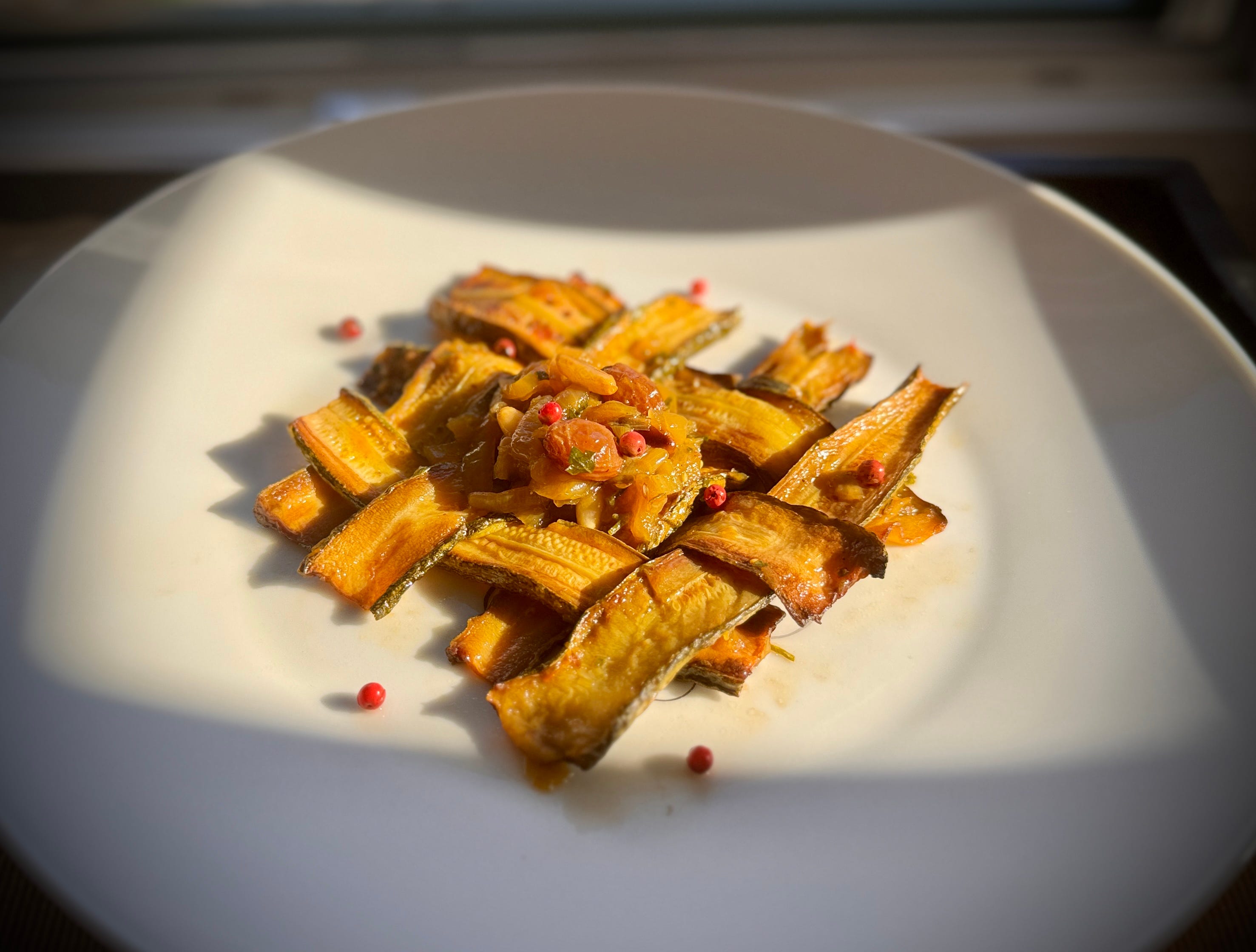
Only Romans walk in slices but all Italians cook in them. Summer might mean thinly sliced grilled zucchini, curled onto skewers. Or you could fry them in a bit of olive oil, then marinate in saor, Venetian dialect for “flavor” and the word for that city’s classic sweet-sour condiment. I recently wrote a detailed saor recipe for my son and daughter-in-law’s Patreon feed, but in essence: slowly caramelize a mess of onions in a wide pan, then add a glass or so of white wine vinegar, a handful of toasted pine nuts and the same of golden raisins which you’ve soaked in wine or grappa until plump. Maybe a spoonful of sugar? Red peppercorns are nice. Saffron if you’re feeling yellow. Serve room temp.
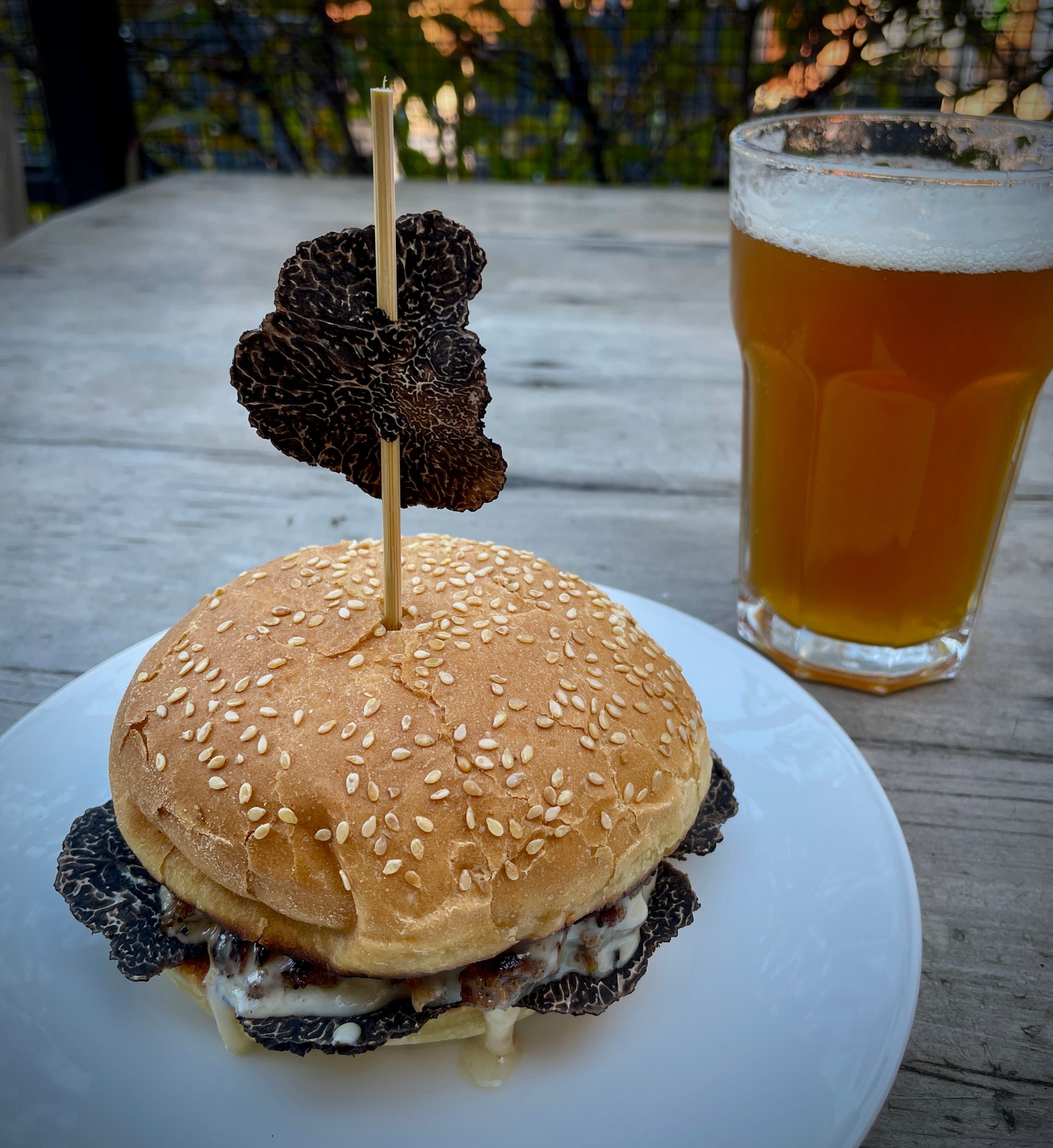
More slices: summer black truffles have arrived at the farmer’s market; there’s even a special tool for slicing them paper-thin, it’s called, naturally, a taglia tartufo. The summer truffles are not as aromatic and flavorful as the winter ones and thus cheaper, lending them to a high-low mash-up or rather smash-up, meaning smashburgers with sliced truffles. Cheese? Per forza!
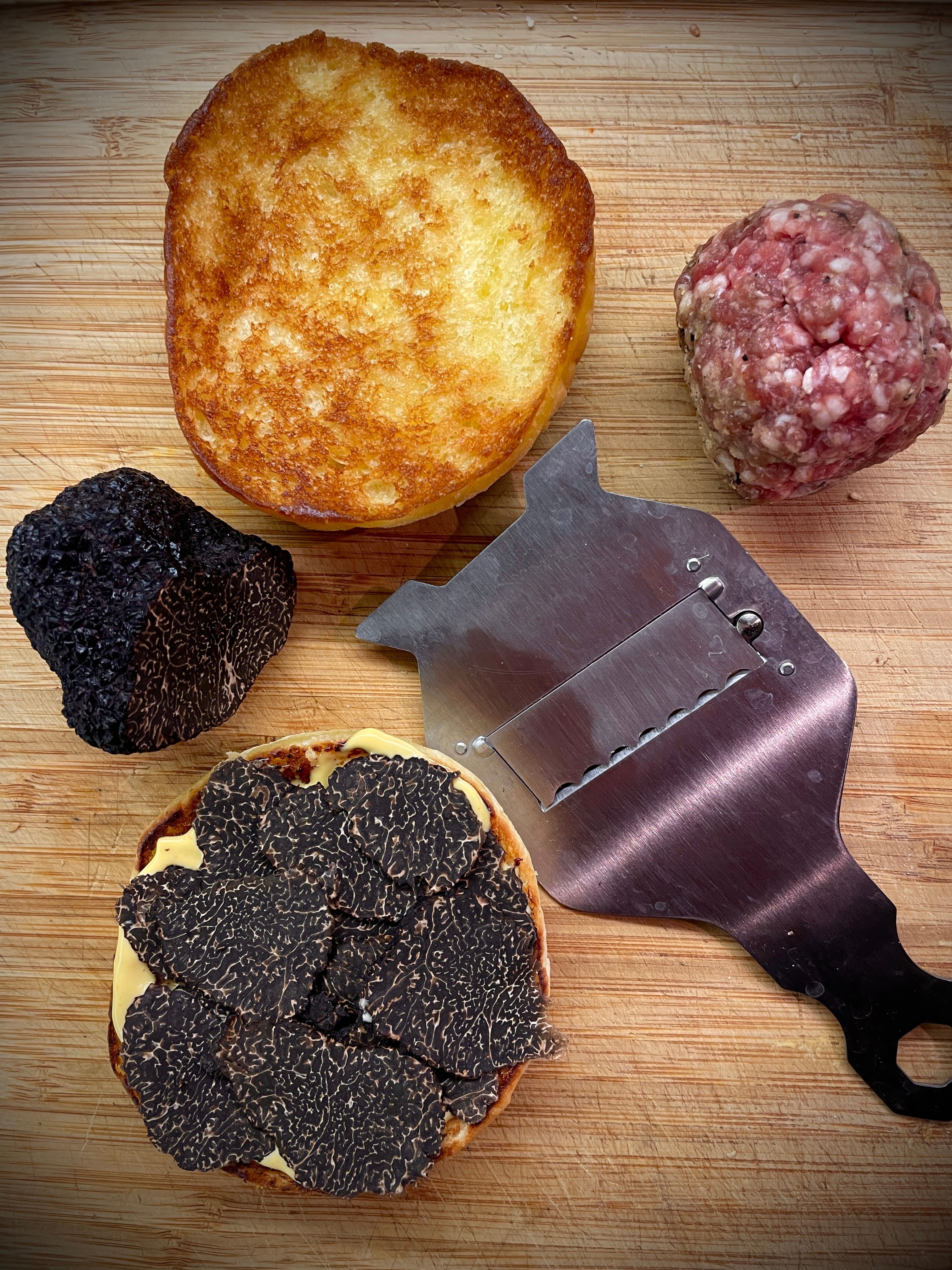
Or a sort of cheese? No treatise on slices (did I just write that?) could neglect American cheese, those easy-to-melt squares individually wrapped in plastic, believe it or not also popular in Italy on cheeseburgers. Here they’re called sottilette, the trademarked name of Mondelez International (ex-Kraft), from sottile which means thin. They are always white, which in America seem reserved for Philly cheese steak sandwiches; I’ve never seen the annatto-dyed yellow slices here.
I’ve also never met an Italian over the age of nine who admits to eating Kraft cheese slices, which are not technically cheese and not technically slices, they are molded into that shape. But as you see them in every Italian supermarket, Italians must consume them, albeit clandestinely. It could be that their status as “not cheese” works in their favor, sparing Italians the indignity of craving cheese that is not Italian. Nope, not cheese. All good. It’s all in how you slice it.
[1] The Italian suffix -accio (-accia fem.) modifies a noun to make it mean something ugly. If you had a bad day you had a giornataccia. It can be used ironically, but romanaccio is considered offensive to many Romans.