
Some (Italians) Like It Hot
Easter in Calabria, the spicy spiritual toe of Italy

If Romans are fond of saying they don’t live in Europe (which starts in Milan), Calabrians would be justified in claiming they don’t live in Italy. Yes, every region of a country only unified since the 1860s lays claim to its “otherness.” But Calabria stands apart, and not just for its Arabic-sounding dialect. Another chief Calabrian distinction is culinary: here on the toe of the Italian boot, the only region of Italy surrounded by both the Tyrrhenian and Ionian Seas, live the only Italians who eat seriously spicy food. Here everything is hot—sometimes even sweets, such as a local honey flavored with ‘nduja, the spreadable cured spicy pork that is now enjoying trendy food status around the world.
Another thing about Calabria, related to food, is the Church. Modern Italy is largely secular; only 19 percent of the population report weekly church attendance—less than half that of the U.S.[1] But national figures belie significant regional differences, and the farther south you go, the greater role religion plays in daily life. The most important religious rituals, and the biggest meals, happen during Holy Week.
* * *
I arrived by train on the afternoon of Good Friday. The station at Pizzo was packed with Easter travelers—mostly younger Calabrians who had moved north in search of work but always come home for Pasqua. My son Harper and his Calabrian wife Eva were running late due to a road closure, so I ambled out to the far train platform and the view across the Tyrrhenian Sea. Far on the horizon, the volcanic island of Stromboli was smoking. Finally they arrived and we set out over the hairpin road into the mountains behind the sea, stopping to let herds of sheep cross, that leads to Dasà.
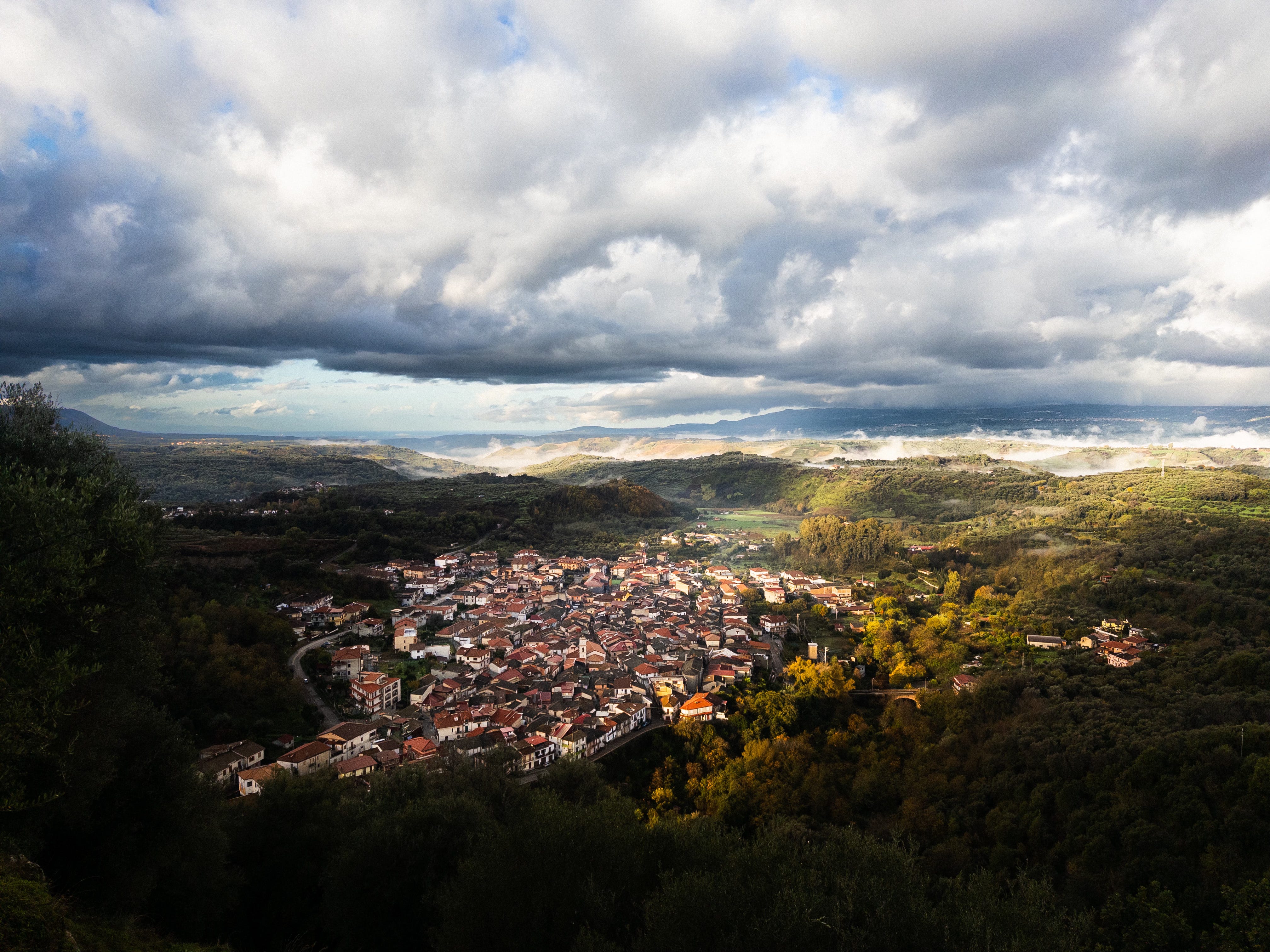
Their village is regionally famous for its annual Easter procession called the ‘Ncrinata. The word in local dialect means “encounter,” and versions of this ritual exist throughout southern Italy and Spain. It’s a re-creation, with life-size wooden statues hoisted on shoulders, of the mythical meeting on Easter morning between Mary, St. John the Apostle and the risen Jesus. The story is not actually in the Bible, and its origins are unclear, but here’s how it goes in Dasà:
Despondent Mary, mourning the death of her son on Sunday morning, encounters John who tells her that the crucified prophet has risen from the dead. She has doubts; he leaves and then returns, at full sprint, with the resplendent son of God tagging along; joy ensues as Mary casts off her black mourning veil and a brass marching band strikes up, followed by fireworks. Spectators, many in tears, rush forward to touch the hem of Mary’s dress.
Dasà’s public staging of the ‘Ncrinata, a tradition for hundreds of years, takes place on the Tuesday after Easter because two nearby towns host their own ‘Ncrinatas on Easter Sunday and Monday. Around noon on Tuesday, hundreds of people pour into the town’s narrow streets and squares, jostling for position. Balconies along the route sag under the weight of spectators. Preparations for the big event take weeks. A key logistical detail is the proper timing of the moment when Mary’s black veil, attached with small threads to her head, is torn off by a string. To foreign observers it can seem a bit like a marionette show or, less charitably, Barbie doll play. Except the dolls are monumental solid wooden sculptures.
The most sacred statue is that of Mary, the patron saint of Dasà where she is known as Santa Maria della Consolazione or St. Mary the Comforter. Her cult is such that every home in town has several framed pictures of the statue. She’s on a bumper sticker. There’s a mural. On the day of the procession, banners with her image unfurl from balconies. The statue dates from at least the 15th century; its home on non-procession days is the oldest church in town, which was built a few years before Columbus discovered America.[2] At one point Italy’s cultural authorities offered to pay for a replica of the statue, hoping the citizens might avoid parading the relic through town, on shoulders and over cobblestone roads. The offer was ignored.
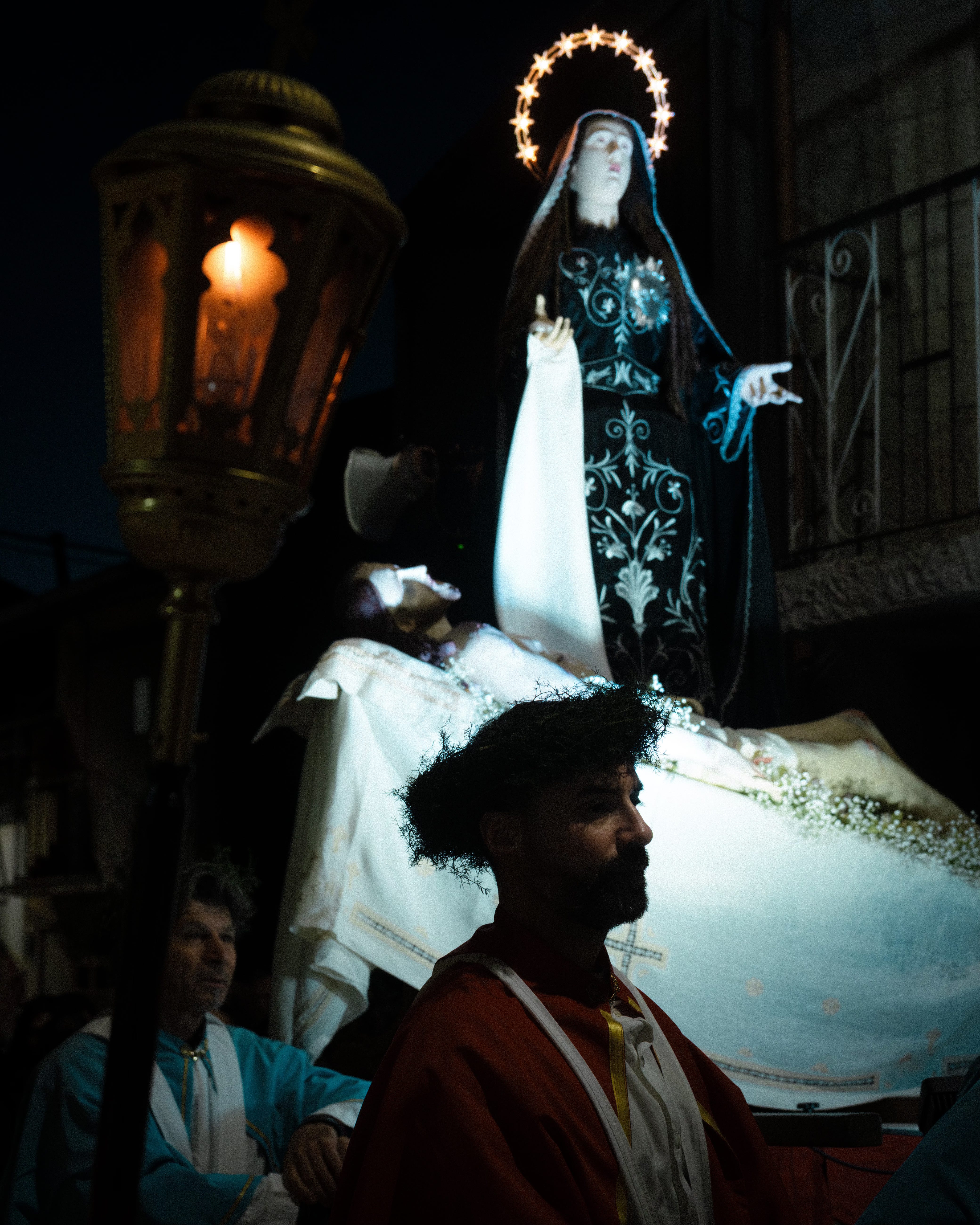
Another statue of Mary (there are several in town) stars in a lantern-lit Good Friday evening procession along the stations of the cross, situated throughout the town. It’s a moving ceremony: town residents, including children, all dressed in white robes and turquoise shoulder capes, carry tall brass candle lanterns and guide Mary along the way.
It was nearly ten o’clock when we finally sat down to dinner at Eva’s parents’ home. Being Good Friday, the menu was fish: a first plate of spaghetti with stewed calamari, cooked for hours until soft as butter, followed by baked dried codfish imported from Norway and known locally as stocco—a traditional Friday meal in Calabria. Unlike baccalà, which is cod that has been preserved in salt, stocco is air dried on racks—a preservation technique well suited to frigid Norway but impossible in southern Italy, where the intense sun would spoil the fish.[3]
You might ask why a preserved fish from Norway is so popular on the toe of Italy, and the answer is an earthquake. On December 28, 1908, a powerful quake centered under the Straits of Messina between Sicily and Calabria, followed by a tsunami, killed around 80,000 people—about the same number as first-day deaths at Hiroshima.[4] The towns of Messina (on the Sicily side) and Reggio Calabria were almost completely leveled. Survivors—maimed, homeless and hungry—wandered aimlessly through the ruins. Countries around the world rallied to send aid. Norwegians sent what they had a lot of: stocco. Ever since, Norwegian stocco has been a staple of Calabrian cuisine.
Stocco can be a hard dish to like. To the American palate (and even many anchovy-loving Italians) it’s on the wrong side of fishy, although I’m guessing no cat has ever turned it down. You could call it an acquired taste, but on first bite you may resolve never to acquire it again.
In Dasà, the Saturday of Easter weekend is what tour itineraries would call “free time”—an unsupervised day with no formal events until Midnight Mass. I woke early to meet Harper for a one-hour hike up the mountain road to Arena, another village like Dasà but organized dramatically along a high ridge and boasting the ruins of an 11th-century Norman castle, mostly destroyed by another earthquake in 1783. In places the road had no shoulder and bordered a cliff edge that dropped off to steep olive groves, with views beyond the valley to the distant sea. The olive trees were ancient and gnarled, and the branches hung over the road drooping with silvery leaves and bracts of infant olives, in April the size of sesame seeds. On the high side of the road, on terraced land above a steep incline, were barking dogs and chicken coops made of rusty old bed spring frames. Orange trees flowered, the air perfumed by the scent of their blossoms.
I woke early on Easter morning and walked down to the café owned by Salvatore Cognetta. You might think Salvatore would be closed on Easter Sunday, but then where would residents get their morning cappuccino and cornetto? In that sense the café functions as a public service, like a pharmacy.
Salvatore is from a famous Italian family of bakers or pasticcieri; his father was considered one of the best in Italy, and he carries on the tradition. I generally avoid Italian cornetti as inferior to the French croissant—more like a piece of soft, sweet bread than a flaky pastry. But Salvatore’s cornetti rival anything in Paris: whisper-thin layers of butter-glazed parchment, so tender and delicate that every bite flakes into confetti-like fragments. At the standup bar, cornetti are served on a napkin, there is no plate, and when you are finished eating, you can’t help but leave the counter and floor looking like a child has just been served. Every morning Salvatore rises before dawn and bakes three types: cream-filled, chocolate-filled (Nutella) and vuoto (“empty”) meaning plain. I always get vuoto because Salvatore’s cornetti need no enhancements.
He told me that in Rome most cafés buy frozen raw cornetti, mass-produced, and toss them in the oven. “Look, I freeze mine too,” he said, “but I make them myself, with lots of butter.”
Salvatore knows Rome—his son has a rare heart condition that has required surgeries and frequent follow-ups at a major children’s hospital in the capital.[5] He tells me that the hospital has a full café with baristas and an expresso machine, which he avoids: “The vending machines make better coffee.”
Easter lunch, with some twenty guests, was up the street at Cousin Bruno’s. A lawyer and amateur painter, Bruno is clearly one of the town’s more affluent citizens, but his only ostentation, if you can call it that, is a large late-model Audi parked outside his family’s townhouse. We arrived carrying trays of pork meatballs made by Eva’s mother Rosa—she won’t let anyone else make them because they never use enough pecorino cheese (“There should be more cheese than pork!”)—and her signature fried cheesy rice balls. In Calabrian dialect the oval-shaped rice croquettes are called braciole di riso, which is odd since in most of Italy braciole means chops or steaks.
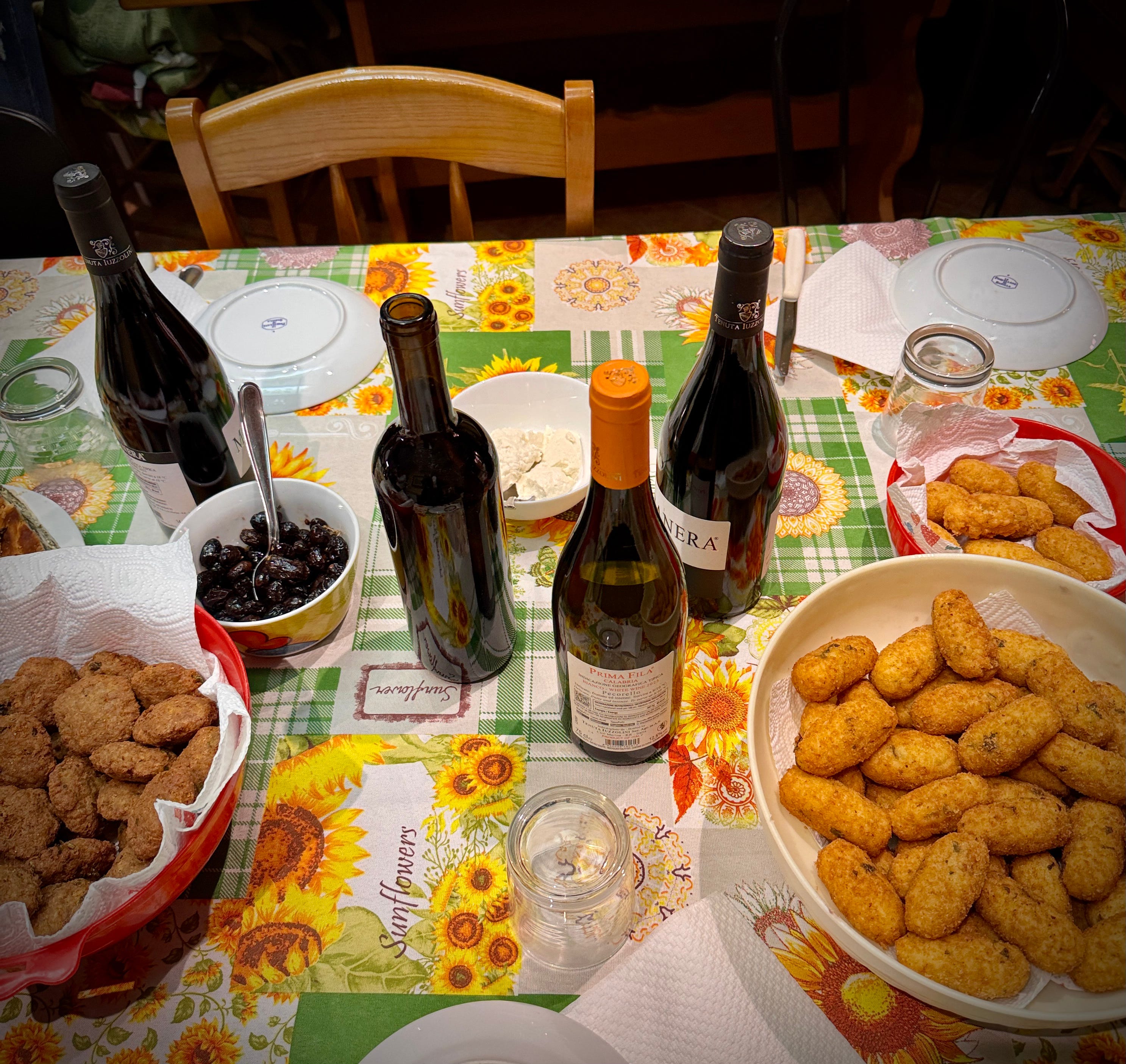
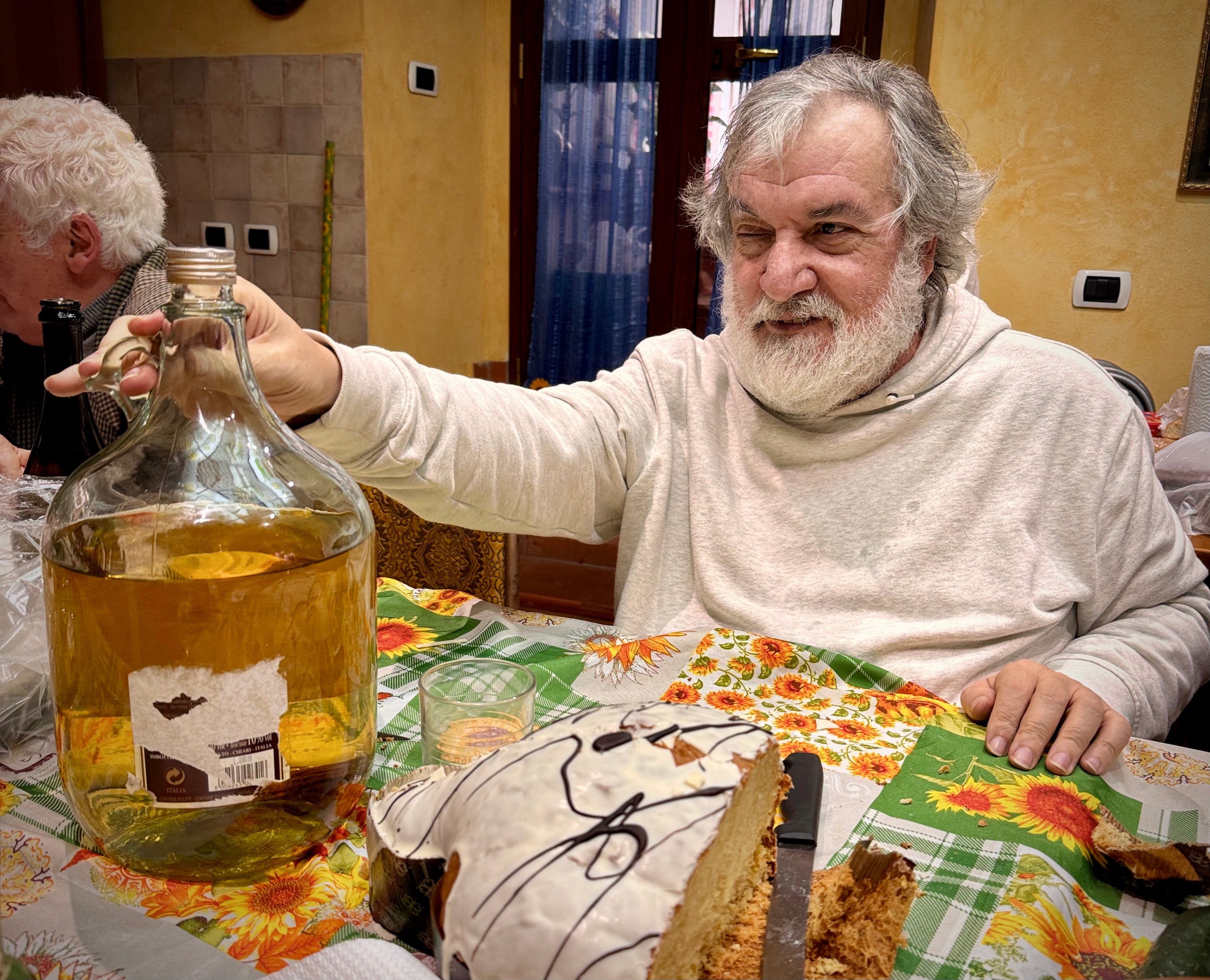
After the antipasto course of meatballs and rice croquettes, Bruno and his wife Paola served up their first course of baked pasta—tube-shaped noodles in tomato sauce with salami, hard-boiled eggs and chunks of provola cheese. Next came platters of rabbit stewed with black olives, over which the conversation centered on how Chinese people eat ants, locusts and dogs. After all this food and many bottles of wine came the palate cleansers: whole cucumbers, peeled at the table, sliced in half and salted; peanuts in the shell; and lupini beans. Then Bruno opened several bottles of spumante as Paola brought out bowls of local strawberries, which you dip in the sparkling wine. Finally came the desserts, various pies and tarts, and Bruno cracked open his five-liter jug of homemade aged grappa (yes, he has a copper still) which closely resembled kerosene in color and strength. Everybody went to bed early.
Easter Monday, called Pasquetta in Italy and a national holiday, brought an outdoor lunch at a neighbor’s farm on a mountain terrace just outside of town. We sat, twenty-five of us including four priests, along a vast table under a grape arbor with views across to several hilltop villages and a colossal concrete cross rising above a local cult or monastery called the Association of the Sacred Heart of Jesus.
The first course was penne pasta with white beans in a light tomato sauce, the beans having been grown on a nearby farm by another guest. We passed around jars of homemade powdered hot peppers, present on every Calabrian table, and dusted our plates. Next came spicy fresh sausage off the outdoor barbecue. The meal was served with Cirò wine, a Calabrian red made mostly from the ancient gaglioppo grape around the hilltop village of Cirò, on the Ionian coast across the mountains from Dasà. There, sea breezes in the morning and evening help protect the vines against fungal diseases. Our host also tended gaglioppo vines, some of them many decades old, along his sloping land. After a simple dessert of sliced fennel and local oranges, out came cold bottles of homemade limoncello and an almost-black anise-flavored liqueur.
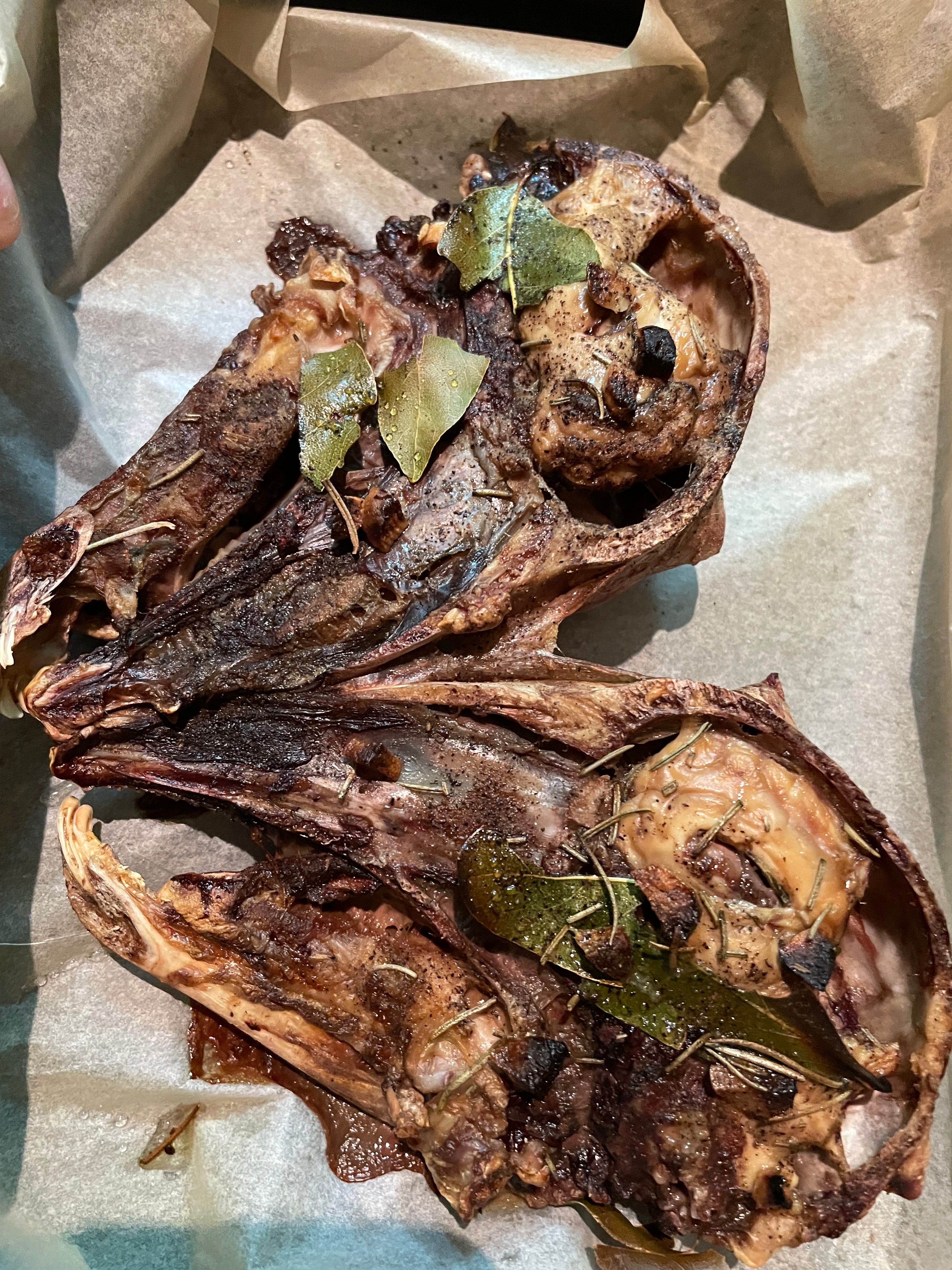
Tuesday: another Easter holiday, another massive lunch, this being the day of Dasà’s ‘Ncrinata. After the midday procession we retired to Eva’s family home and ate lasagna with a Neapolitan-style ragù of tomatoes, pork and carrots, followed by goat stew and, finally, roasted split goat heads. You scoop out and eat the brain first, then flip over each half and devour the tender cheek meat. I could have eaten a dozen. For dessert, Eva had made a traditional pastiera, the Neapolitan cake with ricotta cheese, orange flower water and a basket-weave crust. Another early-to-bed evening.
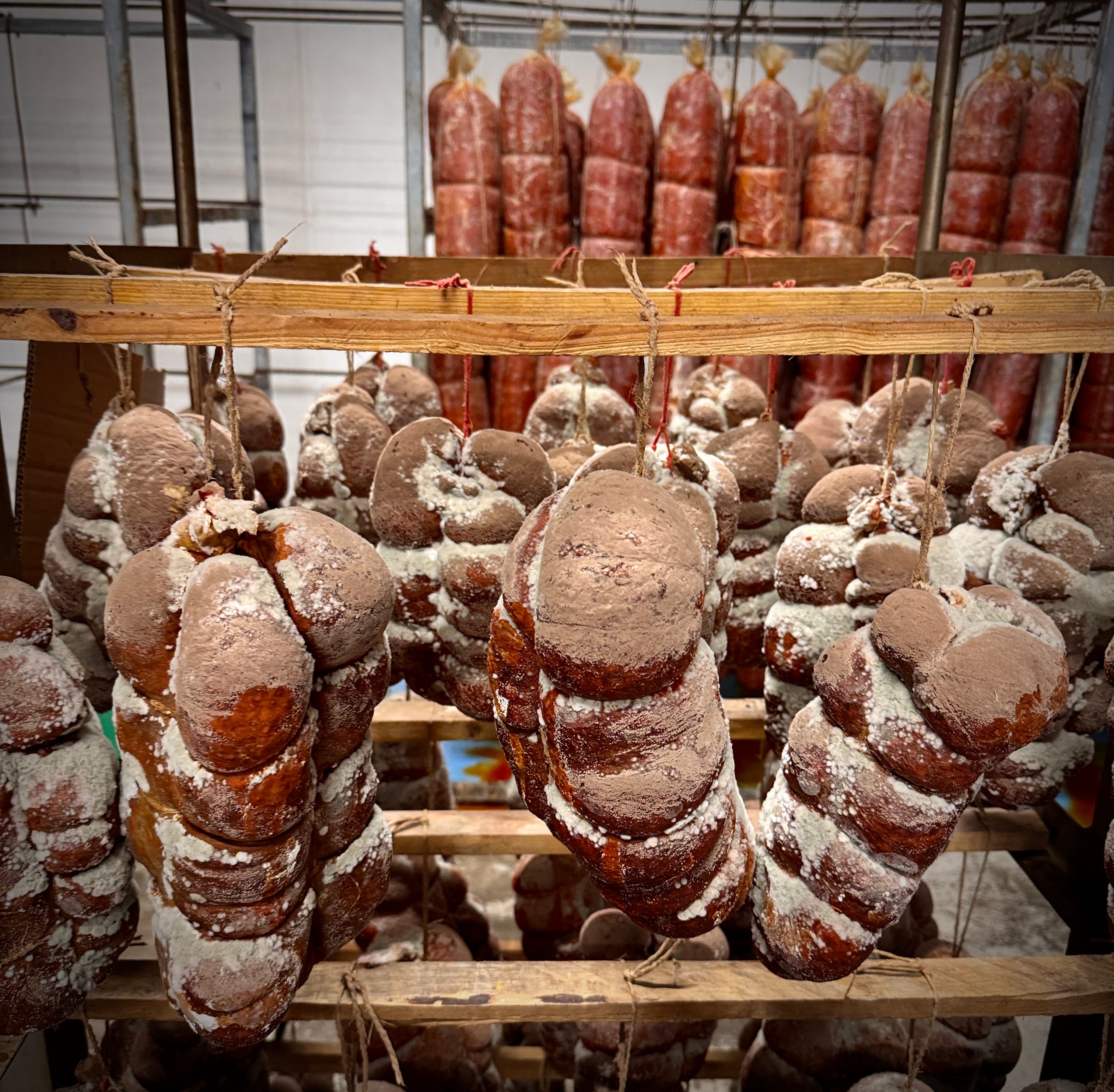
On Wednesday Harper and Eva were making a video about ‘nduja in the nearby town of Spilinga, where most of the commercial product is made. We toured an agriturismo where bathtub-sized vats of the ground pork-and-pepper mix were getting stuffed into casings of all sizes, then into a curing room hung with hundreds of ‘nduja, from the size of baseballs to ones as large as a car bumper. There they would age for months; some were coated in a thick impasto of white mold, which is harmless and washed off before shipping to stores. In another room hung rows of homemade ‘nduja, made by town residents, which the factory kindly offers to age for them in the temperature-controlled warehouse.
On leaving, Tomasso, the young proprietor, who had taken over the business from his father, handed me a plastic shopping bag sagging under the weight of ‘nduja products. There was, besides ‘nduja, spicy capicollo (a large salami made from the throat and shoulder; soppressata (a flattened, smaller salami); salsiccia (a dried link-type sausage dating from pre-Roman times); an entire slab of Calabrian pancetta, and jars of that ‘nduja-flavored honey—all of them just hotter than hell. And thankfully vacuum sealed as I was about to hop on the train back home. It was doubtless not the first time that a second-class train car pulled into Rome from Calabria heady with the scent of hot peppers and cured pork. It probably happens every day.
[1] In 2023, according to the Pew Research Center.
[2] A few years ago the iron cross atop the church façade was struck by lightning and destroyed, on a clear day.
[3] Stocco is short for stoccafisso which is the Italian adaptation of the Norwegian word stokfisk or “stick fish,” a reference to the wooden racks on which the fish is dried.
[4] The tectonic fault line under the Straits of Messina is one reason why a bridge or tunnel connecting mainland Italy and Sicily has never been built.
[5] The pastries may be better, but medical care in Calabria is inferior to that in the north.
As a Calabrese born and raised Italian. My husband I were born in Catanzaro Calabria. And transplanted here in Ontario Canada 🇨🇦. You described our beautiful Calabrese people. We certainly do keep our traditions to heart. And perhaps the Calabrese people suffered the most poverty. The North is spoiled.
And this is why Calabrese have the most faith in Christian traditions. And golden hearts! We also have a lot more Greek roots it’s the Sicilian that has mostly Arabic influences. 😄.
Excellent account of how you were royally treated by Evas family. We love 💕 your son and daughter in law !!
I absolutely love that reflection on the Chinese culture. I’m not surprised lol. Although some people feel offended it’s just that the Calabrese food is rich in depth! Even my mother and mother in law would be hesitant in trying Chinese food here in Canada. 🇨🇦 They would have none of that. We tried bringing them to a very popular restaurant The Mandarin. It’s buffet style. They walked out 😁!
What a great read! Truly delightful.