Take Quickly Distance From the Shores
For the new year, some fiction. A story from my new collection "Femmes Fatalistes"

The wedding went off as planned, meaning no one got killed. Lina had figured on two murders. The first was her uncle Oreste, a lawyer for the Commisso clan of ’Ndrangheta, the Calabrian mafia. He showed up at the Ipomea Beach Resort on Capo Vaticano in advance of the wedding, to review the plans as he would be the officiant. Being divorced, Lina’s daughter Ottavia couldn’t get married in the church so a civil ceremony.
In fact Oreste had gone to negotiate the resort’s fee for the catering, which dropped by like half after his visit. But another clan of ’Ndrangheta controlled the beach resorts along the cape, and those guys hadn’t authorized this visita from the Commisso family, which ran the port to the south. So there was that.
The other murder was herself killing Gino, her ex-husband, possibly across his throat with the serrated cake knife.
Reason prevailed. The mob stayed away and Lina was civil in a relative Calabrian way to Gino and his new girlfriend. It helped that his latest American slut was shorter than Lina, with some obvious neck work. Had the bitch been missing a leg even better, but Lina took life as it came.
“Ciao Gino…” she said without emotion as he approached from around the horizon pool. Neither of them had seen Ottavia, who was holed up in her room before the nuptials with her sister Arianna. The groom, a Roman producer for Netflix Italy, was circulating among the guests, speaking in Italian and English. Lina liked him okay although he seemed a bit young for Ottavia, who at twenty-nine was six years older. He could be a decent starter husband, but for Ottavia he was already number two.
“Ciao Lina!” Gino was drinking a flute of Franciacorta, possibly too quickly. He eyed Lina’s glass of sparkling water and smiled sort of. “I’m so proud of you.”
She gulped her glass dry and said “Ma va fannculo.”
Gino laughed. “I see sobriety hasn’t chilled your Calabrian blood.”
“Shall we try my German side? Geh und fick dich.”
“You look beautiful as always, darling. Salute!” He tipped his glass in a toast, downed his bubbly and turned away.
And that was that. Was she rude to tell her ex to go fuck himself in two languages at their daughter’s wedding? She didn’t think anyone else had heard. Anyway, had it not been rude of Gino to fuck her friends while she was on her many “retreats” over the years, drying out in the mountains of Umbria? Had it been rude of Gino to encourage her drinking, laugh at her antics, beat the shit out of a guy who dumped a bucket of ice water on her head from a hotel balcony because she had been drunkenly singing at four a.m. with her friends, endlessly, “Hit the road, Jack! And don’t you come back no more no more no more no more…?”
Hit the road, Jack. That’s what the hotel manager in Almería had told them that morning after the ice bucket incident. Fuck them all. Sti cazzi. She was the Queen of the Night, the dance club organizer, the event planner, the one who made sure everyone got on the plane for the week on Hydra, or Zanzibar, or in Tangiers. Without Lina, dov’è la festa? Nowhere that’s where. She was the party. She was in control of everything. Except herself, and Gino was fine with that as long as she spread her legs, blacked out, every night. But not anymore.
The offshore breeze picked up as the sun dropped toward the sea, bending the bougainvillea branches that draped over the terrace along the beach. The cone of Stromboli rose from the horizon across the sea, and a column of black smoke puffed like a bong hit from its summit.
“Lina!”
It was her friend Beatrice from Rome. They hugged and kissed. “We never see you anymore!”
“Early to bed,” said Lina. “I work in the morning.”
“I understand.” Beatrice paused. “Senti, do you want to do a line? I expect this will be a late night.”
“Only weed for me now.”
Beatrice had been at Lina’s fiftieth birthday party last year, the last time Lina drank. Of course it had been a big party on a boat on the Tiber, and of course Lina had organized everything. Now she couldn’t remember much about that night, but she did recall Bea hoarding coke. Now she was—what? Offering a sympathy snort? Fuck her too.
“You know we are all so proud of you, Lina. And you look amazing!”
“Thank you for coming. It means a lot to Ottavia that my friends are here.” It didn’t mean much to her personally to see her old club friends, most of whom had probably fucked her husband when she was passed out or drying out, including Beatrice. But it didn’t mean nothing. And really, how could she blame them? Gino was too handsome to be a husband.
“Of course we are here for you!” said Beatrice. “Lunch next week in centro?”
“I’m taking a week off. I won’t be in Rome until October.”
“Where are you going?”
Lina pointed her empty water glass at the smoking island on the horizon. “Him.”
Iddu, in the local dialect. Him. The angry volcano had erupted massively that summer, sending up a mushroom cloud like Hiroshima. The island was evacuated, but not before a tourist died; he had the bad luck to be under a falling chunk of red-hot rock. Life and death on Stromboli was a complex calculation of probabilities, but now what passed for normal life under the volcano had resumed.
Lina leaned over the railing of the ferry as it eased against the pier, scanning the black lava beach. A few pale-skinned Germans on their September school vacation were sunburning. In the small port, past the boatmen advertising night tours of the lava flow around the other side of the island, she hired a three-wheeled Piaggio Ape, spewing blue smoke like a chainsaw, which buzzed her down the Via Vittorio Emmanuele to her rented villa above the narrow Via Regina Elena.
The house was perched over the Grotta d’Eolo—a small cove, ringed with jagged volcanic cliffs, into which thundered waves at high tide twice a day. Behind rose Him, the 3,000-foot chimney from hell, and even in his tranquil moods he cast his long shadow across the shore. The terrace of the villa was covered in black lava powder from the daily belching. Iddu was spewing flame and ash about every ten minutes since the summer Big One. On the door someone had posted a schedule of the siren tests, which could be heard through the town and in Ginostra on the other side of the island where there were not even Ape taxis or paved roads, just mules. The siren was meant to give people enough time to head down to the shore for evacuation. Since summer the government of Sicily, with money from the EU meaning Germany, had been working out a new automatic warning system. But this was Italy so there were problems. Lina wondered how they could predict the next Big One. She wondered what would happen if one of the tests coincided with an actual eruption. How would anyone know it wasn’t another test? But that was her German side thinking; Italians never thought about shit like that.
Part of her liked the danger, why she always came back. She knew the real danger was tsunamis caused by earthquakes, more frequent than eruptions; a major tsunami could kill everyone on the island before they had a chance to reach higher ground, up the slopes of Him. One disaster you fled up; the other down. Either way, eruptions and tsunamis fell into the category of shit she couldn’t control, which released her from any concern, like the needle she occasionally missed.
She found a broom and swept the black grit off the terrace. A hot flash pounded through her chest and face and she had to sit down. After a minute, drenched in sweat, she went inside, turned on the AC, stripped off her soaking clothes and lay on the bed. When the fever passed after five minutes she stood naked before the mirror. She looked fucking hot for fifty-one, which in that moment was her own opinion but shared by everyone. Still she wondered if menopause would make her fat but decided that was something she could control. Then she changed into her bikini, grabbed a towel and walked down the narrow lane, framed in hibiscus and verbena blooms that sagged over the villa walls, to the Grotta.
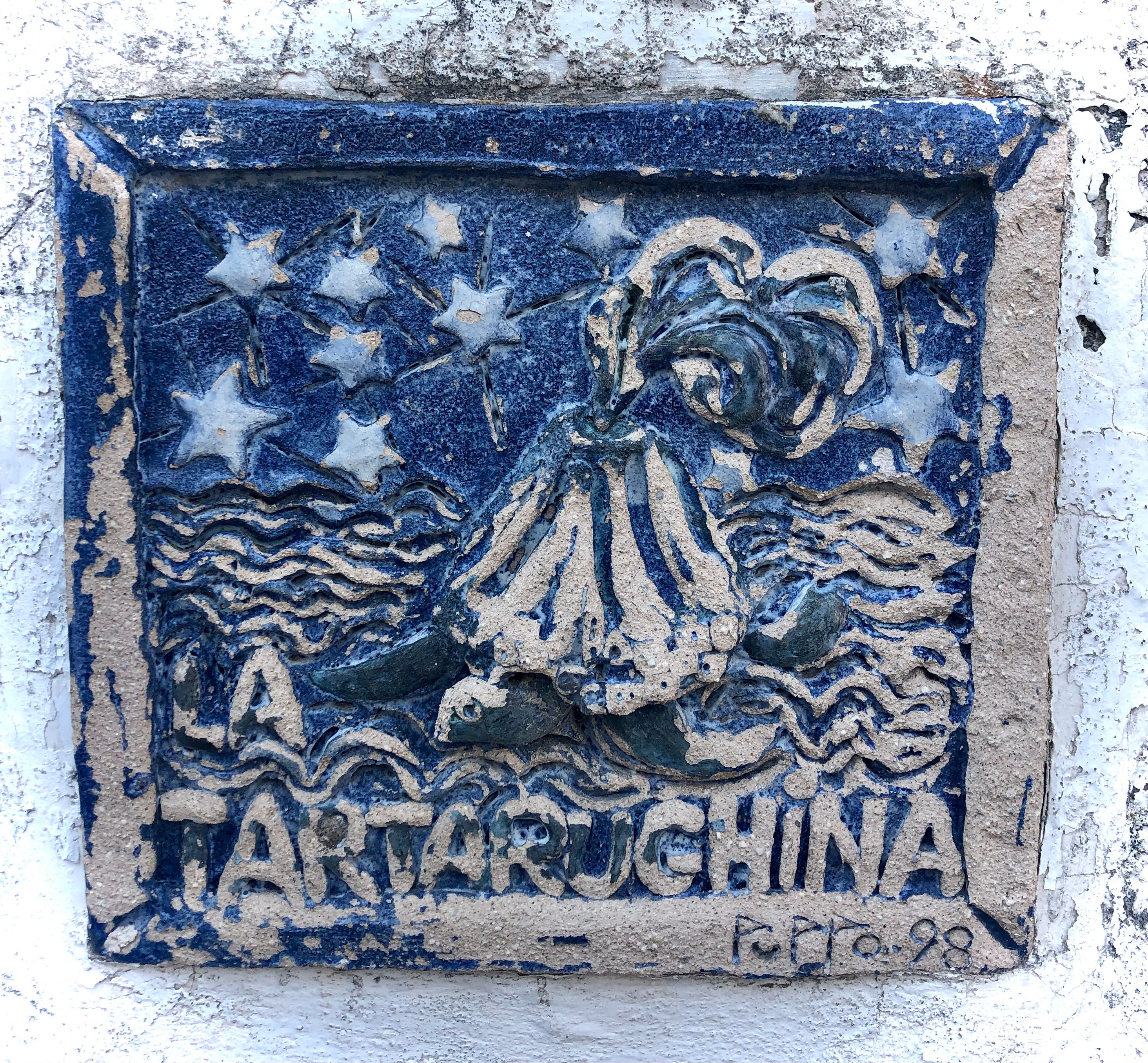
Above the turquoise pool, a multi-lingual sign explained what to do in the event of a tsunami. “Take quickly distance from the shores.” That was the English part, below a cartoon of a big wave crashing into the island, which was represented by the volcano wearing a sad face. Him. Like he cared. After a swim she headed back to the villa, showered, dressed, smoked half a joint and hiked into town for dinner.
There were many restaurants on Stromboli but for Lina only one: Bar Ingrid, on a bluff overlooking the sea across from the parish church of San Vincenzo Ferreri. The pizzeria was named after Ingrid Bergman, the island’s most famous foreign visitor. It was the seventieth anniversary of the filming of Stromboli, which had united star and director, Roberto Rosselini, in art and scandal.
“Buona sera signora!” The old lady at the cash register was still there, same cigarette in her mouth, still remembered her, still pointed Lina to her usual table on the edge of the terrace. The restaurant was about half full and so were the wine carafes on the tables. And the negronis and gin-tonics and Aperol spritzes that Lina tried not to see. Keep walking…
“Well if it isn’t the mother of the bride!”
Lina turned and saw him, the English speaker, a young African man sitting by himself. He had been at the wedding, a friend of the groom. “Lina is your name, right?”
“That’s right. And you are Ladoke.”
“Not many Europeans can pronounce my name, much less remember it. Would you like to join me, Lina?”
She looked around and pulled up a chair. He called the waiter. “Can I buy you a negroni? They are quite good.”
“Thank you but I don’t drink.” She turned to the waiter and ordered a bottle of sparkling water.
“I see,” said Ladoke. “Are you alone?”
“Yes, but not lonely,” she said, wishing she hadn’t put it that way.
“Same here.”
She’d only exchanged a few pleasant greetings with him at the wedding and hadn’t really studied him. Now she saw he was handsome in an unconventional way. He had a severe brow, almost Cro-Magnon, which gave the effect of his eyes being recessed in deep craters, as if his eyeballs were actually inside his brain. His dreadlocks were tied back in a bun.
“Remind me how you know my new son-in-law?” she asked.
“I’m a film producer in Lagos. He interned for me. I taught him how to make very bad movies, which is our specialty in Nigeria.”
They laughed, and found themselves staring into each other’s eyes. Lina pulled away her gaze first and broke the awkward silence with another question.
“What brings you alone to Stromboli?”
“Google Earth.”
Lina laughed again, sending water up her nose.
“No, I’m serious! You see I was looking on Google Earth for places to go after the wedding, and I saw this volcano sticking out of the water. And what amazed me was that it was just this perfect round cone. It looked like some movie version of a volcanic island.”
“It was a movie. Stromboli.”
“I know it. Rosselini. The volcano actually erupted as they were shooting the film.”
“Lucky for Rosselini.”
“Anyway I decided to come. Do you think I made a good choice?”
“That depends on your idea of a bad choice.”
“I would define bad choice as letting you go sit by yourself at that table over there, instead of dining with me.”
Okay, thought Lina. So it begins.
Their gaze met again. This time Ladoke broke the spell. “Your eyes are almost African,” he said. “They are so dark.”
“For a white person, you mean?”
He laughed. “I suppose that’s what I mean.”
“My father was Calabrian. Probably some Moorish blood in there. But my mother was German with blue eyes.” She stopped herself. That was more than she generally shared with strangers. “How old are you, Ladoke?”
“Thirty-one.”
“I could be your mother.”
“Mother? In Africa you could be my grandmother! But I do not ask women their age.”
“You are polite.”
“Perhaps, but the truth is I don’t care about a woman’s age.”
“And what do you care about?”
“Right now? Pizza! Shall we order?”
They signaled for the waiter, who asked if they preferred beer or wine with the pizza.
“Just more water,” said Ladoke.
“You are not drinking with your dinner?” asked Lina.
“I don’t always drink, and anyway I had one negroni.”
“You’re not just saying that to make me feel comfortable?”
“Is that such a bad thing?”
“No. But sometimes when I sense people try to make me comfortable I feel—”
“Uncomfortable?”
She smiled. “Funny how that works. I suppose you will be returning to Africa.”
“Africans always return to Africa. But I hold a British passport so I can stay as long as I like.”
“And how long do you like?”
He shifted his gaze out across the sea, then turned to her again. “Let me ask you a question, Lina. Have you ever seen a Nigerian film?”
“I don’t think so.”
“We start with questions. What if the husband sleeps with the housemaid? What if the schoolteacher gets the daughter pregnant? What if the drug dealer gets run over by the taxi driver? All good questions, but we don’t wait for answers. In Lagos we just start shooting. We never know how it will end—although it always ends badly, usually a result of evil spirits.”
“That’s a funny way to make a movie.”
“It’s a terrible way to make a movie! But it’s a good way to live. I like questions, but I distrust answers.”
Ladoke was staying at the Ossidiana Hotel near the port. After dinner they exchanged phone numbers and said goodnight in the Piazza di San Vincenzo. They hugged and kissed cheeks; she briefly imagined the taste of his lips, but interrupted her own thoughts and said, “I hope to see you around.”
Ladoke laughed. “We could always hope for dinner tomorrow around eight o’clock, same place.”
“Yes, let’s hope,” she said. “Ciao-ciao!”
And so it began. They had dinner at eight the next night, then met the following morning at the Ficogrande Beach for a swim. He let his dreadlocks down, and in the water they swirled around his head like tentacles.
“You look like an octopus!” said Lina.
He laughed and reached for her hand in the water. They briefly embraced, then she pulled away and dove into a wave.
That night over dinner he took her hand, which she allowed for about five seconds before withdrawing to fish a cigarette out of her handbag.
“You know Lina, in Lagos we pay small boys to guard our cars on the street. I think you maybe have one of those boys in your head.”
She laughed. “You want to know more about me because you like me, and that makes me close down.” She sliced her hand through the air in front of her face.
“You think I like you? Are you sure?”
Again he was making her laugh.
“Lina…”
“Stop. Please.”
“What’s the matter?”
“Nothing. It’s just that I am in a place of profound change in my life. I need to concentrate on my own life. In fact I’m moving to Berlin.”
“Berlin! But why?”
“Have you been?”
“Not in many years, it was winter during the film festival. It impressed me as a place under constant change.”
“Rome never changes,” she said. “I’m tired of Rome.”
“So you are restless. I imagine Berlin is a good choice for someone making changes.”
“I suppose it depends on your idea of a bad choice.”
He laughed. “You know Lina, we Africans don’t need self-help books or phone apps to stay focused on the present moment. It’s all we have. But should tomorrow ever come, we will certainly worry about it.”
She lit a cigarette. “You’re analyzing me.”
“I’m observing you. I can see the gears turning. Do I like him? What does he want from me? In fact I desire nothing from you but your presence in this moment.”
And he leaned across the table and kissed her lips.
After dinner he walked back to his hotel, hoping she would follow. But when he looked back at the piazza she was gone. He walked on, feeling the blood drain from his hard-on.
In fact Lina had gone back to the bar to watch the Messina-Reggiana football match. It was the big rivalry—the Derby dello Stretto between the two teams on either side of the Strait, Calabria versus Sicily, and both had loud fans on Stromboli. Far below the terrace she could see the Laurana, the twice-weekly overnight ferry to Naples, lumber into port, her reverse engines groaning. The twin stern gangplanks swung down and the crowd of passengers surged onto the boat. Lina would be on that ship next week; she dreaded going back to Rome but needed to organize for Berlin. Maybe Ladoke would sail with her? Maybe they would share a cabin?
“Goal!” Hachim Mastour, the Reggiana attacking midfielder, put the Calabrians in the lead. Lina cheered; Mastour was also a native Calabrian but of Moroccan parents. She pondered the futility of tracing her own North African blood, which probably dated to the Saracen invasions of the ninth century. Around the bar, in front of the big TV, Italians were ordering more wine and grappa; the German tourists were downing bottles of Messina beer. The Laurana raised her gangplanks and shuddered away from the dock. Soon her cabin lights were a dim glow on the dark horizon, and then she was gone.
The cash register lady came over to Lina’s table and set down a shot glass filled to the rim with the bar’s homemade limoncello.
“Ma no!” said Lina. “Non l’ho ordinato!”
“But it is your usual digestivo,” insisted the old lady through a fog bank of cigarette smoke.
Lina returned a courteous smile. “Grazie tante, signora.”
Lina stared at the bright yellow drink for a few minutes, cocking her head left and right as if arguing with it. Finally she convinced herself it looked like cloudy piss and pushed it away, turning back to the match.
Her phone chirped. It was a text from Ladoke. “Dear Lina, I’m on the overnight boat to Naples. You are an amazing person. I shall never forget you, and Stromboli. 🐙 ”
She lifted the glass of limoncello and downed it in one swallow, strapped on her headlamp and retreated down the Via Vittorio to her villa. There were no street lights on Stromboli, and in the blackness her lamp caught the eyes of cats stalking rats along the side of the road. By the small red home of Bergman and Rossellini, sprays of star jasmine filled the night air with sweet perfume. She walked on past the school and football pitch where the road narrowed between the close white walls of villas. Her footsteps echoed off the walls, as if her sandals were hollow gourds. Just past the Via Siena she sensed someone behind her, which a furtive glance confirmed. A tall figure, a man, no headlamp, was following her. His steps were silent, no echo. Only islanders walked around barefoot and without headlamps. She quickened her pace, as did he. On she walked, it was all downhill now, turning on the Via Barnao which ended above the beach at her place. She had her key in hand, and when she reached her gate she whirled around to confront the stranger, key wedged between her knuckles as a weapon. But he was gone.
Back inside, Lina locked the door and lit up a joint. Her hands trembled, and as the dope took hold she felt pulsing waves of adrenalin rushing to her brain. Escape hormones, she knew them. Get away. She had to get away. But where? The Laurana only ran twice a week in late season. And she couldn’t stay in town with the stranger following her and the bar and the limoncello and who-knows-when she’d go for a gin-tonic. No.
Ginostra.
She could walk to Ginostra on the other side of the island, overnight. In the morning there was a boat from there to Lipari where she could reach the daily hydrofoil to Naples. Maybe she could catch up with Ladoke.
But you could only reach Ginostra over the volcano, there was no coastal path across the lava shards. The trail to the crater had been closed since the eruption, you could only hike up two-hundred-ninety meters where a guard stood. She knew the guard, and she knew right now he was drinking at Bar Ingrid. And she knew the way. She quickly packed up her roller bag and stuck it in a corner, changed into her ankle boots, jammed three hundred euros in her jeans pocket, grabbed a bottle of water, slipped new batteries into her headlamp and ducked out. The stranger was nowhere, and soon she was on the summit trail, which began just up from her villa.
It hit her when the trail steepened. As her headlamp followed the switchbacks through the low juniper, she realized this is the movie.
Stromboli.
Bergman plays a Lithuanian refugee in a resettlement camp after the war; she meets an Italian soldier returning to his life as a fisherman on Stromboli. They fall in love, or at least he does. She sees, in his stubborn ardor, a decent enough man who could get her out of the camp. And so it began. But Stromboli turns out to be a trap. Her new husband is a brute. The local women, apparitions in head scarves, avoid her. The parish priest counsels her to accept her new life, but she is going mad. She decides to climb the volcano and then down to Ginostra. There would be fishermen on that side who didn’t know her, wouldn’t or couldn’t warn her husband. They could help her escape.
But Bergman doesn’t know the volcano, doesn’t know the way. The film ends as she collapses in exhaustion at the summit, just as the volcano begins to erupt.
Lina wasn’t worried about finding her way to Ginostra, but another thought stalled her on the path. What the fuck am I doing chasing a thirty-one-year-old African across the Tyrrhenian Sea?
Or any man. She didn’t chase men. Men chased her. Because she was in charge. She imagined Ladoke in his berth, praying for a text from her, checking his phone as the Laurana heaved and swayed in the sea, forcing himself not to text her again until she responded but then finally relenting and sending her a second message: I will wait for you in Naples. But it didn’t come.
Surely it was the poor signal on the volcano, or the shitty wifi on the boat. She would return to Bar Ingrid and then Ladoke’s string of arduous messages would chime like church bells. Then he would know who was in charge.
By the time she got back to Bar Ingrid, shoes and calves blackened with lava dust, the match was long over, Reggiana won. The Germans had gone to bed, there were only a few locals around the tables, arguing about the penalty kicks.
“Buona sera signora!”
Lina sat at her usual table and checked her phone. Nothing. Her thumbs hovered over the screen. No. I won’t text him. She set down the phone and exhaled. That was easy, just a little willpower. The waiter approached.
“The kitchen is closed,” he said. “Something to drink?”
“Sì grazie. Prendo un gin-tonic.”
Lina could drink a lot of gin-tonics in an hour—exactly how many no one had ever counted—so when the bar closed an hour later she staggered down the Via Vittorio in a blur. Several times she felt the dark barefoot stranger was following her, but when she turned there was no one in the road. Her mind was consumed by two thoughts: shame over drinking, and the realization, bordering on panic, that there was nothing to drink in the villa except her perfume. The last time she drank perfume it ended badly, in the emergency room of the Tiber Island hospital.
At the Via Regina Elena she detoured down to the Grotta, intending to rinse the volcanic soot off her legs. The sea was cold as she waded to her knees, still in her hiking boots, and she quickly withdrew. But the waves called to her as the third-quarter moon dipped almost to the horizon, sending jagged shards of light across the sea. Somewhere out there was Ladoke, in his snug berth, bound for Naples.
Behind her Iddu was growling, his mouth spewing crimson fireworks like an uncorked bottle of Franciacorta. She scrambled clumsily up the high promontory at the head of the Grotta, cutting her wet shins on the sharp lava stone, not caring. At the summit, fifty feet above the waves, she pulled off her headlamp in a defiant swipe and hurled it into the churning sea. She watched as it briefly bobbed in the wake, then sank, the LED glow disappearing. Lina closed her eyes and leaned forward into the wind. And then she was no longer in charge.