
The Word for Watermelon
Blue skies, rolling seas, and the dark side of Italy

We were four when we cast off. The boat was comfortable but not luxurious—a 44-foot older motorboat, belonging to my American friend Donna and her husband Gianni, a retired Roman doctor. The other guest was Fabrizio, 74, also a retired doctor and Gianni’s best friend since medical school. I took the train down from Rome that Saturday morning to Agropoli, the port south of Naples. Fabrizio, who had a summer home in the mountains behind Agropoli, picked me up at the station in his silver Mercedes around noon, and we navigated through heavy summer weekend traffic down to the busy port where Gianni and Donna were already waiting on the boat.
Parking was scarce along the quay so Fabrizio dropped me with my overnight bag and drove off to find a space along the main road. Minutes later he called Gianni to say he had a flat tire and couldn’t manage the spare by himself. Gianni summoned a dockworker who sped off on his Vespa to help. A half hour later Fabrizio returned in his car, and the dock worker helped him find a parking space. But he seemed stressed and exhausted by the ordeal. Gianni told me that Fabrizio had a heart condition.
Finally we tossed off our dock lines and were underway, Gianni at the helm. As we rounded the quay, the Mediterranean opened up; far to the north we could see the cliffs of the Amalfi Coast; with binoculars I could spy La Rondinaia, the villa of the late Gore Vidal. It was a clear day but with a breeze that was kicking up rolling seas. After cruising south for about an hour, we dropped anchor in a cove beyond the beach at Castellabate for lunch and a swim. Donna and I dove off the stern for a dip; the water was warm as a bath. Then we climbed the stern ladder, toweled off and made a Caprese salad of local buffalo mozzarella and tomatoes.
As we ate, Fabrizio announced he was feeling warm and wanted to take a swim. He was tall and relatively obese—you might describe his body shape as similar to Trump’s—and he wasn’t about to dive off the deck of the boat. Instead, he carefully descended the stern ladder, holding an orange float that was tethered to the boat. After about ten minutes paddling around, he was ready to re-board.
But with the waves swelling and the boat rolling, Fabrizio was struggling on the ladder. We abandoned our Caprese salad to help him, then realized his left ankle had been caught between one of the ladder rungs and the transom. We couldn’t free his ankle, which was already swollen, and he was stuck in limbo—holding onto the ladder like a trapeze artist, swinging above the water.
Except Fabrizio was no trapeze artist. Donna and I locked our hands around his wrists in an attempt to hold him up, but his arms were running out of strength. Finally he gave up and said he was going back in the water. I tried to stop him: “Your ankle is caught, you can’t free yourself!”
But he had no more strength in his arms, so he let go of our hands and fell backward, assuming he would land butt first in the water. But of course that’s not what happened. With his ankle still caught in the ladder, he fell head-first, backwards and upside-down, into the sea. Now his ankle was twisted and trapped even more, his back was against the ladder, and his head was underwater. Donna and I grabbed his hands and tried to pull him up. By now Gianni was calling the Coast Guard on the radio. We managed to get his head above the water for a minute, but the rolling boat kept dunking him under the waves. He was still conscious, but obviously weak and scared. He was running out of strength, and we couldn’t lift him.
I dove in the water, thinking I could maybe push him up from below. I swam under him and tried but I couldn’t get any purchase. All I could do was push my feet against the propeller, which of course wasn’t turning but was sharp. I told Donna to hand me a rope, and I made a bowline loop to put around his wrist. Gianni was watching but he was also in his 70s with health problems, so he couldn’t do much except send out more distress calls on the radio.
I put the loop around Fabrizio’s right wrist, but Donna and Gianni couldn’t pull him up; he was just too heavy, and basically unconscious by now. My feet were getting sliced by the propeller and I was running out of energy trying to hoist his head above the waves. His dentures came loose and were rolling around in his mouth. I pulled them out and tossed them on the boat, but I couldn’t keep his head above the water long enough to try breathing into his mouth; I could barely keep myself afloat in the shifting sea. His tongue was hanging out.
“I didn’t realize he had dentures,” said Gianni, which struck me as a weird comment in the moment but made sense later, I guess. I mean, wouldn’t you want to know if your best friend had dentures?
Donna dove in and tried to help me position the orange float under his body, but the seas were too rough; it kept popping out, and I couldn’t tie it around him because I couldn’t let go of his head. We were all screaming “Aiuta! Aiuta”! Help!
Finally, after about 20 minutes, a speedboat of young vacationers approached—a bunch of guys and their dates. Two of the men dove in and swam over to us. They got on the boat and managed to get Fabrizio’s ankle freed—I think they had to break it. But they couldn’t manage to lift him on board either. One of them stayed on our boat; the other swam back to their boat, which then sped away to summon more help.
After about another half hour, me still in the water trying to keep Fabrizio’s head above the waves, a Coast Guard cruiser arrived on the scene and began circling us. I started yelling, “you need to get in the water and help us!” But they just kept circling. I was running out of energy. The water was tinted red from my bloody feet. But sometimes it looked like Fabrizio was breathing, so I held on, forcing myself to continue.
After another 20 minutes, a fast Zodiac arrived with two guys. They weren’t in Coast Guard uniforms; I assumed they were harbor masters. They managed to pull Fabrizio, now totally unconscious, aboard the Zodiac while Donna and I pushed from below, in the water. They raced off to the beach, performing CPR on Fabrizio whose mouth was spewing seawater.
Donna and I got back on the boat and dried off, my towel stained in blood from my feet. After a while, the Zodiac from the harbor patrol returned to pick up the young man from the recreational speedboat who had stayed onboard with us. They said they were trying to “reanimate” Fabrizio on the beach. In the distance I could see an ambulance and crowds of people along the shore.
We waited for maybe half an hour. Finally the Coast Guard cruiser pulled alongside and held out a basket on a pole; they wanted Fabrizio’s identification card. Then they exchanged phone numbers with Gianni.
After another hour, the guys on the Zodiac returned. “State parenti?” one of them asked. Are you his relatives? This was not a good sign.
“We are just friends,” I replied.
The man was crying. “I’m sorry. We did all we could. There were four medics on the beach. We need to contact the family.”
“He’s divorced,” said Gianni. “I know his children in Rome.”
“Come with us.”
They helped Gianni into the Zodiac, then motored off.
Now it was just me and Donna on the boat. We sat, waiting for at least another hour. Around 5:30 pm, the Coast Guard cruiser pulled up again and said they couldn’t let Gianni pilot our boat back to the harbor; he was too stressed after talking to Fabrizio’s son and daughter. “Are either of you licensed boat captains?” We shook our heads no.
I told them I was an experienced sailor in America but that I had never piloted a boat in Italy. “Aspetta,” I said. Wait. I went up to the bridge and confirmed I could read and follow the nav screen. But the dashboard engine controls were in Italian, and my nautical vocabulary was limited. There seemed to be controls for bow thrusters, which you would need to dock, but I wasn’t sure. I told the harbor master I wasn’t confident given the high seas.
“Arrivo,” he said. Then he boarded the boat and cranked up the engine while Donna and I raised the anchor. We were off, back to port.
Gianni was on the quay, waiting for us. People on the dock embraced us, consoled us. The woman who ran the refreshment kiosk brought us a pot of chamomile tea. I wanted wine, and lots of it. A woman from a sailboat moored near us recognized me from MasterChef and wanted to know all about the TV show. She didn’t know about the accident, the drowning, and I didn’t want to tell her.
We had eaten nothing but a slice of mozzarella hours earlier, but our ordeal was far from over. The police escorted us down to the Coast Guard station, at the other end of the port; there would be an interrogation. Which of course there would be; a noted Roman doctor with several homes had died at sea. Maybe we had murdered him?
We sat for a long time, past dark, in a tiny waiting room with an espresso vending machine and a large-screen TV playing an endlessly repeating video of a Twix candy bar commercial. They took our passports and made copies. I could see through the glass wall that they were photocopying every page of my passport. I had a double-size 50-page passport filled with visas from around world, going back almost 10 years. The guy ran out of paper. It took him a long time to find more. The clock on the wall kept ticking.
The officers explained that we would each be interviewed separately, doubtless to see if our stories matched up. Gianni went first. It took an hour. I snapped a video of a Coast Guard officer getting coffee from the vending machine. I don’t know why I did it, just boredom. He saw me and yelled, then made me delete the video. Then he motioned to a paper sign taped on the glass partition, warning in tiny print against no pictures. Whatever.
Next they called in Donna. Another hour. Then me.
Even by the normally musical standards of the Italian language, the commandante of the Agropoli Guardia Costiera had a notable name: Valerio de Valerio. The walls of his commodious office were decorated with many honors and plaques. The air conditioning was set to meat-preservation levels, unusual in Italy. He motioned me to sit across from his large desk and began: “How are you doing?”
“Well,” I said, “I’m exhausted, hungry and bleeding. But mostly I’m sad and consumed by guilt that I couldn’t save him. Otherwise, fine.”
Then he asked me to recount the story of what happened, step by step. Sometimes he interrupted me—I was going too fast; he wanted to know more about this or that. He was typing away as I spoke. At one point he seemed skeptical of how it all happened. As in, why couldn’t we release his ankle right away? Why was it so difficult to free him from the ladder? I said, “Signor Commandante, I lift weights every day; I exercise, I ride my bicycle all around Rome even on the hottest days. I’m in pretty good shape, but I’m 64 years old and this guy was fucking heavy.” He nodded.
At the end of my story, he read back his written version, then asked if I wanted to add anything else. I wanted to say “Yeah, where the fuck were you guys when we needed you? Why did the cruiser just circle around for an hour while I was in the water, bleeding and trying to save his life by myself?” But I said no, it’s fine. He printed out three copies, then made me read and sign them. We were done.
It was 10:30 when we sat down to dinner at the Palazzo Dogana overlooking the harbor. The hotel’s elegant dining terrace is, naturally, noted for its fresh seafood, but I’d had quite enough of the sea for one day; the saltwater was still stinging my lacerated feet. I briefly considered the bocconcini of angler fish over a white bean cream sauce with grated bottarga roe from Sardinia. Instead I ordered the veal chop with fries and arugula. We ate mostly in silence. The owner stopped by our table to take a selfie with Max di MasterChef; some other diners did the same, all of them oblivious to our disastrous day. People were dressed up, and we looked like slobs having not changed or cleaned since the ordeal. After dinner Gianni announced he was retiring to the boat, but Donna wanted to show me the historic old center of town, up on the cliffs above the sea. I agreed to hobble up with her—the wine having sufficiently anesthetized my wounded feet.
By the time we scaled the steep road up to the centro storico it was after midnight. The main drag, lined with bars, was packed with young people drinking—just another Saturday night in a port town during summer vacation. They swarmed me. “Max! Max! Oddio! Look, it’s Max di Masterchef! Can we take a picture? Can we buy you a drink? Tell us about the chocolate sphere, how did you do it?” Their accents confirmed they were mostly young Neapolitans—citizens not noted for their reticence, even by the relaxed standards of propriety in Italy.
What could I say? “I’m sorry but it’s not a good time. A man just drowned in my arms, I’ve been interrogated by the Coast Guard commander, and I’m wracked with guilt that I might have saved him?”
No.
I said, “Guys, thanks for your support! I’ll have a Negroni, and a white wine for my friend!”
We slept on the boat. The next morning Gianni brought over the local newspaper with the headline news: “Dramma a Santa Maria Di Castellabate: muore noto medico romano.”
“Drama at Santa Maria di Castellabate: Noted Roman Doctor Dies.”
The article said an investigation was ongoing. I was glad to see my name was not mentioned, and I was never again contacted by authorities. I assume their “investigation” concluded, properly, that it was nothing but a tragic accident. Just one of those things.
After coffee at the kiosk on the quay, we gathered our bags and packed up Gianni’s car, another Mercedes—apparently the official vehicle of all Roman doctors. Fabrizio’s son was coming down from Rome to pick up his dad’s Mercedes. I put all of his belongings in the duffle he had brought along—his Panama hat, wallet, wristwatch, three phones and teeth—and dropped them at the Coast Guard station for his son to pick up later. It was Sunday, and Italians were all driving home from the beach. The normal three-hour drive from Agropoli to Rome took six. We didn’t make the usual stop to buy some local buffalo mozzarella at the dairy.
A few days later at the funeral in Rome, I approached Fabrizio’s daughter. She was a woman named Angela in her forties who it turns out was an acquaintance; she had been to a party on my terrace, but I didn’t connect her to Fabrizio that day on the boat. Rome is a small town, as its residents like to say. “Angela, I’m so sorry,” I said. I wasn’t meaning that cliché that everyone says at funerals—“I’m sorry for your loss.” This was different.
“I’m sorry I couldn’t save your father’s life,” I said. “I tried. I promise I tried. The Coast Guard never came for hours.” By then I was crying. She hugged me.
“Max,” she said, “non preoccuparti!” Don’t worry! “You know that Italy is a beautiful, ugly country.”
* * *
Of course every country has its ugly side. But the dissonance is particularly jarring in Italy, a place of such abundant beauty. Foreigners naturally focus on the beauty part—the art, the food, the sea, the fashion brands—ignoring (as tourists can) the pervasive Mafia influence, the ineffective and often corrupt governments, the violence against women that is still all too common. And yes, the apparent indifference of rescue workers to a drowning man.
The Italian’s fatalistic worldview can be partly attributed to the tectonic faults underfoot—earthquakes have killed hundreds of thousands of Italians in recorded history. Volcanoes smoke and belch fire daily. In this fragile and frequently violent land, the life and death of individuals outside the family is background noise.
Orson Welles distilled the bigger picture in The Third Man, playing the corrupt American businessman Harry Lime in postwar Vienna: “In Italy for thirty years under the Borgias they had warfare, terror, murder, bloodshed. But they produced Michelangelo, Leonardo Da Vinci and the Renaissance. In Switzerland they had brotherly love and five hundred years of democracy and peace, and what did that produce? The cuckoo clock!” [1]
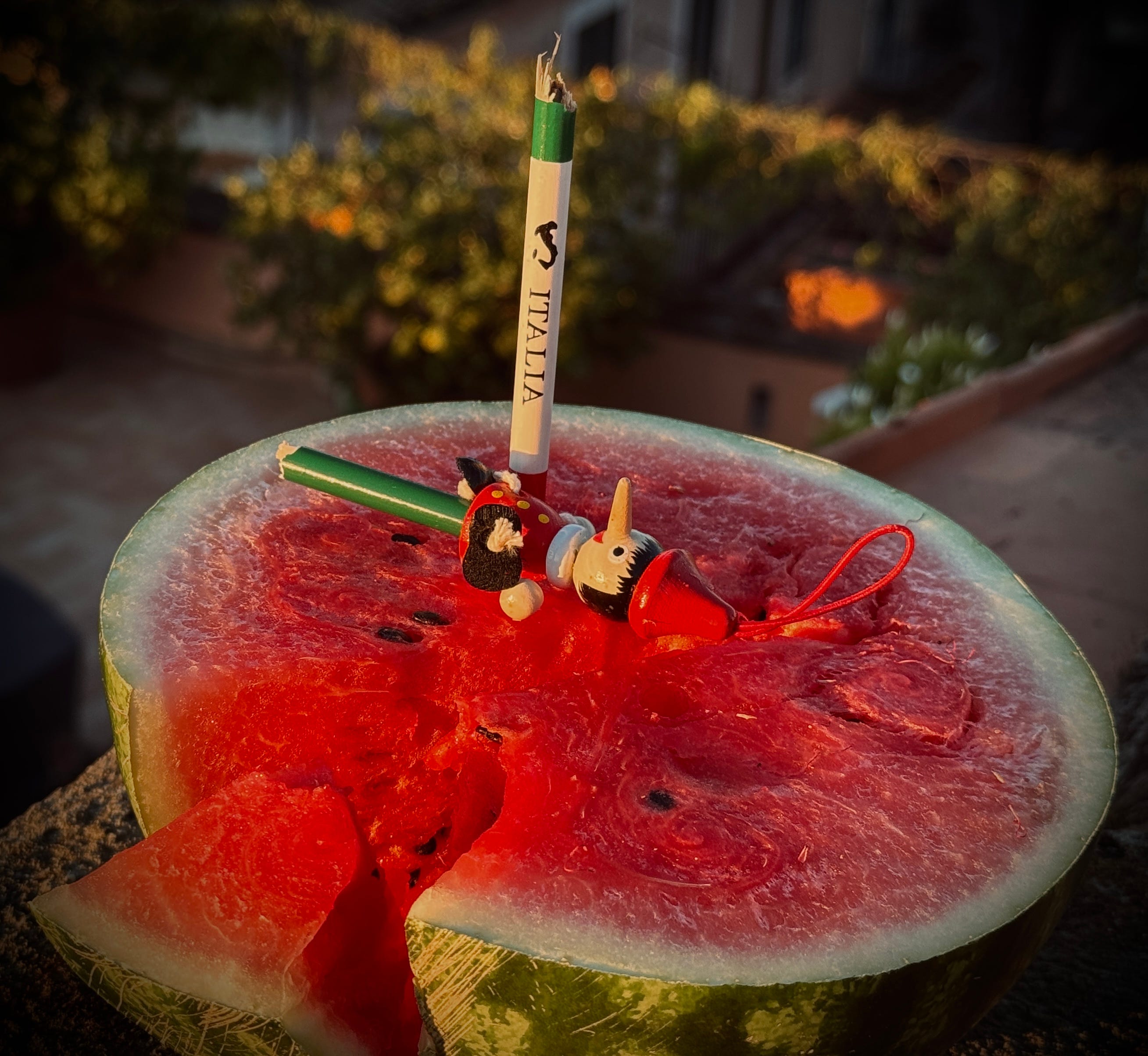
Apart from its chilling cynicism, Harry Lime’s monologue hints at some truth. Italy, like its famous pizza, was forged in a searingly hot oven whose embers still burn. The dozens of nation-states that comprise modern Italy were wrought into one land only during the time of the American Civil War, with equivalent violence. It has been argued that “Italy” is no more a country than “Scandinavia.” Italians can’t even agree on the word for watermelon. (Anguria in Milan, cocomero in Rome, popone in Tuscany, mellone d’acqua in Calabria).
Yet if there’s one thing that unites Italians, it’s television. Every home has a set in the kitchen, and it’s always on. The public and private networks beam the same mix of reality gameshows and car-chase local news, certainly the trashiest programming in all Europe, into every home the length of Italy. It’s not Michelangelo, but it’s not nothing. The literary form known as magical realism is associated with Latin America, but Italian culture has its own tradition of mixing fables and reality, from Pinocchio to Fellini’s Roma. Ambiguity could fairly be called an Italian invention, along with banking, pizza and the radio. You could argue the un-reality of reality TV fits into that category, whatever its cultural significance. In his autobiography, the German film director Werner Herzog wrote, “I watch trash TV because I think the poet shouldn’t avert his eyes.” I confess to averting my eyes when I appear on Italian television: That’s what I look like? I still don’t get it, but I’m happy to be a part of something Italians can agree on.
I came to Italy to eat well, hoping I might occasionally have the good luck to join Italians in their own kitchens. I didn’t expect to be in every Italian kitchen, every Thursday night. Sometimes you get more than you hope for. Sometimes you get what you could never imagine.
[1] The lines are not in the Graham Greene novel; Welles improvised them during filming.
what a tale. an amazing read of a tragic event.
Oh Max, how grim, how very grim and sad. This is the stuff of PTSD and nightmares. I'm so glad that you were able to hear Angela's words absolving you. Your efforts were heroic. I hope you can find some comfort in that. Eternal peace to Fabrizio.