
When Nothing Will Do
Embracing emptiness, in life and a soufflé

It seems reasonable to believe that in the beginning there was nothing. The void. And it must have been really something because its ongoing nature has occupied philosophers, scientists and mystics for thousands of years. Fittingly for something that is nothing, it goes by many names—śūnyatā (Buddhism), wuji (Taoism), fana (Sufism), shunya (Hinduism). They all consider the void a place of renewal and enlightenment, where we let go of material attachments and endless desires stuck on replay. Rather than negation, the void is a place of promise, like the womb.
Beyond Eastern religious philosophies, ancient and medieval Western scientists called the void aether, taken from the name of the Greek god of the upper sky, himself son of the gods of Darkness and Night. To early scientists, aether was the fifth element or quintessence after earth, fire, air and water.
Then there’s the void of the empty luggage rack on Trenitalia 9310 from Rome to Turin last week, where my suitcase was last seen just before Milano Rogoredo station.
To be honest, my first reaction on realizing that my bag containing a €5,000 hearing aid, several rare pieces of jewelry and a few sets of custom-made Italian suits, sweaters and shoes was now being picked through on a park bench was less Zen than Fuckkkkkk. But after arriving in Turin, filing a police report and an insurance claim with the train line (which might possibly cover a small part of the loss), I embraced the void. And bought some socks and underwear.
Then I started to think about the void in cooking.
You could start with water. Taoists compare the void to water, which flows freely into any container and takes its form. As water will find its way, according to Taoism, so will the void. This metaphor helps us navigate unexpected challenges, such as when the pasta water boils over into the void below my stovetop.
Speaking of scorching, we could move on to alchemy—a form of cooking—in which the initial step of physical transformation is nigredo or decomposition through burning. This blackness was, for alchemists, the primal chaotic void necessary before purification. Carl Jung was strongly influenced by alchemy when he developed his idea that humans must pass through a deep melancholic journey—the “dark night of the soul”—before psychological healing. Shakespeare talks of alchemy in his sonnets, many of which have characters passing through nightmarish evenings to reach purification.
I felt the blackness that first night in our Turin hotel as I tossed and turned, recalling ever more cool stuff in my bag, never to be seen again. That tie I loved! That scarf Alexandra gave me! (She next to me, soundly asleep.)
Blackened Creole redfish (do they still make that?) might fit the definition of nigredo in cuisine. But a more conventional understanding of the void in cooking would look at the prevalence of empty spheres—like the chocolate sphere that was my triumph on MasterChef Italia. More on that next week, but for today I want to talk about another dish full of empty space: the soufflé.
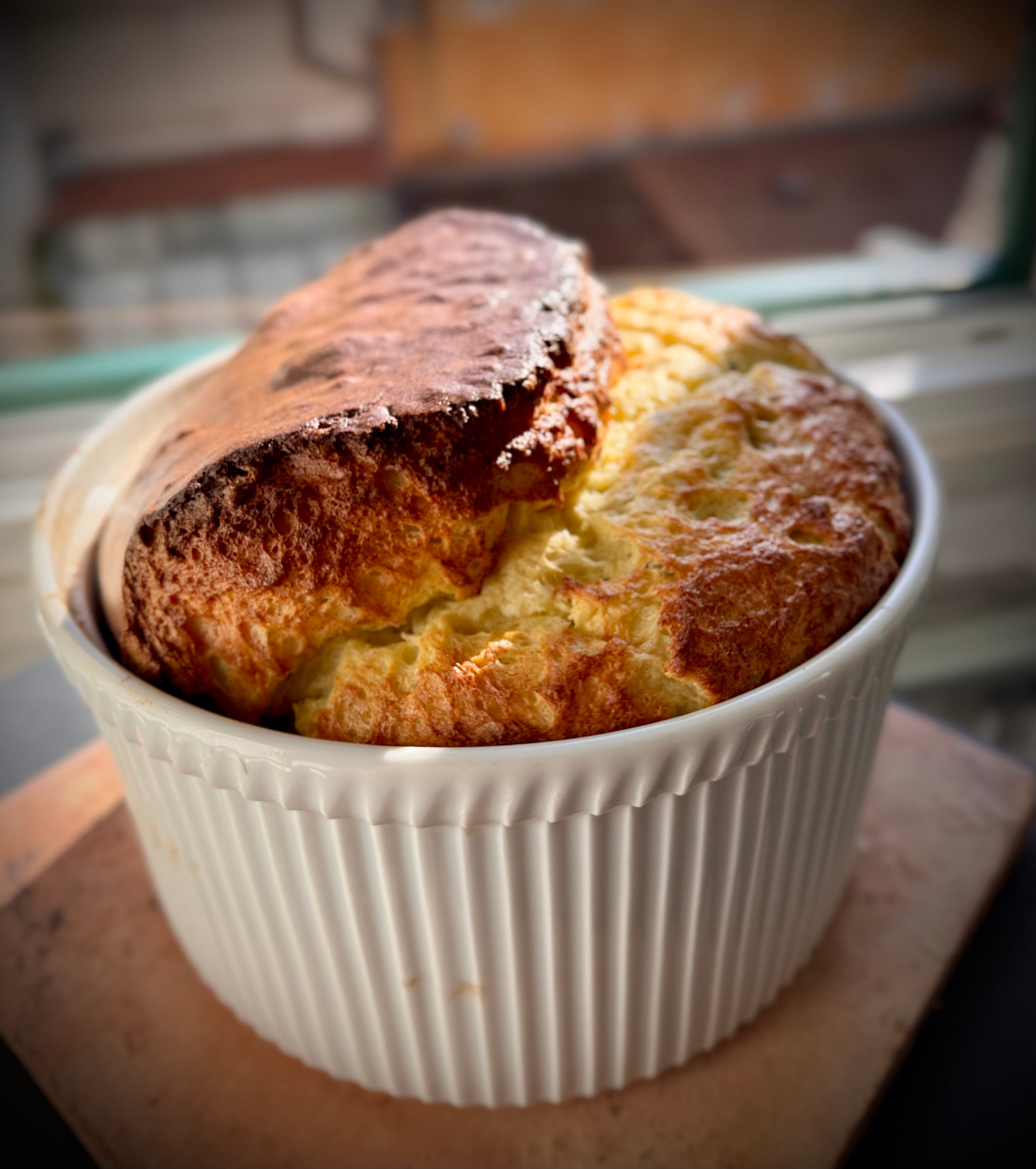
A soufflé, of course, is mostly void. You whip egg whites to create millions of tiny bubbles, the air inside which expands under heat. But the thermodynamic explanation, like defining love as a function of dopamine receptors, falls short. A soufflé is magic. Serving it is theater. Eating it is a sublime passage between crisp crust and oozy interior. I am almost certainly the only person in Rome who makes them because they are French and Romans don’t make French food. I make them a lot. I have it down.
Soufflés cause needless angst in the kitchen. The secret “ingredient” is the dish—it must be made for soufflés which is to say straight-sided, allowing the mixture to rise maximally. So outfitted, you can easily make showstopping savory dinner cheese soufflés, or swoon-inducing chocolate dessert versions. You can make them in individual ramekins but I prefer the drama of a large single soufflé—I use a two-quart model made in France by Apilco, roughly seven inches diameter, which serves four.
To make a savory soufflé:
Separate 6 eggs. Make a bechamel sauce: Melt 4 tablespoons butter, add the same of flour, cook on low heat, stirring to prevent burning (no nigredo here) for a few minutes to cook out the raw flour taste, then slowly add 1-1/2 cups warmed milk, stirring for another couple minutes until thickened. Off heat, add the egg yolks and a cup of grated cheese—half Parmigiano and either Cheddar, Gruyère,1 Gorgonzola or whatever you like. Salt and pepper, a bit of mustard powder. Want more? Add either a handful of cooked and well-drained spinach or chopped ham, but resist the urge to kitchen-sink a soufflé; keep it simple. Beat the egg whites with a pinch of tartar into soft peaks. Fold everything together gently, transfer into a buttered soufflé dish and bake on the lowest rack at 400F for about 40 minutes. More time will give you a drier soufflé, less time will be more molten—as you prefer. Also, every oven is different; experiment.
By the way, Turin is a lovely place to visit even without clothes. It was the seat of the Savoy kings, who still sit astride bronze horses in the many colonnaded squares—in reality no more heroic than their current trashy descendants, living in exile since the war and reduced to stomping their feet and demanding return of the crown jewels. My wardrobe all week of the same selvedge jeans, sneakers and wool-silk cardigan I had been wearing on the train did not seem to diminish the city’s overall elegance.
Believed to lie at an intersection of white and black magic, Turin has been famous for centuries as a center of occult studies—the 16th-century French mystic Nostradamus is said to have practiced alchemy there. Today you hear as much French as Italian. I imagine someone there is making a soufflé.
An odd fact about Italy is the near impossibility of finding Gruyère cheese, which is made in next-door Switzerland. You can find Swiss Emmentaler in every grocery store, but no Gruyère, not even in specialty cheese shops.
Well. You know. It’s really disappointing this happened to you but you get to buy new stuff !!
And about the soufflé…. I have been obsessed with Yorkshire puddings! And as as Italian this stuff is pure heaven. Is soufflé the same texture. ?
I’m sorry for your loss. It’s said that women expand their wardrobes while men merely replicate, and there’s truth in that, but not because we’re lazy (well, maybe a little because we’re lazy) but because we have an intuitive, emotional, irrational connection not only to sentient beings but to inanimate objects — an article of clothing, a Lamborghini Huracan (or, in my case, a 1963 Ford Fairlane station wagon with a flathead six, a three-on-a-tree shifter, and a rear compartment exactly the size of a double bed) — as well. As for the wonders of Turin, to your list I’d add the original Grom gelato shop, a knock-your-socks-off automobile museum, pistachio-cream-filled cornetti, and, best of all, bicerin, the coffee preparation nonpareil.