
When There Was Nobody in Italy
Covid sucked, but not on the empty trails along the Cinque Terre

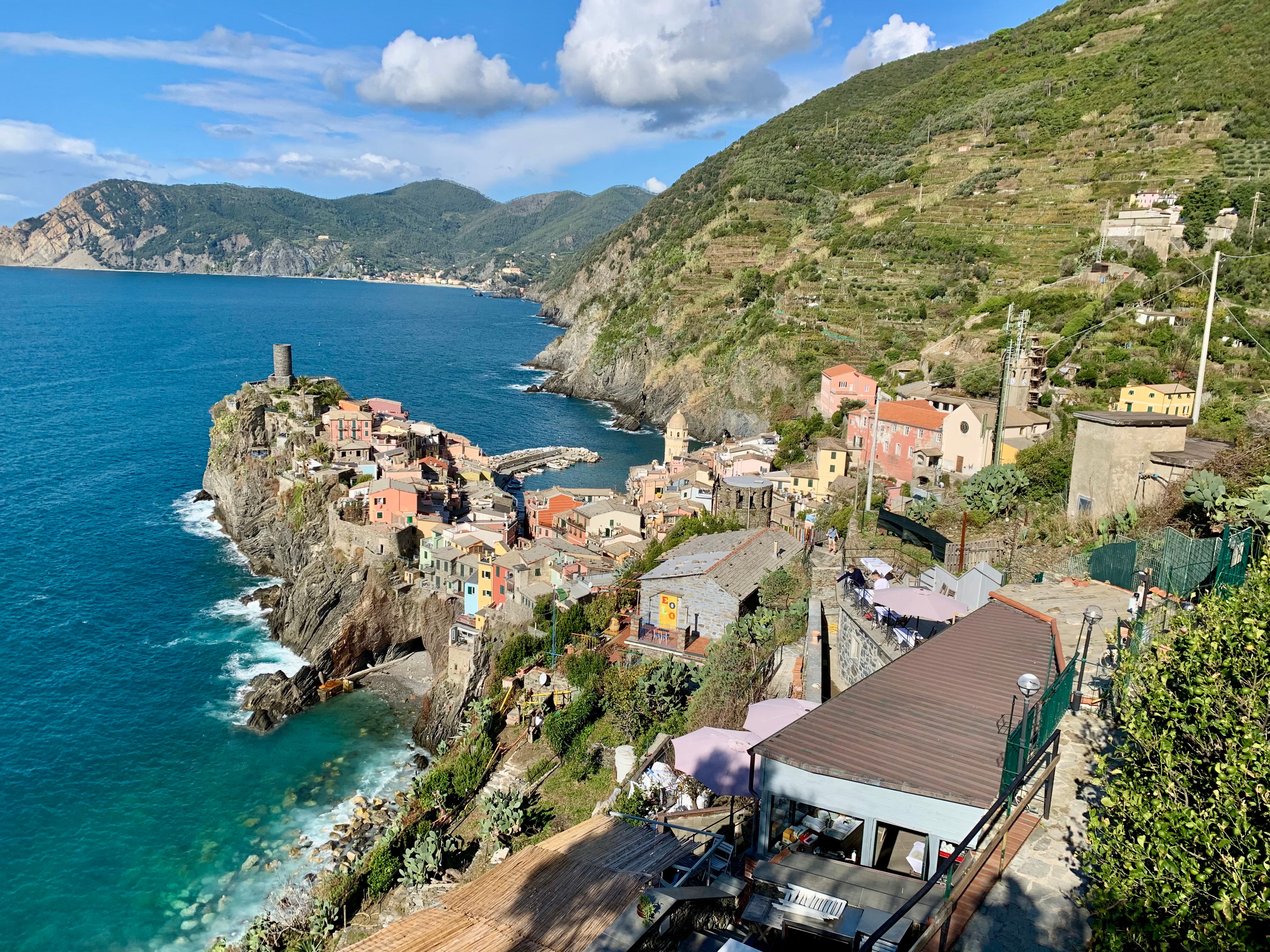
I had always wanted to see the Cinque Terre, or Five Lands—a two-mile stretch of five picturesque villages along the Ligurian Sea, south of Genoa. I finally got my chance during Covid—and during the recording of MasterChef in Milan.
We were picking teams for an external challenge, one of those episodes where the contestants venture out and cook in the real world. Besides breaking up the potential monotony (for home viewers) of seeing us every week in the same studio, the external challenges demonstrate our ability to work on one of two teams. For this challenge, Jia Bi and Federica, our two captains thanks to winning a previous studio challenge, alternated choosing their team members. In the end Jia Bi was down to choosing between me and Eduard, a native of the Dominican Republic but raised in Italy. The contestant not chosen would sit out the team challenge and go straight to the next Pressure Test.
“Well Max is a great cook and he knows a lot,” Jia Bi graciously explained. “But he’s American, and he cooks in a different style than the rest of us. I’m worried the Italian judges will not appreciate his techniques.” And with that, she chose Eduard. Fair enough.
Then came the details: teams would be competing in the kitchen of a downtown Milan hotel, where they would prepare a “royal brunch” of four courses. Each contestant would be responsible for one course. Brunch is still a relatively novel concept in Italy—one of those American imports, like cheeseburgers, viewed with both fascination and suspicion. Which is to say it hasn’t yet reached the level of tired cliché in America that led Anthony Bourdain to savage it relentlessly. Some of the contestants needed it explained:
“It’s like a breakfast but then it becomes lunch.”
“So the first course is a pastry and espresso?”
“Not an Italian breakfast. Like an American breakfast with eggs.”
I heard muttering around the irony that they would be making an American meal while the only American contestant was sidelined. But the die was cast.
I was happy to sit out the external challenge and take my chances on the Pressure Test the next day; I generally did well on those, and my performance on external challenges was mixed. I could go back to my room and take a nap! As it turned out, it was explained that after the days’ external challenge there would be two days off—which gave me three days off in total. I made a plan.
The five towns of the Cinque Terre date to the Middle Ages when they were built as defenses against foreign invaders. They descend, impossibly it would seem, along terraces from steep mountains that collapse into the azure sea. In his Divine Comedy, Dante modeled Purgatory after the cliffs of the Cinque Terre. Even today it is difficult to reach them by road; they are connected by a nineteenth-century train line (mostly tunnels) along the coast—or you can hike between them, on vertiginous trails that wind through terraced vineyards and olive groves.
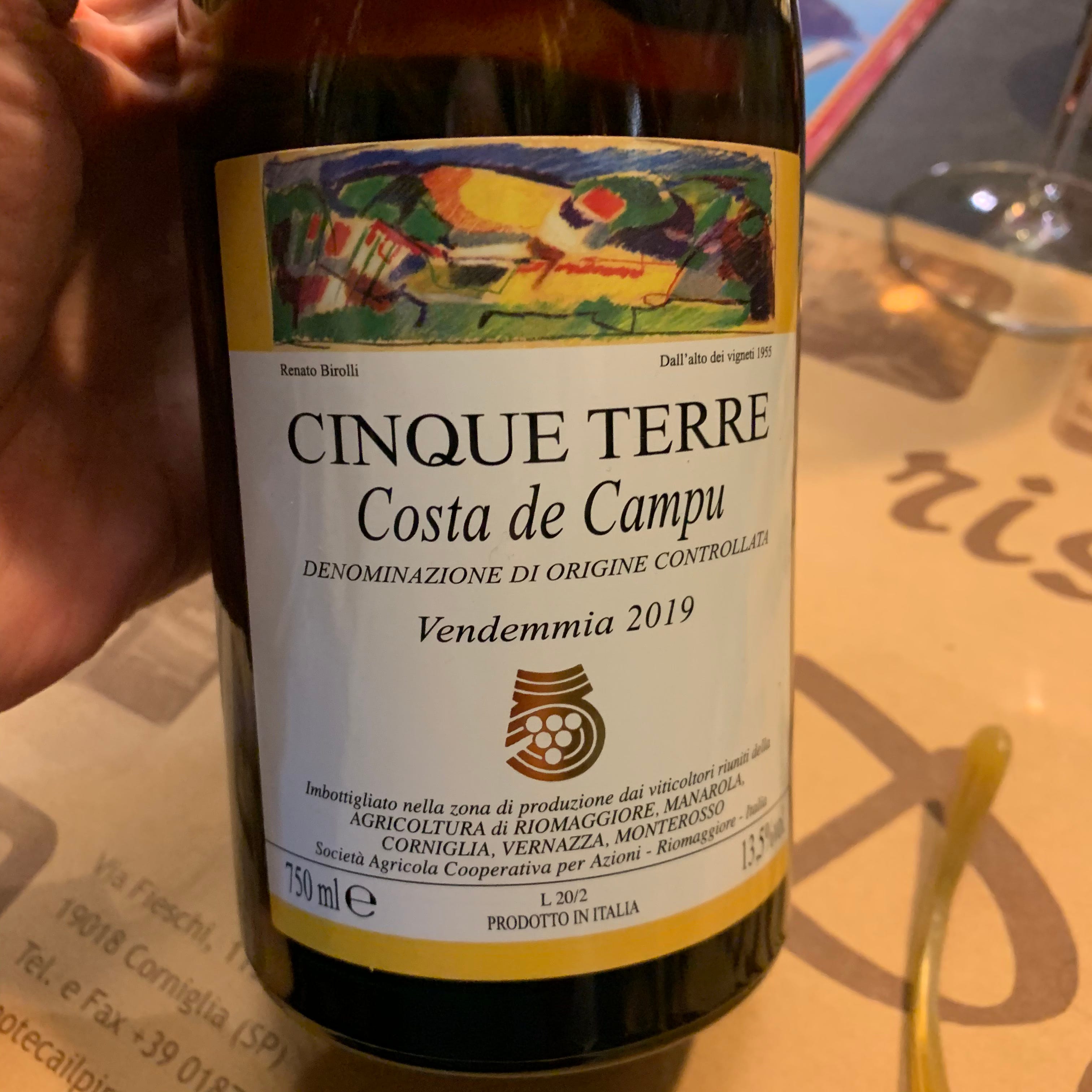
Wine and olives are still important local products; the region’s bracingly dry and aromatic white wine (“Cinque Terre” is a controlled denomination) is made mostly with the local Bosco grape along with some Albarola and Vermentino. It was said to be the favorite wine of Pope Paul III, who was possibly in a Cinque Terre state of mind when he commissioned Michelangelo to paint The Last Judgment in the Sistine Chapel.
But today, tourism drives the economy. And like so many famously beautiful places in Italy, that’s the problem. These days the village streets and mountain trails of the Cinque Terre are about as authentic and evocative as New York’s Saint Patrick’s Day parade, and equally crowded with assholes.
But in late 2020, I had my chance to see the Cinque Terre without the masses. Tourism was banned; non-EU citizens could only enter the country with a residency permit. The Italian trains were still running, infrequently—reservations required, every other seat booked, masks obligatory. It was only two hours from Milan, via Genoa.
On my phone I booked a pre-dawn ticket from the local suburban commuter station. I packed nothing but a toothbrush and a phone charger in my pockets—no bag, no change of clothes for a one-night trip. This was guerilla tourism. Then I booked an AirBnb in the Cinque Terre village of Corniglia, high on a cliff above the sea.
The train arrived in Riomaggiore, the first of the Cinque Terre towns, in late morning. From there I set out on the mountain trail to Manarola, the second village. There was no one else on the trail, in any direction. The route traversed steep terraced vineyards where the grapes are harvested on hands and knees. Each row had modern plastic irrigation tubing threaded between the vines; I wondered how global warming would affect these ancient plots.
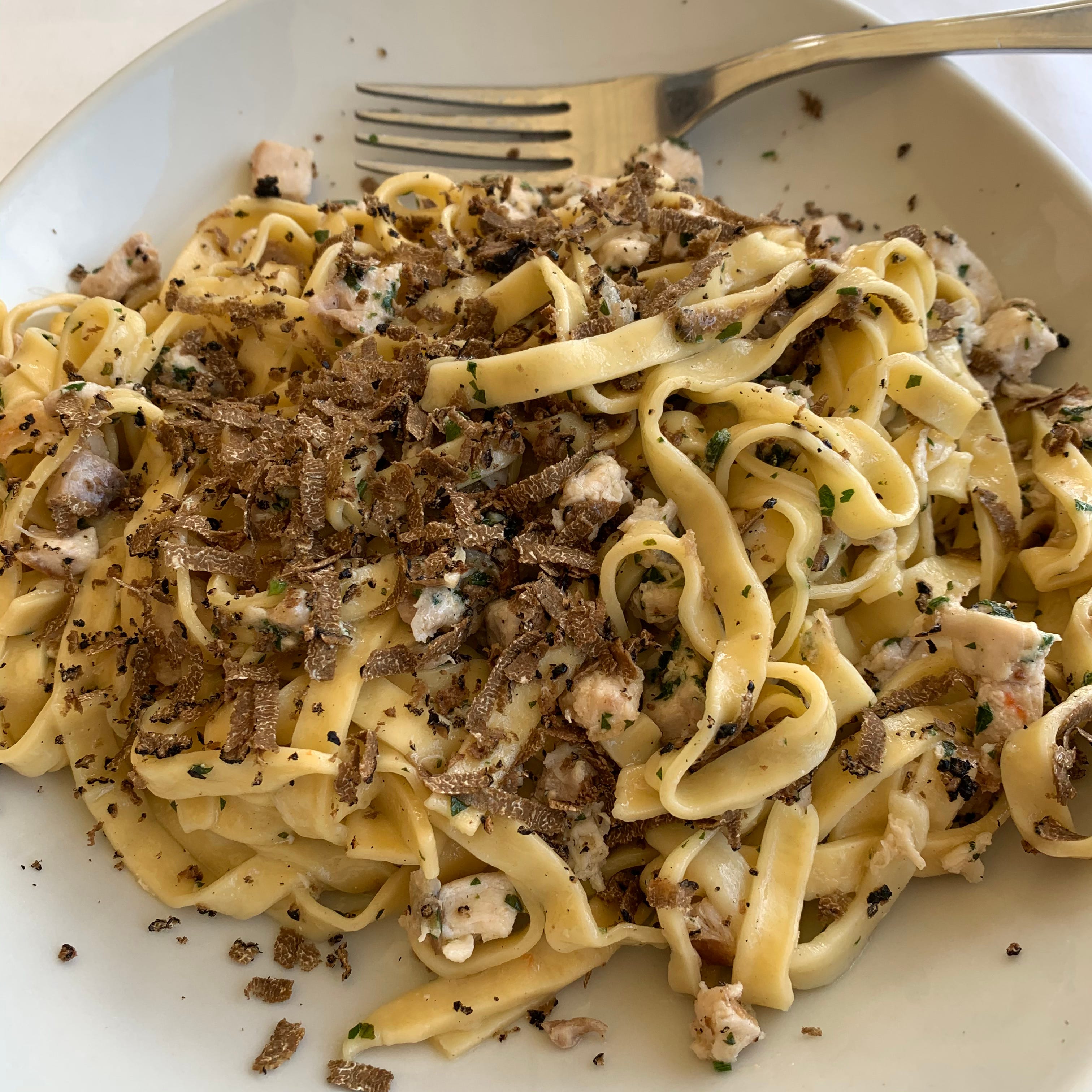
After two strenuous hours I descended into Manarola for lunch at Trattoria dal Billy, a cliffside locale over the sea. There were a few Italian families at tables along the outdoor terrace. I swooned, first over the view then over fresh local anchovies marinated in lemon juice, homemade tagliatelle with swordfish and shaved black truffles, and of course a bottle of Cinque Terre wine. I thought of my friends back in Milan, frantically making a “royal brunch” in a hotel kitchen.
Okay I didn’t think about them at all.
After lunch I took the rickety train one stop to the third town, Corniglia. From the seafront station I ascended a steep staircase with thirty switchbacks, up to the town proper and its commanding vista over the Ligurian Sea. I checked in to my modest room for the night, then walked over to the clifftop terrace of the Bar Terza for aperitivi—a strong Negroni and a bruschetta with tomatoes and fresh tuna.
My AirBnB host had recommended dinner at La Cantina de Mananan, a narrow stone cavern with chalkboard menus, one of which explained the rules of the house:
· Go ahead and order a full bottle of wine, you can take away what’s left.
· Don’t put cheese on seafood dishes.
· Don’t mix different dishes on the same plate.
· Finish your meal with a nice coffee and a grappa. We don’t serve cappuccino or similar drinks.
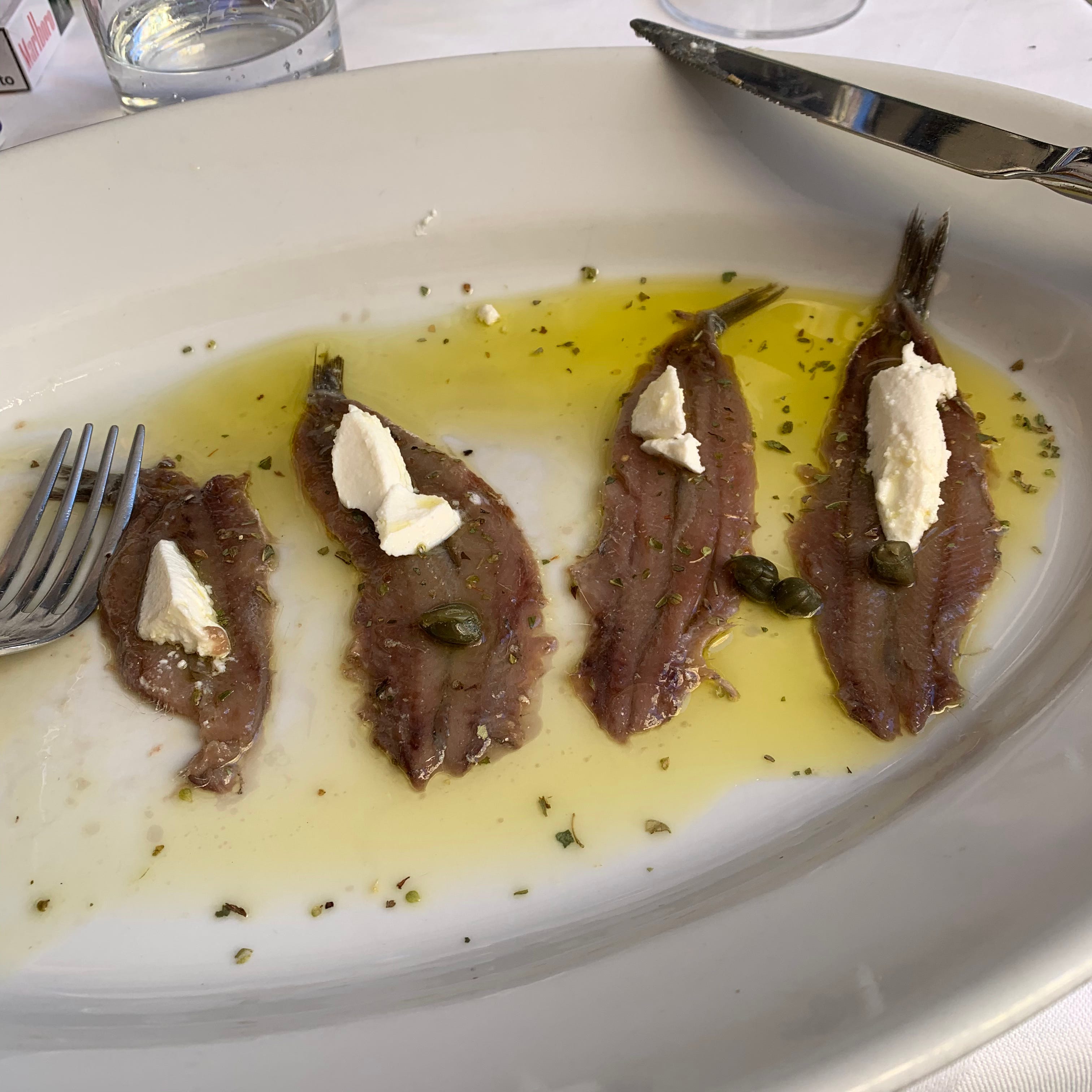
I liked this place already; then came the food. It was hard to choose dinner, but I settled on an antipasto of more local anchovies—this time dried and salted, then marinated in oil and topped with burrata cheese,[1] followed by pansotti, a type of large ravioli stuffed with spinach and ricotta, in a walnut sauce. Dessert was a flawless panna cotta crowned with candied walnuts and caramel sauce. There was wine, naturally, and local grappa. It was late when I ambled back to my room along the cliff terrace; the town was asleep, the cobblestone alleys empty. There were no streetlights, only the Milky Way arcing above the sea.
Back in my room, another MasterChef contestant texted me to say the brunch challenge was chaos. It wasn’t until watching the show, months later, that I learned he had a meltdown on camera. He was baking thin-sliced potato rounds in an oven—until he realized the oven wasn’t turned on. In fairness all these new digital cooking appliances can be impossible to navigate, especially without reading the inch-thick owner’s manual.[2] He panicked and started screaming; Chef Locatelli screamed back: “If you are given an oven you must work with it!”
“Who won?” I texted him back.
“We don’t know. They will announce it on Monday, back in the studio.”
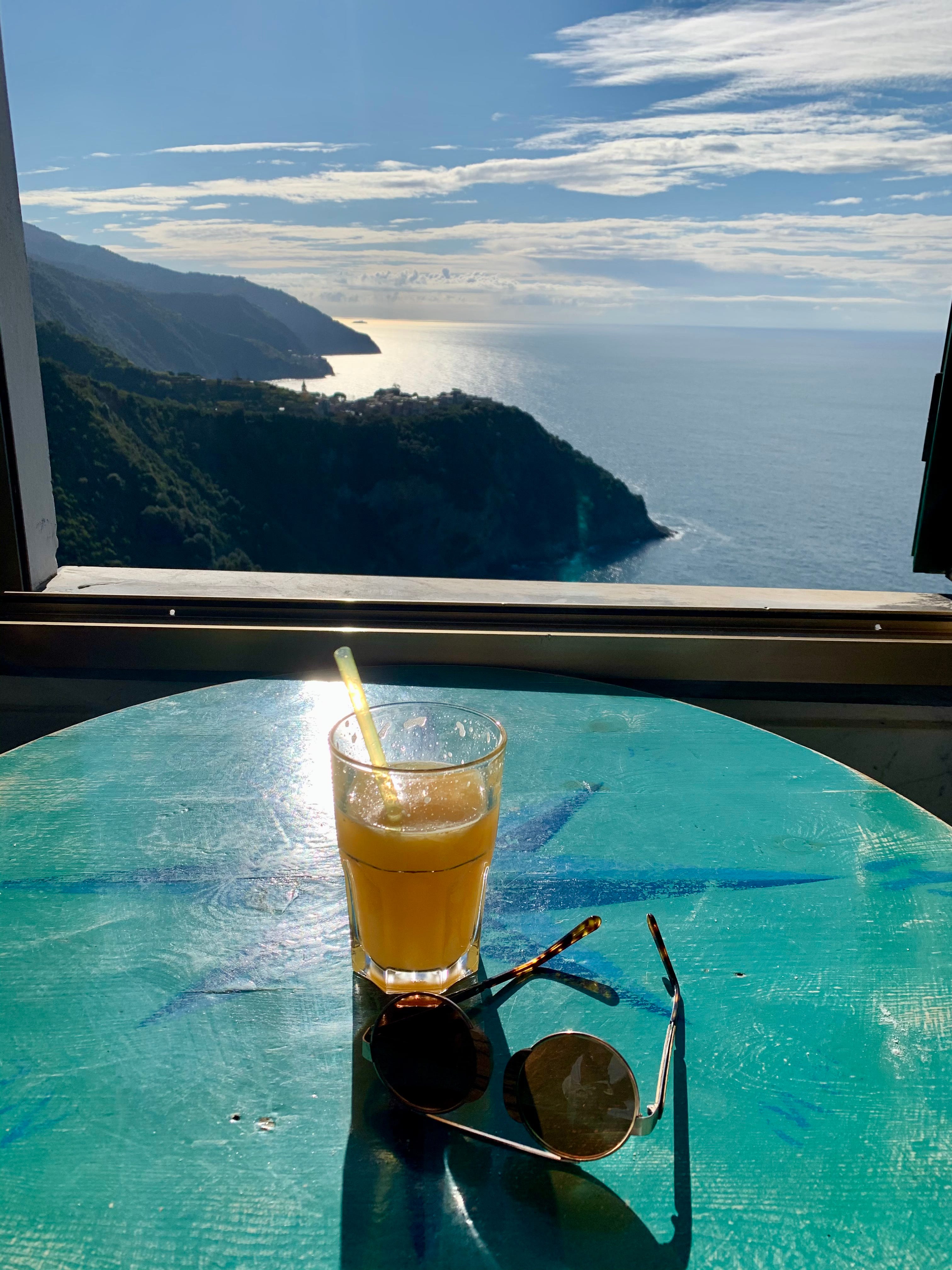
The next morning I hiked from Corniglia to the fourth town, Vernazza, along the Sentiero Azzuro or Marine Path. Along the way I stopped in a trailside café above the sea for an espresso and a fresh-squeezed orange juice. In my life I have hiked portions of the Appalachian Trail, and I never saw a café like that. But maybe I was in the wrong section.
The port of Vernazza had a small, curving stone pier with the ruins of an eleventh-century castle and tower at its base. In the small Piazza Marconi, next to the fourteenth-century church of St. Margaret of Antioch, I lunched on a Neapolitan-style pizza with a very Ligurian topping: pesto. Then I took the train to Monterosso, the final village, for an afternoon of sun along the town’s wide beach. Paragliders were landing on the near-empty stretch of sand. Then I put on my Covid mask and took the train back to Milan.
[1] Preserved anchovies are an exception to the Italian rule of no cheese with seafood.
[2] If there is a human who actually prefers oven keypads over big dials, message me.